



The energy efficiency of domestic refrigerators is a major driver of household electricity consumption, particularly in tropical climates where everyday use can intensify energy demand. Qiao et al. [1] show, through a combined survey and experimental analysis, that refrigerator user behaviour influences energy-saving potential, particularly through door-opening frequency and duration. Lv and Zhang [2] show that the purchase of energy-saving refrigerators is influenced by both supply- and demand-side factors, including energy-efficiency awareness, environmental concern, economic motivation, and trust in energy-efficiency information. Harrington et al. [3] demonstrate, using laboratory and household field data, that room temperature strongly affects household refrigerator energy consumption. In Colombia, diverse climates and uneven income distribution create variable usage patterns, which demand a nuanced understanding of how environmental, sociocultural, and regulatory factors interact to achieve sustainable improvements.
Previous research has used multi-criteria approaches to identify determinants of energy performance in refrigeration and related systems, highlighting the value of structuring expert judgment and conducting sensitivity analyses under realistic scenarios. However, most of these studies fail to explicitly integrate environmental, social, and regulatory dimensions into a single, replicable framework for Latin American tropical contexts. This gap hinders our understanding of how factors such as ambient temperature, user habits, income, and public policy interact to affect real-world refrigerator performance. To address this gap, this study proposes the Analytic Hierarchy Process framework that (i) hierarchically structures environmental, thermodynamic, social, and policy criteria; (ii) incorporates judgments from a diverse panel of experts; and (iii) enables sensitivity analysis for real-world usage scenarios, with a focus on Colombia and similar tropical regions. This methodological approach enables the generation of actionable recommendations for industry and regulators, while also establishing a replicable baseline for future cross-regional comparisons [4], [5].
Recent work in the built environment shows that the Analytic Hierarchy Process has become a mature decision-support method for energy-efficiency problems - ranging from patent-informed evaluations of green-building energy solutions [6], to multidimensional assessment framework for retrofit projects [7], the integration of building-energy simulations with the Analytic Hierarchy Process to rank heating-system alternatives [8], and the selection of renewable technologies for hotel buildings using Analytic Hierarchy Process-Based multicriteria schemes [9]. In tropical contexts, Analytic Hierarchy Process-derived performance indicators have also been used to weight energy use, indoor air quality, and comfort criteria for heating, ventilation, and air-conditioning-related decision-making [10]. Taken together, these studies confirm the robustness and transferability of the Analytic Hierarchy Process in climate-sensitive energy decisions; however, appliance-level applications that jointly incorporate real-use conditions and household socioeconomic-factors particularly for domestic refrigeration in Latin American tropical settings – remain limited, supporting the novelty of the present prioritisation of the factors that most determine household refrigerator energy efficiency in Colombia.
At the global scale, the residential sector remains a major contributor to energy use and carbon dioxide emissions [11]. In Colombia, the residential sector accounts for 20% of national energy consumption [12]. Ramírez Sánchez et al. [13] report that refrigerators represent between 30% and 50% of household electricity bills, especially in tropical areas with high average temperatures, and describe the implementation of energy-efficiency labelling through Technical Labelling Regulation (RETIQ) as well as regulatory discussions and road-map proposals for minimum energy performance standards (MEPS) in residential refrigeration.
Cardoso [14] shows that ambient temperature, appliance ageing, and usage habits can cause real refrigerator consumption to differ from labelled values. Belman-Flores et al. [15] further demonstrate that incorporating door-opening status into refrigerator control can reduce energy use, confirming the relevance of user behaviour and control strategies. Therefore, the impact of energy-efficiency policies depends not only on technical efficiency but also on local climate, equipment condition, and household use.
Garcia-Miranda et al. [16] show that income, consumption habits, household characteristics, and technology influence residential electricity consumption in Colombian households. More than 70% of the population lives in the lowest income stratum, resulting in limited access to efficient technologies and a greater prevalence of old and low-performance energy equipment, as well as higher household densities with adverse operating conditions for refrigerators [17].
Additionally, the relationship between electricity bills and household income is affected by subsidies and socioeconomic level [18], which reinforces the need to understand the relative influence of refrigerator energy-consumption factors when designing public policies. Therefore, knowing the factors that determine the electricity consumption of refrigerators, and their level of impact is essential for establishing public policies aimed at reducing it. This research seeks to answer this question by applying the Analytic Hierarchy Process to analyse and prioritise the factors that influence the energy performance of domestic refrigerators in Colombia under real-life conditions in low-income Colombian households. The authors aim to answer the question: which factors are perceived by experts as most influential for domestic refrigerator energy efficiency under Colombian household conditions, and how should they be prioritised?
This study employs the Analytic Hierarchy Process to identify and prioritise the determinants of energy consumption in domestic refrigerators in Colombia. The methodology integrates real-world usage conditions with environmental, sociocultural, technological, and regulatory variables. The specific objectives are to: (1) define a hierarchy of relevant criteria and sub-criteria for refrigeration energy use in tropical contexts; (2) estimate relative weights based on judgments from a diverse expert panel; (3) evaluate three intervention strategies – related to usage environment, technological upgrades, and labelling standards – comparing their expected impact on consumption; and (4) conduct a sensitivity analysis to test the robustness of the conclusions. To our knowledge, this is the first study to apply an AHP framework that jointly considers environmental, sociocultural, techno-thermodynamic, and regulatory factors to prioritise domestic refrigerator energy-efficiency in a Latin American tropical setting.
The novelty of this approach lies in its integrating real-world operating conditions and household socioeconomic variables within a single Analytic Hierarchy Process structure to generate actionable recommendations that bridge equipment design, user education, and public policy.
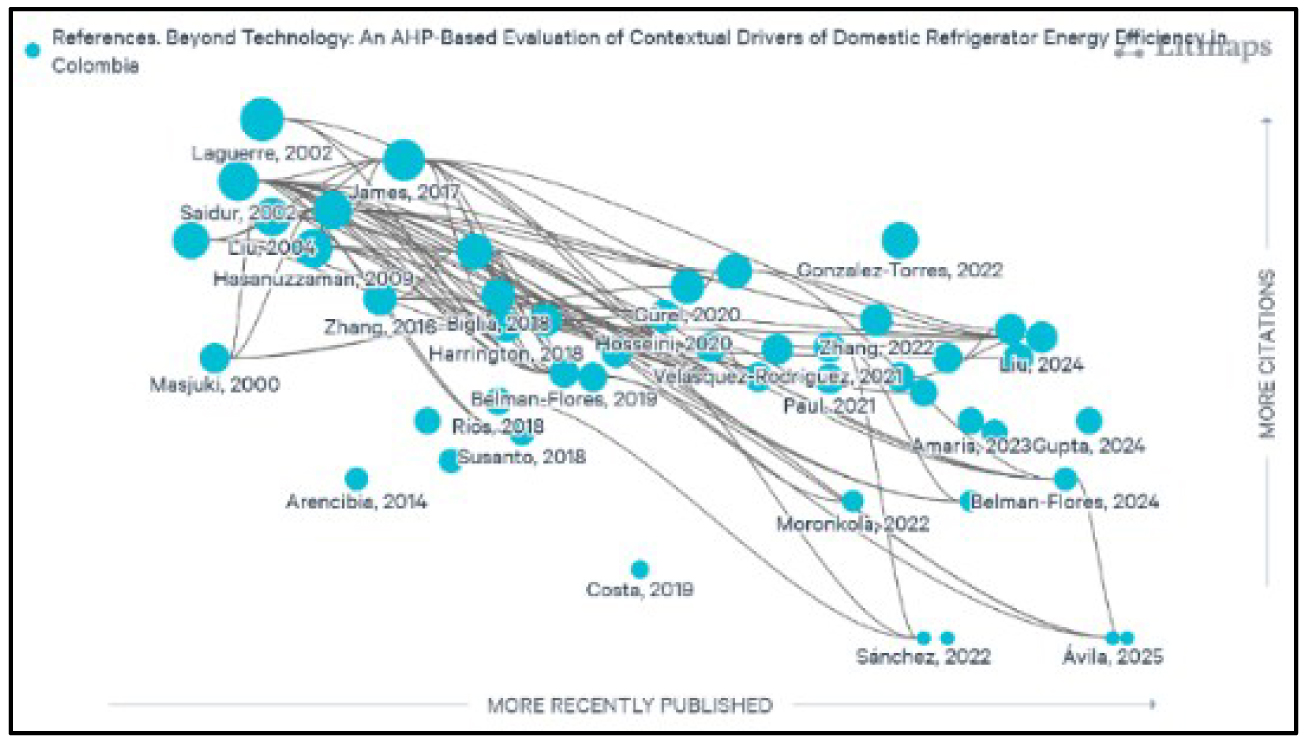
To obtain the factors influencing the energy performance of domestic refrigerators, a comprehensive review of the specialised literature was conducted. The literature review reveals that environmental (24 studies) and social aspects (23 studies) outweigh research on household refrigerator efficiency, highlighting the significance of usage conditions and user behaviour in influencing performance outcomes. Techno-thermodynamic (14 studies) and policy dimensions (14 studies), although less frequently explored, provide critical insights into technological innovation and regulatory frameworks. This thematic classification guided the selection of criteria within the AHP model. The citation network in Figure 1 illustrates how this research strands converge, highlighting both the historical foundations of the field and the most influential contributions. All reviewed sources are cited appropriately in the references section.
The Analytic Hierarchy Process (AHP), introduced by [19], is a multicriteria decision-making method designed to prioritise competing criteria, sub-criteria, and alternatives within complex scenarios. Its methodology is based on decomposing a problem into a hierarchical structure and synthesising the relationships between its elements. This systematic approach yields a prioritised ranking that closely approximates an optimal decision, making it a widely adopted tool for structuring and solving intricate decision-making problems , and has been widely applied in energy and transport studies [20]. The method’s core principle involves deriving a system’s priorities through a sequence of pairwise comparisons. This process generates specific weights for each evaluation criterion based on the judgments provided by experts [21], [22]. Analytic Hierarchy Process is well-suited to this study because it can systematically incorporate expert judgments on multiple interacting factors (environmental, social, technical, and regulatory) that affect refrigerator efficiency, as demonstrated in nuclear safety assessments [23].
The procedure followed four operational stages. First, the specialised literature was reviewed and grouped into environmental, social, techno-thermodynamic, and policy dimensions. Second, these dimensions were translated into a hierarchical AHP structure comprising four main criteria, twelve sub-criteria, and three intervention alternatives. Third, nine experts completed individual pairwise comparison matrices using Saaty’s 1–9 scale; individual judgments were aggregated through the geometric mean method, following standard group AHP procedures. Fourth, priority vectors and Consistency Ratios were calculated for each matrix, all values fell below the 0.10 threshold, and the final ranking was tested through sensitivity analysis by varying the weights of the two dominant criteria (environmental and social) by ±20%.
The initial simplified hierarchy serves as a foundational model that can be elaborated to any degree of complexity necessary for a realistic problem representation. A well-constructed hierarchy must fulfil four key properties: it should be complete (representing all relevant attributes), non-redundant, minimal (excluding superfluous elements), and operational. Its formulation is arguably the most creative phase of the AHP and can involve negotiating divergent perspectives among stakeholders. Securing a consensus on the final structure is therefore an essential step before resolution. Although a single, consolidated hierarchy is a powerful modelling tool, the model can be refined by decomposing it into more granular, specialised hierarchies when sufficient data becomes available, a principle also highlighted in energy system optimisation studies [24].
A panel of nine experts with backgrounds in energy efficiency, appliance engineering, and environmental policy provided pairwise comparison judgments for all criteria and sub-criteria using Saaty´s fundamental 1-9 scale. Each expert completed an individual comparison matrix, which was then aggregated using the geometric mean method, following standard AHP group decision-making procedures. Consistency ratios were calculated for each matrix and for the aggregated matrix to ensure acceptable logical coherence of the judgments (CR< 0.10).
The value function for each alternative is calculated as follows (Equation (1)):
Where:
(a): indicates the final value of alternative a
wi denotes the weight of the i-th criterion
vi denotes the performance of the alternative in relation to the i-th criterion
Considering two vectors, x = (x1, x2, …, xn) and y = (y1, y2, …, yn), their relationship can be expressed in matrix notation as (2). Where A is the judgment matrix, given by (3).
This relationship is expressed algebraically in Equation (4).
Since
Therefore, can be expressed by (6) or (7).
This can be expressed as the matrix equation (8).
The Consistency Index (CI), defined in Equation (9), measures the deviation of the principal eigenvalue (λmax) from the matrix order (n). This deviation occurs because inconsistencies in the pairwise comparison matrix (A) cause λmax to exceed n.
The Consistency Ratio (CR) is defined by Equation (10).
The RI parameter, or Random Index, represents the average CI of randomly generated reciprocal matrices using the Saaty scale [19]. The final consistency evaluation is performed by calculating the CR. For this research, the following interpretative scale is adopted:
CR ≤ 0.1: Acceptable consistency
0.1 < CR < 0.2: Borderline or questionable consistency
CR ≥ 0.2: Unacceptable inconsistency
A CR value of 0.2 or higher indicates that the pairwise comparisons at that stage are highly inconsistent, and the expert is required to revisit and revise their judgments.
The criteria and sub-criteria were selected from the thematic classification of the reviewed literature. Environmental aspects were addressed in 24 reviewed studies, for example [25], [26], [27], [28], [29], [30]; social aspects in 23 for example [14], [31], [1], [15], [12], [30], [17]; techno-thermodynamic aspects in 14 for example [32], [33], [34], [35], [36]; and policy aspects in 14 for example [28], [13], [37], [11], [17]. The criteria were refined to avoid redundancy and ensure operational relevance: environmental criteria were defined as contextual operating conditions external to the appliance (ambient temperature, relative humidity, refrigerator location), while techno-thermodynamic criteria were defined as intrinsic equipment attributes and heat-transfer mechanisms (refrigerator age, refrigeration cycle efficiency, and cabinet/heat-exchanger heat-transfer losses).
The citation network mentioned above also qualitatively guided the selection of sub-criteria, and its main themes and clusters are illustrated in Figure 1. This served only as a structural reference, while all weights were strictly obtained from expert pairwise judgments in accordance with the AHP methodology.
The hierarchical scheme of the model applied is shown in Table 1. The factors were selected from the systematic literature review described in the previous section.
Determining Criteria |
Sub-Criteria |
|---|---|
Environmental |
Ambient temperature, Relative humidity, Refrigerator location |
Techno-thermodynamic |
Refrigerator age, Refrigeration cycle efficiency, Heat transfer |
Social |
Door opening frequency, Thermal load, Socioeconomic strata |
Policy |
Energy labelling, Regulations and standards, Minimum performance standards |
Environmental criteria were defined as contextual operating conditions surrounding the household refrigerator’s use: ambient temperature, relative humidity, and equipment location. Although these variables affect thermodynamic performance (e.g., ambient temperature raises condensation temperature and thus reduces coefficient of performance, they are classified as environmental because they represent external conditions of operation rather than intrinsic design attributes of the appliance. Techno-thermodynamic criteria, in contrast, were defined as equipment-level factors and heat-transfer mechanisms that are intrinsic to the appliance: refrigerator age, refrigeration cycle efficiency, and cabinet/heat-exchanger heat-transfer losses.
In the AHP methodology, alternatives represent possible courses of action or scenarios that are evaluated to determine the most suitable option according to established criteria [38]. In this study, three alternatives were formulated to capture the various dimensions that influence the energy efficiency of household refrigerators: (i) environment and refrigerator usage, (ii) compressor technology, thermostat position, design, and insulation, and (iii) energy labelling, regulations, and Minimum Energy Performance Standards.
This methodological framework enabled the identification of priority factors and alternatives with acceptable consistency ratios, thereby strengthening the reliability of the results presented in the subsequent section. At the same time, the general findings underscore the need for a more contextual and nuanced multi-criteria approach to assessing refrigerator efficiency; accordingly, the next section applies the Analytic Hierarchy Process to systematically prioritise the identified factors.
Table 2 summarises the expert panel composition and the elicitation parameters used in the AHP procedure. The nine experts were selected on the basis of their recognised professional experience and disciplinary relevance to the study criteria.
Parameter |
Description |
|---|---|
Number of experts |
9 |
Areas of expertise |
Energy efficiency, refrigeration engineering, environmental policy, social and economic factors, industrial engineering, electronics, sociology |
Range of professional experience |
12 to 30 years |
Elicitation instrument |
Pairwise comparison matrices |
Scale used |
Saaty scale 1 to 9 |
Aggregation method |
Geometric mean (AHP group) |
Consistency threshold |
CR < 0.10 |
CR of main criteria matrix |
CR = 0.034 |
The expert panel for AHP was comprised of nine specialists with diverse backgrounds and recognized experience in the topics associated with each defined criterion. This methodological sequence strengthened the robustness of the analysis and guaranteed the logical consistency of the judgments, measured through the Consistency Ratio (CR = CI/RI), which reached an acceptable value of 0.034. The panel included experts with professional experience ranging from 12 to 30 years, covering disciplines such as environmental, mechanical, industrial, and electronic engineering, as well as sociology, energy policy, and economics. Collectively, they provided insights on thermodynamic analysis, refrigeration technologies, insulation materials, IoT-based monitoring, user behaviors, socioeconomic factors, regulatory frameworks, and the economic implications of energy efficiency. This combination of long-standing expertise and disciplinary diversity, together with the careful selection of experts based on their proven relevance to the research scope, ensured a rigorous and academically responsible evaluation of the factors influencing refrigerator performance.
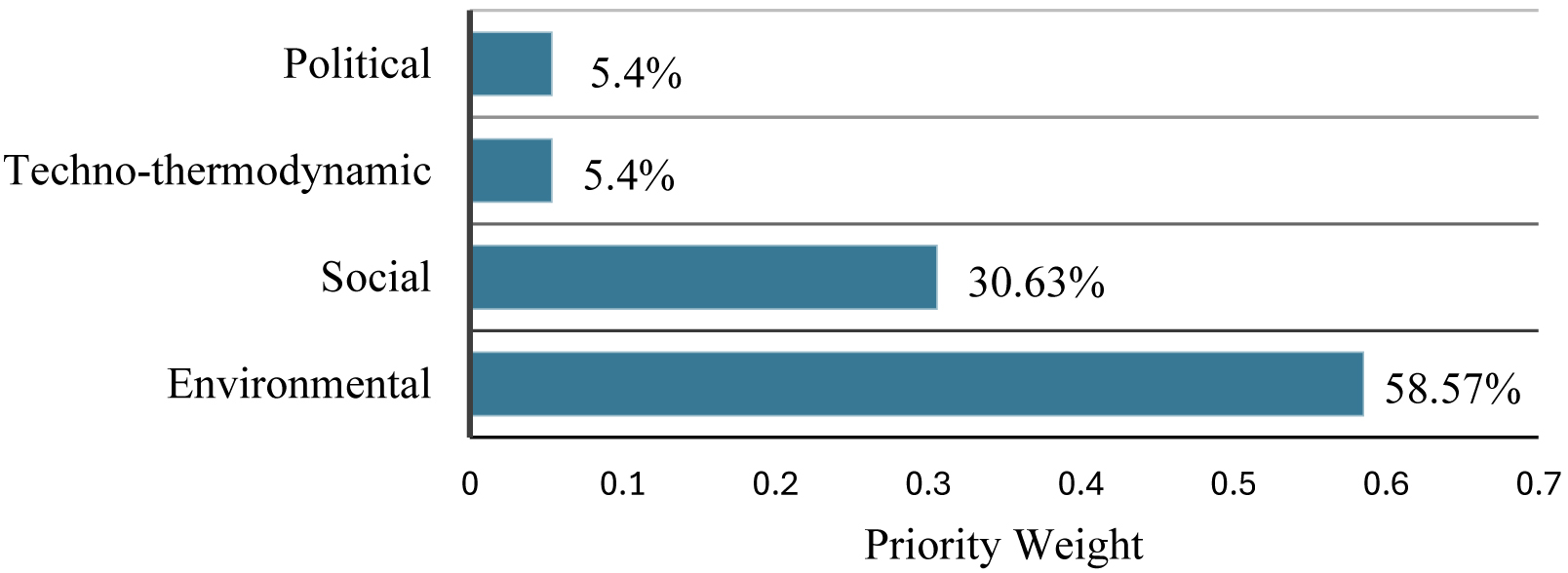
The results of the pairwise comparison matrix for the determining criteria, obtained from the aggregated judgments of the expert panel, show that the environmental factor received the highest weight (0.5857), followed by the social criterion (0.3063). At the same time, the techno-thermodynamic and policy criteria have a minor influence (0.0540 each). These results highlight the significant role of environmental and social criteria in decision-making processes related to domestic refrigerator energy efficiency. Since the consistency ratio (CR = 0.034) is well below the threshold of 0.10, it confirms that the judgments are consistent and the results are reliable.
These weights should be interpreted as expert-derived priorities based on the hierarchical model and the reviewed literature, rather than as direct measurements of electricity consumption, refrigeration efficiency, or realised energy savings.
Table 3 presents the Consistency Ratio (CR) obtained for each pairwise comparison matrix. All values are below the 0.10 threshold, confirming the logical coherence of the expert judgments at every level of the hierarchy.
Comparison matrix |
Calculated CR |
Threshold |
Evaluation |
|---|---|---|---|
Main criteria |
0.034 |
< 0.10 |
Acceptable |
Environmental sub-criteria |
0.062 |
< 0.10 |
Acceptable |
Techno-thermodynamic sub-criteria |
0.036 |
< 0.10 |
Acceptable |
Social sub-criteria |
0.027 |
< 0.10 |
Acceptable |
Policy sub-criteria |
0.000 |
< 0.10 |
Acceptable (Perfect consistency) |
The aggregated pairwise comparison matrix for the policy sub-criteria yielded CR = 0, indicating a perfectly consistent preference structure. This result is mathematically possible when the aggregated judgments are fully transitive - i.e., when the geometric mean of the experts’ individual matrices produces ratios that satisfy
These results are consistent with those reported by [26] and [37], who identified that variables such as ambient temperature, relative humidity, and habitual refrigerator usage patterns have a significant influence on actual energy consumption, especially in tropical contexts.
The corresponding pairwise comparison matrix and priority vector for the main criteria are presented in Table 4. To facilitate interpretation of the aggregated priorities, Figure 2 summarises the weights assigned to the four main criteria.
Pairwise Comparison Matrix |
Normalized Matrix |
||||
|---|---|---|---|---|---|
Criteria |
Environmental l |
Techno-thermodynamic |
Social |
Policy |
Priority Vector |
Environmental |
1 |
9 |
3 |
9 |
0.5857 |
Techno-thermodynamic |
1/9 |
1 |
1/7 |
1 |
0.0540 |
Social |
1/3 |
7 |
1 |
7 |
0.3063 |
Policy |
1/9 |
1 |
1/7 |
1 |
0.0540 |
1.556 |
18 |
4.286 |
18 |
1 |
|
*Calculated consistency ratio: 0.034
The significance of this research lies in the methodological innovation, which, while acknowledging certain convergences with previous studies, moves beyond them by explicitly integrating context-related environmental, techno-thermodynamic, social, and public policy criteria. This multidimensional approach allows the findings to be more closely aligned with the Colombian context, producing insights that are both context-sensitive and analytically robust. At the same time, the framework remains sufficiently flexible to be adapted to other geographical and sociocultural settings, thereby broadening the relevance and impact of the study.
Recent studies [1], [15], [39] demonstrate that even advanced refrigeration systems fail to meet expectations when used in everyday, uncontrolled environments. From ambient conditions to user habits, the context of operation proves to be just as decisive as the technology itself in determining real energy efficiency.
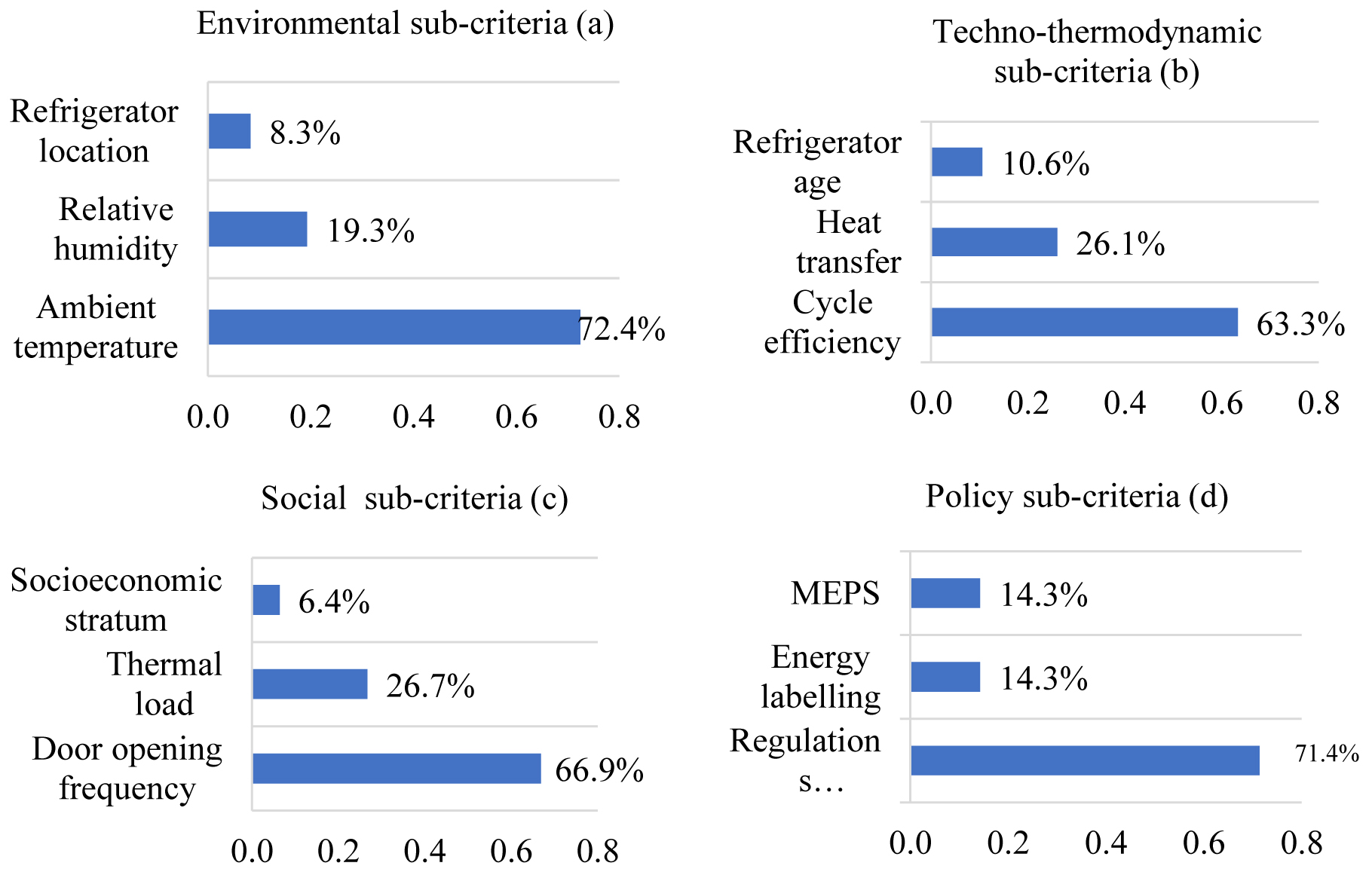
The pairwise comparison matrix for the Environmental dimension sub-criteria proves that ambient temperature is the most critical factor, with a 0.7235 weight, followed by relative humidity at 0.1932. In contrast, refrigerator location has the least importance, with a 0.0833 weight, and an acceptable consistency ratio of 0.062. These results emphasise that variations in ambient temperature exert the most decisive influence on the energy consumption and performance of domestic refrigerators. In contrast, humidity and placement conditions, although relevant, play secondary roles, aligning with prior experimental results [27], [37].
The results identify ambient temperature as the most influential sub-criterion, with the most significant relative weight within this category. This finding confirms that minor thermal variations can have a substantial impact on energy consumption. Relative humidity, although it carries less weight, maintains a moderate level of influence, evidencing its secondary yet relevant role. In contrast, the location of the refrigerator within the home obtained the lowest priority, suggesting a more limited effect compared to the other sub-criteria evaluated. These results align with those reported by [28] and [40], who have empirically demonstrated the pre-eminence of thermal conditions over other contextual factors in the energy efficiency of domestic refrigeration.
The results shown in Table 5 indicate that alternative A1, focused on environmental criteria and real-use operating conditions, received the highest priority, with an approximately 63% weighting. In the Colombian context, Ramírez Sánchez et al. [13] place residential refrigeration within the national energy-efficiency policy discussion and show the relevance of labelling and minimum-performance approaches for regulating household appliance energy demand. Hasanuzzaman et al. [27] experimentally show that ambient temperature and cabinet load influence heat transfer and refrigerator-freezer energy consumption under warm and humid conditions. Biglia et al. [29] provide large-scale household monitoring evidence linking ambient temperature, appliance temperature, electricity consumption, and user practices in domestic cold appliances. Andrade-Ambriz et al. [41] further show that frost accumulation on evaporator surfaces reduces heat-exchange capacity and that accurate frost classification can support the optimization of defrost operation. Together, these studies support the prioritisation of A1, since environmental exposure and real-use conditions directly affect refrigerator performance and should be considered when designing context-sensitive energy-efficiency strategies.
Sub-criterion/Alternatives |
A1 |
A2 |
A3 |
Priorities |
|
Ambient Temperature |
A1 |
1 |
3 |
5 |
0.63 |
A2 |
1/3 |
1 |
3 |
0.26 |
|
A3 |
1/5 |
1/3 |
1 |
0.11 |
|
Sub-criterion/Alternatives |
A1 |
A2 |
A3 |
Priorities |
|
Relative Humidity |
A1 |
1 |
3 |
5 |
0.63 |
A2 |
1/3 |
1 |
3 |
0.26 |
|
A3 |
1/5 |
1/3 |
1 |
0.11 |
|
Sub-criterion/Alternatives |
A1 |
A2 |
A3 |
Priorities |
|
Refrigerator Location |
A1 |
1 |
5 |
1 |
0.45 |
A2 |
1/5 |
1 |
1/5 |
0.09 |
|
A3 |
1 |
5 |
1 |
0.45 |
The analysis shows that the refrigeration cycle efficiency received the most significant weight (63.33%). This is consistent with prior experimental and simulation studies, which have demonstrated that cycle design improvements, such as more efficient compressors, electronic expansion valves, and adaptive control, can enhance system performance under realistic load and temperature conditions.
Heat transfer (25.97%) is the second most influential sub-factor, highlighting the importance of insulation quality, heat exchanger design, and frost control as determinants of thermal performance to further reductions in energy consumption [32], [33]. This is further supported by experimental findings in hybrid cooling systems, where optimised surface configurations – such as finned tubes and corrugated plates – have demonstrated up to threefold improvements in heat transfer efficiency under variable flow and temperature conditions [34].
Finally, equipment age obtained a lower weight (10.70%), which reinforces that, while technical innovations can improve energy efficiency, their impact is less significant if they are not accompanied by a favourable installation and use environment.
Table 6 supports that alternative A2, which focuses on incorporating comprehensive technological improvements, achieved the highest priority within the techno-thermodynamic criterion analysis, with a 66% weighting. This alternative considers key elements, including the selection of appropriate technologies, correct thermostat placement, thermally efficient design, and the use of advanced insulation materials. This result is aligned with recent studies that highlight the potential of emerging technologies such as oil-free linear compressors, low global warming potential refrigerants, and phase-change materials to reduce both energy consumption and the environmental footprint [33], [35], [36], [42]. Prioritising this alternative validates the need to focus innovation and regulation efforts in these areas to achieve substantial improvements in energy efficiency under real-life operating conditions.
Sub-criterion/ Alternatives |
A1 |
A2 |
A3 |
Priorities |
|
Refrigerator Age |
A1 |
1 |
1/5 |
1/5 |
0.09 |
A2 |
5 |
1 |
1/3 |
0.30 |
|
A3 |
5 |
3 |
1 |
0.61 |
|
Sub-criterion/Alternatives |
A1 |
A2 |
A3 |
Priorities |
|
Refrigeration Cycle Efficiency |
A1 |
1 |
1/5 |
5 |
0.25 |
A2 |
5 |
1 |
5 |
0.66 |
|
A3 |
1/5 |
1/5 |
1 |
0.09 |
|
Sub-criterion/Alternatives |
A1 |
A2 |
A3 |
Priorities |
|
Heat Transfer |
A1 |
1 |
1/3 |
5 |
0.30 |
A2 |
3 |
1 |
5 |
0.61 |
|
A3 |
1/5 |
1/5 |
1 |
0.09 |
Door opening frequency (66.89%) was the most relevant social sub-criterion, followed by internal heat load (26.74%) and socioeconomic status (6.40%). These results evidence that user behaviour has a significant impact on energy consumption, especially in environments with high food turnover or shared equipment. This type of behaviour is not easily controlled by technology, which represents an additional challenge for manufacturers.
The alternative analysis of these criteria (see Table 7) shows that the A1 option, focused on user behaviour and thermal management, has the highest weighting (72%), confirming the direct influence of practices such as door opening frequency and thermal load on energy consumption [31], [43]. These habits can compromise efficiency even in technologically advanced equipment, emphasising the need for awareness and education strategies to modify user behaviours and enhance technological benefits [37], [44].
Sub-criterion/Alternatives |
A1 |
A2 |
A3 |
Priorities |
|
Door Opening Frequency |
A1 |
1 |
7 |
5 |
0.72 |
A2 |
1/7 |
1 |
1/3 |
0.08 |
|
A3 |
1/5 |
3 |
1 |
0.19 |
|
Sub-criterion/Alternatives |
A1 |
A2 |
A3 |
Priorities |
|
Thermal Load |
A1 |
1 |
7 |
5 |
0.72 |
A2 |
1/7 |
1 |
1/3 |
0.08 |
|
A3 |
1/5 |
3 |
1 |
0.19 |
|
Sub-criterion/Alternatives |
A1 |
A2 |
A3 |
Priorities |
|
Socioeconomic Stratum |
A1 |
1 |
7 |
3 |
0.64 |
A2 |
1/7 |
1 |
1/5 |
0.07 |
|
A3 |
1/3 |
5 |
1 |
0.28 |
Furthermore, socioeconomic and cultural factors influence access to and effective use of efficient technologies, maintenance decisions, and perceptions of energy savings [14], [45], [46]. These results reinforce comprehensive approaches that articulate technology, education, and differentiated policies, taking into consideration the specific social context. Additionally, they emphasise the importance of public policies and educational programs that focus on user behaviour, as well as design strategies incorporating technologies aimed at mitigating inefficient use, such as opening sensors, alarms, or thermal compartments, as suggested [42], [47].
The analysis of the policy criteria revealed that regulation and standards have a dominant influence (71.43%), while energy labelling and MEPS each account for 14.29%. The consistency ratio obtained in this comparison was 0, which indicates perfect coherence in the judgments and confirms the reliability of the results. This finding suggests that, in countries like Colombia, where energy regulations are not yet mandatory or are outdated, their impact on market energy efficiency is limited. This hierarchy stresses the role that regulations play in implementing effective energy policies for domestic refrigeration by establishing a mandatory framework that guides both manufacturers and consumers. Several studies have demonstrated that strong regulatory frameworks are crucial in catalysing the transition to more efficient technologies, while labelling and MEPS act as complementary mechanisms that facilitate informed decision-making and promote technological renewal [21]. These findings reaffirm the need to update public policies in Colombia, integrating regulatory, informational, and incentive components that respond to real operating conditions and the national socioeconomic context.
Table 8 shows that alternative A3, which integrates energy labelling, regulatory frameworks, and mandatory minimum performance standards under real-life operating conditions, achieved a priority of nearly 70%. This high weighting reinforces the importance of strengthening regulatory frameworks and labelling systems that more accurately reflect actual efficiency losses, thereby facilitating the adoption of more efficient technologies [13], [28], [48].
Sub-criterion/Alternatives |
A1 |
A2 |
A3 |
Priorities |
|
Energy Labelling |
A1 |
1 |
1/5 |
1/7 |
0.07 |
A2 |
5 |
1 |
1/5 |
0.23 |
|
A3 |
7 |
5 |
1 |
0.70 |
|
Sub-criterion/Alternatives |
A1 |
A2 |
A3 |
Priorities |
|
Regulation and Standards |
A1 |
1 |
1/5 |
1/7 |
0.07 |
A2 |
5 |
1 |
1/5 |
0.23 |
|
A3 |
7 |
5 |
1 |
0.70 |
|
Sub-criterion/Alternatives |
A1 |
A2 |
A3 |
Priorities |
|
MEPS |
A1 |
1 |
1/5 |
1/7 |
0.07 |
A2 |
5 |
1 |
1/5 |
0.23 |
|
A3 |
7 |
5 |
1 |
0.70 |
The repeated pattern in Table 8 reflects the aggregated expert preference structure for the policy sub-criteria: both energy labelling and MEPS received identical priority weights (0.1429) because the geometric mean of individual judgments placed them at equal importance relative to regulations and standards. The Consistency Ratio for this specific aggregated matrix is CR = 0, a mathematically valid result that arises when the preference ratios in the matrix are fully transitive. This does not imply that all individual expert judgments were perfectly consistent; it reflects the outcome of the group aggregation for this particular comparison.
Several studies have highlighted the effectiveness of integrated policies, which combine regulation, economic incentives, and consumer education, in accelerating the transition to more efficient household refrigerators [3], [28], [49]. Together, these results consolidate a multidimensional vision for strengthening the Colombian regulatory framework, aimed not only at updating public policies but also at promoting technological innovation and defining research priorities in line with global energy sustainability challenges.
To complement the numerical results reported in the tables, Figure 3 provides a visual summary of sub-criteria weights within each dimension, showing the dominance of ambient temperature (72.4%), door-opening frequency (66.9%), refrigeration cycle efficiency (63.3%), and regulations and standards (71.4%) as the leading sub-criteria in their respective categories.
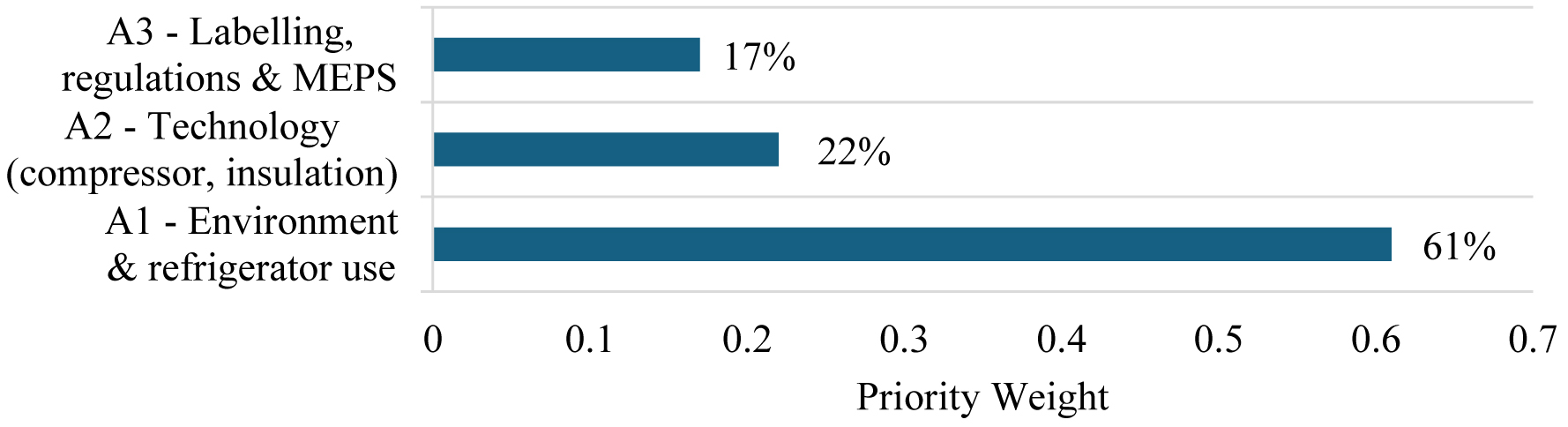
The final ranking of the three alternatives evaluated through the Analytic Hierarchy Process is reported numerically in Table 9 and visualised in Figure 4. Alternative A1 ranked first, followed by A2 and A3
Alternatives |
Code |
Priorities |
|---|---|---|
Environment and use of refrigerators |
A1 |
0.61 |
Technology of the compressor, thermostat position, design, and insulation |
A2 |
0.22 |
Energy labelling, regulations and MEPS |
A3 |
0.17 |
Alternative A1 stands out for prioritising educational and awareness-raising interventions, as well as adjustments to equipment layout, which address the root causes of the main consumption factors reported in the specialised literature [50], [51], [46], [31]. For example, campaigns aimed at reducing the frequency of door openings or encouraging proper maintenance can generate savings greater than those derived solely from technological improvements, as highlighted by [43] and [45].
The alternative A2 leverages advances in technologies proven effective in other contexts [32], [36] and advanced insulation, although its deployment in Colombia is constrained by economic and regulatory factors, as noted by [17], [44]. Furthermore, the feasibility of rapidly disseminating these innovations depends on proper integration with existing domestic infrastructure.
Alternative A3 enhances the effectiveness of energy policies through continuous improvements in labelling and the adoption of MEPS tailored to local conditions [37]. The success of these measures is linked to their adaptation to domestic operational reality and the widespread dissemination of information that guides consumer behaviour [14].
The robustness of the AHP model, tested against significant variations in the weights of the most sensitive criteria, confirms that alternative A1 remains a priority even if technological incentives or regulatory requirements were increased. To teste robustness, we varied the weights of the most influential criteria-environmental (0.5857) and social (0.3063)- by 20% without altering the overall ranking. Even with such variations, the alternative focused on the environment and real-world use remained the highest priority (61%), well above the technological (22%) and regulatory (17%) options. This means that only changes greater than 39% (the absolute difference between A1 and A2) could invert the ordering, confirming the robustness of the model.
This underlines the importance of developing integrated strategies where user participation and the treatment of contextual criteria are the core of any energy efficiency intervention.
In summary, the convergence of evidence reveals the need for future policies, designs, and regulations to prioritise both user education and awareness, as well as technological and regulatory adaptation to Colombia’s specific challenges, aiming at a holistic perspective that has proven to be more effective in reducing actual energy consumption and moving toward sustainability.
The energy performance of domestic refrigerators is determined by environmental, techno-thermodynamic, social, and policy factors, which influence their power consumption, the efficiency of the refrigeration cycle (COP), and the heat load the system must extract [52].
Among these, environmental factors play a particularly critical role. Household indoor temperature is the most influential environmental factor in domestic refrigerators’ energy consumption [29], accounting for up to 18% of a refrigerator’s annual energy consumption [3].
This is because the higher the indoor temperature, the greater the temperature gradient with the interior. The compressor operates longer, resulting in increased energy consumption [53], [54]. In addition, it raises the condensation temperature of the refrigerant, decreasing COP and also increasing electricity consumption [27].
High humidity introduces water vapour into the cabinet when the door is opened, which condenses and freezes in the evaporator, adding a latent heat load that forces the system to carry out additional compression or defrost cycles, thereby worsening the energy performance [43].
In tropical humid environments, frost control links environmental and techno-thermodynamic dimensions because moisture ingress during door openings may condense and freeze on evaporator surfaces, increasing thermal resistance and defrost demand.
The refrigerator’s physical location influences its efficiency. If it is placed close to heat sources, near the walls, or in areas with poor ventilation in the condenser, it raises the condensation temperature, thus reducing energy efficiency [30], [55]. The importance of this factor lies in the fact that it is the only environmental determinant that refrigerator users can control.
In addition to environmental influences, techno-thermodynamic aspects also play a fundamental role. The techno-thermodynamic dimension considers design, technology, and operating conditions of their components as factors that determine their energy efficiency throughout their lifespan. The age of the refrigerator negatively influences energy consumption, due to deteriorating thermal insulation and door seals, as well as wear of compressors and control systems, which increases heat loss and reduces the coefficient of performance, resulting in energy loss between 10% [3] and 30% [56] compared to a new one.
The efficiency of the refrigeration cycle is highly contingent on the type of compressor, refrigerant, and technology used. Modern models with inverter compressors and refrigerants such as R-600a can adapt their operation to thermal demand, reducing start-stop cycles and improving the COP compared to conventional equipment [57].
The heat transfer between the condenser, evaporator, and the environment is a critical aspect: dirty exchangers, accumulated frost, or poor ventilation increase thermal resistance, which in turn increases electricity consumption [27].
Beyond these technical aspects, social factors also exert a considerable influence. People’s habits and socioeconomic status have a significant influence on the energy performance of refrigerators. The frequency of door openings is one of the most critical factors that increases the thermal load and the compressor operation time [43]. Also, the thermal load, resulting from the quantity and temperature of the food introduced, drives the compressor’s operating time. Those factors can account for more than 13% of the yearly energy consumption in real operating conditions [58]. Finally, socioeconomic conditions influence both the acquisition of efficient equipment and its usage patterns: higher-income households tend to replace older equipment with more efficient models. They are usually more able to maintain energy-efficient practices, while lower-income families tend to have outdated equipment and habits that increase energy consumption [55].
In parallel, policy-related factors also play a decisive role in shaping energy performance outcomes. Regulatory frameworks and consumer information define the technological offering and users’ purchasing decisions. Energy labelling enables consumers to compare the energy efficiency of different models, introducing market incentives for manufacturers incorporating technological improvements that enhance energy performance [28]. The regulations and standards established by governments ensure that appliances meet basic efficiency levels. Minimum Energy Performance Standards are the primary policy instruments, as they progressively strengthen requirements, forcing the industry to innovate in compressors, insulation, and control systems [3]. However, these standards do not always account for performance degradation due to ageing [56] or variations resulting from actual usage conditions, which limits their ability to reflect energy consumption throughout the entire life cycle accurately.
Despite the widespread enforcement of Minimum Energy Performance Standards and labelling schemes, the evidence suggests that a critical energy performance gap between rated laboratory efficiency and actual electricity consumption of domestic refrigerators in tropical, developing economies remains.
Existing policy and design paradigms fail to bridge this gap because they often treat efficiency determinants in isolation, overlooking the complex, non-linear interdependencies between demanding ambient thermodynamic conditions, resource-constrained user behaviours, and technological obsolescence.
Consequently, there is a distinct lack of comprehensive, multi-criteria decision-making frameworks capable of systematically quantifying and hierarchising these heterogeneous variables (environmental, social, techno-thermodynamic, and policy). This deficiency hinders the formulation of robust, evidence-based strategies to decouple the growing demand for residential cooling from intensive energy use, thereby constraining progress toward genuine sustainability in the sector.
This study delivers four principal contributions. First, it provides a replicable methodological framework for prioritising the determinants of refrigeration energy consumption in tropical, low-income settings by integrating context-specific environmental, social, techno-thermodynamic, and policy dimensions. Second, the expert-derived Analytic Hierarchy Process priorities indicate that environmental and real-use variables were judged to be highly influential in domestic refrigerator energy performance, although these priorities should not be interpreted as direct field measurements of electricity consumption or quantified expected energy savings. This finding highlights the need to complement technological improvements with contextual strategies related to operating conditions, user behaviour, and policy adaptation. Third, for manufacturers, the results support tropicalised design strategies, improved insulation, robust heat-exchanger performance, and door-opening sensors or alarms. For regulators, they support labelling and minimum energy performance standards that better reflect tropical real-use conditions. For educators and energy-efficiency programmes, they support targeted guidance on door-opening frequency, thermal load, equipment location, and maintenance. Finally, the study establishes a foundation for subsequent research to apply this methodology in other tropical nations and to supplement it with empirical field data. The scope of this work is deliberately focused on the Colombian context and comparable tropical regions. Although the expert panel was intentionally selected for its disciplinary diversity and proven experience in energy efficiency, refrigeration technologies, user behaviour, socioeconomic analysis, and policy frameworks, the findings remain conditioned by expert elicitation and literature-informed criteria. Therefore, the Analytic Hierarchy Process priorities should be interpreted as a structured expert-based ranking rather than as direct evidence of measured electricity consumption or quantified expected energy savings. Future research should validate these priorities through in-situ household measurements, assess their relationship with measured household energy savings, and test the transferability of the framework in other tropical regions.
The authors express their sincere gratitude to the Antonio Nariño University of Colombia for its valuable support in the research, particularly for funding the project entitled "Determination of the actual performance of different types of domestic refrigerators under tropical conditions for strata 1, 2 and 3 in Colombia." Their commitment to research has been fundamental to the development of this study.
- ,
The Impact of User Behavior Based on Energy-Saving Potential of Refrigerators: A Combined Survey and Experimental Analysis with Reference to China ,Sustainability , Vol. 17 (3), :814, https://doi.org/10.3390/su17030814 - ,
Influencing Factor Analysis on Energy-Saving Refrigerator Purchases from the Supply and Demand Sides ,Sustainability , Vol. 15 (13), :9917, https://doi.org/10.3390/su15139917 - ,
Opening the door on refrigerator energy consumption: quantifying the key drivers in the home ,Energy Efficiency , Vol. 11 (6), :1519-1539, https://doi.org/10.1007/s12053-018-9642-8 - ,
Multi-Criteria Sustainability Analysis for Variable Refrigerant Flow System Manufacturer Selection: An Integrated Multi-Criteria Decision-Making Approach to Environmental and Technical Performance ,Sustainability , Vol. 17 (2), :781, https://doi.org/10.3390/su17020781 - ,
Sensitivity analysis approaches in multi-criteria decision analysis: A systematic review ,Applied Soft Computing , Vol. 148 , :110915, https://doi.org/10.1016/j.asoc.2023.110915 - ,
Green building energy: Patents analysis and analytical hierarchy process evaluation ,Heliyon , Vol. 10 (8), , https://doi.org/10.1016/j.heliyon.2024.e29442 - ,
Life Cycle Sustainability Assessment: An Index System for Building Energy Retrofit Projects ,Buildings , Vol. 14 (9), :2817, https://doi.org/10.3390/buildings14092817 - ,
Integrating energy simulations and analytical hierarchy process procedure in multi-criteria evaluation of heating systems for industrial buildings ,J. Build. Eng. , Vol. 95 , :1102032024, https://doi.org/10.1016/j.jobe.2024.110203 - ,
Renewable Energy Technology Selection for Hotel Buildings: A Systematic Approach Based on AHP and VIKOR Methods ,Buildings , Vol. 14 (9), :2662, https://doi.org/10.3390/buildings14092662 - ,
Global Air Conditioning Performance Indicator (ACPI) for buildings, in tropical climate ,Building and Environment , Vol. 203 , :108071, https://doi.org/10.1016/j.buildenv.2021.108071 - ,
Review of EU product energy efficiency policies: What have we achieved in 40 years? ,Journal of Cleaner Production , Vol. 421 , :1384422023, https://doi.org/10.1016/j.jclepro.2023.138442 - ,
Factors Influencing Electricity Consumption in Rural Households ,Energies , Vol. 17 (6), :1392, https://doi.org/10.3390/en17061392 - ,
Residential Refrigeration MEPS in Colombia: A Review and a Comparative Analysis ,Energies , Vol. 15 (17), :6483, https://doi.org/10.3390/en15176483 - ,
Influences of the ambient temperature, degradation effect and usage habits over the energy consumption of domestic refrigerators in Brazil ,RSD , Vol. 11 (15), , https://doi.org/10.33448/rsd-v11i15.37739 - ,
Intelligent Control Based on Usage Habits in a Domestic Refrigerator with Variable Speed Compressor for Energy-Saving ,Clean Technol. , Vol. 6 (2), :528-550, https://doi.org/10.3390/cleantechnol6020028 - ,
Modeling of a domestic frost-free refrigerator ,International Journal of Refrigeration , Vol. 30 (2), :311-322, https://doi.org/10.1016/j.ijrefrig.2006.06.006 - ,
A dynamic analysis of strategies for increasing energy efficiency of refrigerators in Colombia ,Energy Efficiency , Vol. 11 (3), :733-754, https://doi.org/10.1007/s12053-017-9601-9 - ,
Experimental comparison between R152a and R134a working in a refrigeration facility equipped with a hermetic compressor ,International Journal of Refrigeration , Vol. 60 , :92-105, https://doi.org/10.1016/j.ijrefrig.2015.06.021 - ,
A scaling method for priorities in hierarchical structures ,Journal of Mathematical Psychology , Vol. 15 (3), :234-2811977, https://doi.org/10.1016/0022-2496(77)90033-5 - ,
Development of a multi criteria model for assisting EV user charging decisions ,J. sustain. dev. energy water environ. syst. , Vol. 11 (2), :1-232023, https://doi.org/10.13044/j.sdewes.d10.0439 - ,
Integrating the DEMATEL with the analytic network process for effective decision-making ,Central European Journal of Operations Research , Vol. 27 (3), :653-678, https://doi.org/10.1007/s10100-018-0601-4 - , , Decision Making with the Analytic Network Process: Economic, Political, Social and Technological Applications with Benefits, Opportunities, Costs and Risks, 2006
- ,
Prioritizing Safety Aspects: Advanced Multi-Criteria Decision-Making for Nuclear Power Plant Site Selection in Indonesia ,J. sustain. dev. energy water environ. syst. , Vol. 12 (4), :1-20, https://doi.org/10.13044/j.sdewes.d12.0525 - ,
Experimental Study of Pulsating Heat Pipe to Improve Photovoltaic Efficiency ,J. sustain. dev. energy water environ. syst. , Vol. 14 (2), :11406682026, https://doi.org/10.13044/j.sdewes.d14.0668 - ,
Impact of room temperature on energy consumption of household refrigerators: Lessons from analysis of field and laboratory data ,Applied Energy , Vol. 211 , :346-3572018, https://doi.org/10.1016/j.apenergy.2017.11.060 - ,
Study of domestic refrigerator temperature and analysis of factors affecting temperature: a French survey ,International Journal of Refrigeration , Vol. 25 (5), :653-6592002, https://doi.org/10.1016/S0140-7007(01)00047-0 - ,
Effects of operating variables on heat transfer and energy consumption of a household refrigerator-freezer during closed door operation ,Energy , Vol. 34 (2), :196-198, https://doi.org/10.1016/j.energy.2008.11.003 - ,
Investigating the real life energy consumption of refrigeration appliances in Germany: Are present policies sufficient? ,Energy Policy , Vol. 155 , :112275, https://doi.org/10.1016/j.enpol.2021.112275 - ,
Temperature and energy performance of domestic cold appliances in households in England ,International Journal of Refrigeration , Vol. 87 , :172-184, https://doi.org/10.1016/j.ijrefrig.2017.10.022 - ,
Sensor-equipped refrigerator to assess the factors influencing energy consumption in Colombian households real conditions ,Journal of Engineering Science and Technology , Vol. 20 (5), :1273-12882025https://jestec.taylors.edu.my/V20Issue5.htm - ,
Perspectives on Consumer Habits with Domestic Refrigerators and Its Consequences for Energy Consumption: Case of Study in Guanajuato, Mexico ,Energies , Vol. 12 (5), :860, https://doi.org/10.3390/en12050860 - ,
Environmental and economic assessment of a low energy consumption household refrigerator ,Engineering Science and Technology, an International Journal , Vol. 23 (2), :365-372, https://doi.org/10.1016/j.jestch.2019.06.003 - ,
Thermal management and performance enhancement of domestic refrigerators and freezers via phase change materials: A review ,Innovative Food Science & Emerging Technologies , Vol. 66 , :102522, https://doi.org/10.1016/j.ifset.2020.102522 - ,
Thermal Performance Analysis of Dry Unit of Hybrid Closed Cooling Tower ,IJTech , Vol. 16 (1), :27-45, https://doi.org/10.14716/ijtech.v16i1.7081 - ,
Cladding phase change materials in freezing and chilling zones of household refrigerator to improve thermal performance and environmental benefits ,Journal of Energy Storage , Vol. 55 , :105476, https://doi.org/10.1016/j.est.2022.105476 - ,
Analysis of Energy Efficiency of Domestic Refrigerators ,Engineer , Vol. 52 (3), 2019, https://doi.org/10.4038/engineer.v52i3.7364 - ,
Policies and measures for energy efficiency improvement at households: A bibliometric analysis ,Int. J. Renew. Energy Dev. , Vol. 13 (1), :31-51, https://doi.org/10.14710/ijred.2024.57769 - ,
Thermal and Hydrodynamic Performance Analysis of a Shell and Tube Heat Exchanger Using the AHP Multicriteria Method ,IJTech , Vol. 14 (3), :522-5352023, https://doi.org/10.14716/ijtech.v14i3.6000 - ,
Potential of latent thermal energy storage for performance improvement in small-scale refrigeration units: A review ,Renewable and Sustainable Energy Reviews , Vol. 187 , :113746, https://doi.org/10.1016/j.rser.2023.113746 - ,
Energy impacts of defrosting in household refrigerators: Lessons from field and laboratory measurements ,International Journal of Refrigeration , Vol. 86 , :480-494, https://doi.org/10.1016/j.ijrefrig.2017.12.002 - ,
Frost thickness estimation in a domestic refrigerator using acoustic signals and artificial intelligence ,Expert Systems with Applications , Vol. 201 , :117071, https://doi.org/10.1016/j.eswa.2022.117071 - ,
A novel intelligent control method for domestic refrigerators based on user behavior ,International Journal of Refrigeration , Vol. 136 , :209-218, https://doi.org/10.1016/j.ijrefrig.2022.01.017 - ,
Performance comparison with effect of door opening on variable and fixed frequency refrigerators/freezers ,Appl. Therm. Eng. , Vol. 24 (14–15), :2281-22922004, https://doi.org/10.1016/j.applthermaleng.2004.01.009 - ,
Modeling and analysing the barriers to the acceptance of energy-efficient appliances using an ISM-DEMATEL approach ,Journal of Modelling in Management , Vol. 18 (6), :1809-1833, https://doi.org/10.1108/JM2-02-2022-0064 - ,
Residential Electricity Consumption and Adaptation to Climate Change by Colombian Households ,Economics of Disasters and Climate Change , Vol. 7 (2), :253-279, https://doi.org/10.1007/s41885-023-00131-3 - ,
Responsiveness of low-income households to hybrid price/non-price policies in the presence of energy shortages: evidence from Colombia ,Energy Efficiency , Vol. 11 (3), :641-6612018, https://doi.org/10.1007/s12053-017-9595-3 - ,
A Practical Approach to Residential Appliances on-line Anomaly Detection: A Case Study of Standard and Smart Refrigerators ,IEEE Access , Vol. 8 , :57905-579222020, https://doi.org/10.1109/ACCESS.2020.2982398 - ,
Experimental investigation and dynamic modelling of an upright freezer under periodic door opening conditions ,International Journal of Refrigeration , Vol. 153 , :356-369, https://doi.org/10.1016/j.ijrefrig.2023.06.004 - ,
Enabling access to household refrigeration services through cost reductions from energy efficiency improvements ,Energy Efficiency , Vol. 12 (7), :1795-1819, https://doi.org/10.1007/s12053-019-09807-w - ,
Frosting and defrosting characteristics of household refrigerators and freezers: Recent progress and perspectives ,Energy and Buildings , Vol. 303 , :1137552024, https://doi.org/10.1016/j.enbuild.2023.113755 - ,
Accurate classification of frost thickness using visual information in a domestic refrigerator ,International Journal of Refrigeration , Vol. 145 , :256-263, https://doi.org/10.1016/j.ijrefrig.2022.08.019 - ,
Thermal and Energy Evaluation of a Domestic Refrigerator under the Influence of the Thermal Load ,Energies , Vol. 12 (3), :400, https://doi.org/10.3390/en12030400 - , Factors effecting energy consumption of household refrigerator-freezers, in, 2000 TENCON Proceedings. Intelligent Systems and Technologies for the New Millennium (Cat. No. 00CH37119), 2000
- ,
Evaluación experimental de compresores herméticos en condiciones de clima tropical: eficiencia y capacidad frigorífica [Experimental evaluation of hermetic compressors under tropical climate conditions: efficiency and refrigeration capacity] ,Inf. tecnol. , Vol. 25 (2), :103-1102014, https://doi.org/10.4067/S0718-07642014000200012 - ,
Factors affecting refrigerator-freezers energy consumption ,AJSTD , Vol. 19 (2), :57-672002, https://doi.org/10.29037/ajstd.338 - ,
Impact of aging on the energy efficiency of household refrigerating appliances ,Appl. Therm. Eng. , Vol. 205 , :1179922022, https://doi.org/10.1016/j.applthermaleng.2021.117992 - ,
Energy Performance Analysis of a Solar Refrigerator Using Ecological Refrigerants ,J. sustain. dev. energy water environ. syst. , Vol. 11 (2), :1-25, https://doi.org/10.13044/j.sdewes.d11.0446 - ,
Peering into the cabinet: Quantifying the energy impact of door openings and food loads in household refrigerators during normal use ,International Journal of Refrigeration , Vol. 104 , :437-454, https://doi.org/10.1016/j.ijrefrig.2019.05.040