


Global climate changes are widely supported by scientific evidence and can already be directly perceived by populations across a wide range of environments, whether natural or built [1]. The effects of these transformations, mostly negative, form part of everyday experience in many parts of the world, with particular concern in densely populated urban areas, where vulnerabilities to climate risks are exacerbated by inequality [2]. January 2025 recorded a global mean temperature 1.75 °C above pre-industrial levels, representing the 18th consecutive month in which temperatures exceeded the 1.5 °C threshold [3], the limit set by the Paris Agreement [4]. This threshold, originally projected to occur between 2021 and 2040, materialised as early as the 2023–2024 biennium, raising concerns—especially among the most vulnerable populations—by deepening inequalities and intensifying the challenges of climate justice [2]. This intensifying climate crisis has highlighted the need for urgent Climate Adaptation (CA) measures to protect vulnerable populations and ecosystems, particularly in urban areas.
In Brazil, some regions have already experienced average temperature increases of up to 3°C compared with the last six decades [5]. This situation is exacerbated by the intensification of Extreme Climate Events (ECE), such as storms, droughts, floods, heatwaves, and hurricanes, which exceed historical patterns of climate variability [6]. Such events affect ecosystems [7], compromise food security [8], drive forced migration [9], threaten livelihoods [10] and widen social inequalities [11].
The worsening of this scenario has been clearly expressed through its new designation, climate emergency [12], and it continues to demand the adoption of CA measures. However, warnings have been issued regarding the existence of limits to adaptation, which are defined by factors such as economic capacity, socio-environmental conditions, degree of exposure, and vulnerability, among others. As the climate crisis intensifies, these barriers become more rigid, and adaptation becomes not only more difficult, but also more costly [13].
As epicentres of vulnerability, cities are particularly affected by rising temperatures, which intensify urban heat islands and overload critical infrastructure, with significant impacts on health [14]. Flooding and water scarcity driven by ECE further challenge urban sustainability and resilience [15]. There is, however, a consensus that the convergences between the themes of sustainable development [16] and resilient cities offer fertile ground for synergies and solutions for CA. These areas complement one another and enable the generation of multiple, long-term benefits. By exploring these synergies, cities can build a more resilient, sustainable, and equitable future, in which CA becomes a driver of positive development [17].
There are several CA strategies, among which Nature-based Solutions (NbS), such as Green Infrastructure (GI), have been recommended [18]. These include urban parks, tree cover, rain gardens, bioswales, green roofs, and blue-green infrastructures [18]. In comparative studies on urban greening and health equity planning, such measures are associated with reduced heat exposure and improved well-being [19]. In an assessment conducted across twelve cities in the United States, dense vegetation and proximity to water bodies were shown to reduce land surface temperature, reinforcing the role of GI in mitigating urban heat islands [20]. In Toronto, the literature further shows that flood-adaptive GI can support stormwater management and reduce climate vulnerabilities, provided that it is accompanied by more inclusive planning processes [21].
In this context, the promotion of public policies geared towards CA [22] and urban resilience is crucial. Accordingly, the following are considered: (i) green and/or blue strategies, that is, biophysical systems, ecosystem restoration, or natural infrastructure; (ii) grey strategies, such as conventional engineering solutions; and (iii) hybrid strategies, which consist of combining measures (i) and (ii) [2]. These strategies have been recognised for their potential to mitigate climate risks while promoting essential Ecosystem Services (ES) and improving quality of life in cities [23]. Such solutions are crucial for strengthening urban resilience in the face of Climate Change (CC) and for achieving the objectives of the 2030 Agenda for Sustainable Development (SDG), especially SDG 11 (Sustainable Cities and Communities) and SDG 13 (Climate Action) [24].
As the risks associated with the climate emergency generate increasingly uncertain living conditions, the adoption of effective solutions to ensure the sustainability and resilience of urban areas becomes urgent [25]. In this context, this study reviewed international experiences that incorporate GI into CA actions in response to CC. The discussion emphasises governance approaches, social equity, and the transformative potential of GI to address urban climate risks. Several international frameworks, such as the Paris Agreement, the Sendai Framework for Disaster Risk Reduction, the United Nations (UN) Sustainable Development Goals (SDG), the New Urban Agenda, and the European Green Deal, highlight the critical role of local administrations in tackling the climate crisis [26].
In this context, Local Climate Action Plans (LCAP) emerge as fundamental strategies to operationalise mitigation and adaptation measures in an integrated manner. These plans have gained prominence in global climate governance processes, supported by initiatives such as the Global Covenant of Mayors [27]. When developed through participatory approaches, LCAP provide important tools for shaping sectoral policies, contributing to more resilient urban development [28]. International experiences show that LCAP can align local administrations with global climate targets. However, there is wide variability in the content, scope, and effectiveness of these plans across countries and regions, which is directly related to disparities in financial resources, technological capacities, and administrative infrastructure [29]. These inequalities significantly affect the effectiveness of the proposed actions.
International frameworks developed by organisations such as the IPCC [30], UN- Habitat [31], and ICLEI [32] provide relevant guidance for urban climate planning. Even so, recent reviews reveal persistent gaps. Pizzorni et al. [33] point to the limited translation of adaptation content into more concrete urban and local measures. Aboagye and Sharifi [29] show that many urban plans and frameworks remain weakly integrated and insufficient in areas such as governance, financing, and the assessment of plan adequacy. In this context, the literature also highlights the absence of equity criteria in urban adaptation processes [34]. Such criteria include the explicit recognition of historically marginalised groups and of the socio-structural vulnerabilities that shape their exposure to climate risks [19]. They also include effective participation in decision-making processes and the incorporation of the experiential knowledge of affected communities [21]. In addition, gaps remain regarding the promotion of multiple climate co-benefits in climate action plans [35].
These gaps reveal a misalignment between the theoretical objectives of sustainability and the realities of implementation, particularly in contexts marked by profound social vulnerability. In Amsterdam and Bristol, for example, climate and health plans did not centre justice concepts or intersectional approaches, remaining largely technocratic in orientation [19]. In Boston, Philadelphia, Amsterdam, and Barcelona, green adaptation interventions were associated with physical displacement, socio-cultural displacement, and forms of exclusionary climate protection [36]. In Thorncliffe Park, Toronto, flood-adaptive GI planning remained grounded in technical and economic valuation criteria, with the systematic exclusion of the experiential knowledge of low-income immigrants [21].
It is at this point that the present article is positioned, combining recent international literature with a documentary analysis of the Campinas LCAP. The study examines how GI and NbS are incorporated as public adaptation policy instruments, with a focus on typologies, governance, equity, and implementation barriers.
From this perspective, the main contribution of the article lies in combining recent international literature with documentary analysis of a local plan to show how global adaptation agendas are translated, contested, and operationalised at the municipal level. Rather than merely describing one case, the study offers an analytical reading of the institutional, normative, and distributive conditions that shape the incorporation of GI as a public adaptation policy.
In the Global South, urban centres are disproportionately affected by climate impacts due to high population density and limited infrastructure. However, densification processes often restrict the expansion of GI by reducing the availability of parks, forests, and gardens [37]. Urban GI plays a fundamental role in regulating the local climate through mechanisms such as shading and evapotranspiration, constituting an essential strategy for CC adaptation [38]. Adaptation measures are recognised as instruments for risk reduction in cities, promoting greater resilience to climate impacts [39].
Cities around the world have been mobilising around this agenda. More than 2,366 jurisdictions across 40 countries have declared a climate emergency, covering a population of over 1 billion people [40]. International initiatives, such as 100 Resilient Cities and the C40 network, seek to strengthen urban resilience strategies through the implementation of collaborative actions and the dissemination of good practices among cities [41]. However, a comparative analysis of international case studies reveals divergent trajectories and multiple challenges. In this context, this paper aimed to analyse CA strategies, through the lens of the use of GI in cities facing climate risks, in relation to the SDG of the 2030 Agenda, in light of international experiences and studies.
This study adopted the Narrative Literature Review (NLR) [42] as the main methodological approach to consolidate theoretical and empirical knowledge on CA strategies, the role of GI, and its relationship with international public policies and the SDG. The review focused on three main thematic strands: (i) the current context of CA; (ii) the main impacts and adaptation demands in urban centres; and (iii) the role of NbS, including lessons from international case studies. Scientific articles and reports were obtained through searches in the Scopus and ScienceDirect databases. The search strategy included combinations of keywords such as: “climate adaptation”, “GI”, “urban resilience”, “climate justice”, “nature-based solutions”, and “sustainable cities”.
The inclusion criteria prioritised publications in English and Portuguese, published from 2020 onwards, addressing urban contexts in relation to CC adaptation. Public policy reports from international organisations were also included. Studies were selected and categorised according to thematic relevance and geographical focus, with an emphasis on identifying challenges, opportunities, and public policy instruments associated with implementing GI as a CA strategy.
Additionally, a documentary survey of the LCAP [43], was conducted to analyse GI/NbS typologies and to compare them with the evidence identified in the review.
This study did not perform primary modelling of energy consumption or its own quantitative environmental impact assessment. Evidence on climatic performance, thermal regulation, stormwater management, and other effects attributed to GI derives from the reviewed studies and is discussed comparatively throughout the Results and Discussion section, always with explicit reference to the respective sources.
Among the examples of incorporating GI into urban adaptation policies, the case of Pakistan stands out, where several actions have been implemented at the municipal level to address CC [38]. One such initiative is the Clean Green City Movement, launched in 2019, which focuses on expanding vegetation cover and promoting urban cleanliness as key CA measures. This strategy also encourages the participation of local actors in climate governance, reinforcing the role of communities in responding to environmental transformations [38].
With regard to the Global North, five cities - Amsterdam, Bristol, Montreal, Toulouse, and Portland - were analysed from the perspective of the intersections between GI, public health, and environmental justice [19]. The analysis identified three main patterns of action in urban CA initiatives: (1) Neglect, exemplified by Amsterdam and Bristol, where climate and health visions lacked grounding in social justice and did not adopt intersectional approaches, prioritising technocratic governance; (2) Omission, observed in Montreal and Toulouse, where equity rhetoric was present but not accompanied by concrete measures ensuring benefits for vulnerable populations; and (3) Aspiration, in the case of Portland, which showed stronger alignment with climate justice policies by articulating urban planning, public health, and intersectoral governance [19]. The case stands out for adopting a climate equity and health framework, identifying socio-structurally vulnerable populations, providing culturally accessible materials, and fostering collaboration between the Office of Planning and Sustainability, the Multnomah Health Department, and community-led coalitions such as the ACHIEVE Coalition [19]. The plan also proposes increasing the equitable distribution of tree canopy and explicitly seeks to incorporate the perspectives of communities historically excluded from climate action planning. Even so, the literature does not allow us to conclude that green gentrification was fully avoided, but it does indicate that Portland offers a stronger example of the institutionalisation of climate justice principles in adaptation planning [19].
By contrast, the importance of urban GI on private land in Austrian cities was highlighted [44]. Although urban planning has historically concentrated GI efforts on public areas, the authors argue that safeguarding and expanding GI on private land, especially residential properties, represents a strategic lever to strengthen urban resilience. The findings identify four main barriers: (1) the absence of explicit political targets for climate-protection-oriented spatial planning across all levels of governance; (2) the lack of legal obligations requiring authorities to adopt concrete measures; (3) insufficient robust indicators for the evaluation, monitoring, and control of GI; and (4) a shortage of specific, binding legal instruments to regulate GI on private properties. These obstacles undermine the effectiveness of CA policies and point to the need for regulatory and strategic revisions enabling the full integration of urban GI into territorial planning [44].
Finnish cities, in turn, have shown increasing alignment between municipal climate action plans and GI priorities, although implementation still faces regulatory and spatial constraints [45]. A growing recognition of the importance of GI as an essential component of climate resilience was identified in the climate action plans of Finland’s six largest cities [45]. In India, the cities of Chennai and Kochi initiated blue–green infrastructure restoration projects in response to SDG 11 and 13, re-establishing ecological networks that had been lost within the urban fabric [46]. In these cities, accelerated urbanisation profoundly altered watercourses and water bodies that had traditionally been integrated into green and blue infrastructures [46]. In response, municipal governments began processes to recover these structures, reframing them as strategic resources for climate resilience. The renewed actions in channels and flood-prone areas indicate a positive shift in social and administrative perceptions regarding the relevance of blue–green infrastructure and its integration into urban planning regulations.
In the United States, 4,617 urban green spaces across twelve cities representing different climate zones, according to the Köppen classification, were analysed [20]. Using Geographic Information Systems and Generalised Linear Mixed Models, the authors examined the relationship between green and blue spaces and their combined effect on regulating land surface temperature. The results indicated that factors such as vegetation density, proximity to water bodies, and park size significantly influence reductions in surface temperature, with average drops of up to 3 °C in areas with dense vegetation, reinforcing the role of GI in mitigating urban heat islands.
However, as interventions in urban green spaces intensify, climate justice concerns become more evident, especially regarding green gentrification. Studies conducted in Boston, Philadelphia, Amsterdam and Barcelona define this phenomenon as the production of new or intensified socio-spatial inequalities associated with green interventions, such as parks, ecological corridors, community gardens, and other GI typologies [36]. In this process, environmental and climate benefits may coexist with socially regressive effects, such as physical displacement, socio-cultural displacement, housing insecurity, erosion of community ties, exclusionary use of new green spaces, and exclusionary climate protection [36]. In parallel, the literature shows that these effects tend to be reinforced when green interventions become intertwined with real estate revalorisation, rising housing costs, and broader cost-ofliving pressures, bringing back the central question: for whom is the green city, after all? [47].
These findings underscore the need for integrated planning that combines ecological functionality with social justice. Without intentional efforts to prioritise vulnerable populations, GI policies risk exacerbating inequalities rather than reducing them [36]. Green climate gentrification affects historically marginalised populations marked by racial, social, and economic vulnerabilities, such as those living in low-income neighbourhoods. These territories, already shaped by historical disinvestment, now face new threats: both CC and displacement imposed in areas with lower climate resilience. These findings reinforce the importance of integrating principles of social justice and equity into the formulation and implementation of urban CA plans [36]. In practical terms, this integration may involve the explicit identification of historically marginalised groups, the articulation between climate planning and public health, partnerships with community-led coalitions, and the provision of culturally accessible materials [19].
Evidence indicates that GI planning has been guided by technocratic approaches and economic valuation logics, aiming to protect areas of high monetary value from flooding while neglecting considerations related to climate justice. By contrast, a study conducted in Toronto, Canada [21], examined how flood-adaptive GI planning can incorporate the experiential knowledge of socially under-represented groups, with an emphasis on epistemic justice and on recognising the sociocultural valuation of ES. The research focused on the Thorncliffe Park neighbourhood, a high-density residential area predominantly inhabited by low-income immigrants. The study explored: (1) residents’ experiential knowledge of flood events, flood-adaptive GI, and structural vulnerabilities; (2) the structural causes of epistemic injustice in previous GI interventions; and (3) alternative locations for future flood-adaptive GI. The methodology included 199 online questionnaires with residents, 20 in-depth interviews with community leaders and urban planning experts from the City of Toronto, as well as policy analyses. In addition, the research incorporated a spatial component, with 120 online participatory mapping exercises and surface runoff analyses. The results show that Thorncliffe Park residents continue to be systematically excluded from decision-making processes related to blue–green infrastructure planning, as flood management remains guided by technical and economic criteria. These findings highlight the urgency of developing more inclusive and participatory processes for planning and implementing green and blue infrastructures.
This finding helps explain why green interventions may reproduce injustice even when they are framed as CA. In Thorncliffe Park, planning remained guided by technical and economic valuation criteria, with the systematic exclusion of residents’ experiential knowledge, especially that of low-income immigrants, alongside barriers related to social networks, citizenship rights, communication tools, and climate awareness opportunities [21]. This suggests that, without inclusive mechanisms of recognition and participation, GI may reinforce pre-existing vulnerabilities rather than reduce them.
By contrast, Portland appears in the literature as a case of stronger alignment with climate justice principles, particularly through the articulation between planning, public health, and community partnerships, as well as the recognition of socio-structurally vulnerable groups [19]. Even so, the available evidence does not allow a conclusive claim that green gentrification was fully avoided. For this reason, Portland is treated here as a case of stronger institutional alignment with climate justice, rather than as definitive proof of the absence of the phenomenon.
As demonstrated by the study [47], urban tree-planting processes in Global North cities are intertwined with urban valorisation strategies aimed at attracting capital investment, raising the question: for whom is the green city of the future intended? By analysing the interrelationship between pro-green rhetoric adopted by urban administrations, urban affordability, and dimensions of social justice in tree-planting programmes, the study investigated the extent to which—and for what reasons—the level of discursive promotion of environmental sustainability in cities predicts variations in affordability levels. The research was based on a macro-scale analysis of tree-planting trajectories in 99 cities across Western Europe, the United States, and Canada. Regression analysis results indicate a correlation between greater intensity and longevity of green rhetoric and rising urban living costs. Among the main determinants of this relationship between tree planting and affordability are the degree of active intervention by municipal public authorities, the presence of redistributive policies, and the historical centrality attributed to inclusion and social equity in urban planning and development.
A study conducted in two Portuguese cities, Elvas and Faro, investigated residents’ level of awareness of CC, sensory perceptions associated with GI, and the attributes most valued by citizens within these structures [48]. The results indicate that residents in both cities demonstrate high climate awareness, and report similar perceptions regarding the positive sensations attributed to GI and the elements considered most important in its configuration. However, the factors explaining these patterns differ between the two localities, showing that different urban contexts shape the population’s relationship with GI in distinct ways. This finding reinforces the importance of considering local specificities in the planning and implementation of GI, providing relevant evidence for cities in southern Europe facing similar climate challenges. In this sense, local specificities may be incorporated through participatory tools that capture residents’ perceptions, locally valued GI attributes, and context-dependent needs, as well as through public consultation mechanisms that inform decision-making [49]. The incorporation of public expectations and needs into decisionmaking is widely promoted by the European Union, which supports regular research initiatives such as the Eurobarometer in order to capture citizens’ perceptions of the role of GI in relation to social, economic, and environmental challenges. Regardless of direct policy uptake, citizen participation contributes to increasing collective knowledge about climate issues, strengthening the population’s capacity to formulate informed policy proposals. Moreover, public engagement may be essential, insofar as citizens are also called upon to share responsibility for mitigating the effects of CC, whether by adopting behaviours that avoid maladaptive responses or by collaborating in the maintenance of GI [48].
In the Brazilian context, a study examined the feasibility of implementing GI in the Pirambu neighbourhood, located in a social interest zone in the city of Fortaleza, in the Northeast of the country. This is an area characterised by high socio-environmental vulnerability, as indicated by the Municipal Adaptation Plan, marked by deficiencies in urban infrastructure and buildings, high population density, and low human development indices [50]. The adopted methodology combined decision-support techniques to select among different GI typologies and spatial analyses conducted with geoprocessing tools, with the aim of providing ES and environmental benefits directed at mitigating the impacts arising from CC. The methodological framework was structured based on the Fortaleza Adaptation Plan [51] and the GI Implementation Guide [52]. Based on these instruments, four GI solutions were proposed: multi-use pathways, rain gardens, permeable pavements, and soil bioengineering techniques. The research results identify the proposed location for each of these interventions, their respective ES and environmental benefits associated with mitigating global warming, the benefits resulting from their implementation, and the SDG potentially addressed. From an international perspective, this case study offers methodological inputs to improve decision-making processes and to formulate public policies aimed at strengthening GI performance [50]. Among the CA strategies recommended for the neighbourhood, the need to consolidate GI as a cross-cutting public policy stands out, oriented towards mitigating the effects of ECE, such as high temperatures, heatwaves, prolonged droughts, and intense rainfall. However, the analysed technical document does not specify the GI typologies to be applied, nor does it define the technical and operational parameters required for their implementation [50]. By contrast, other studies have already pointed to more concrete technical and operational references, such as vegetation density, proximity to water bodies, and park size as relevant parameters for climatic performance [20], as well as siting, scale, configuration, and co-design processes as relevant operational dimensions for more contextsensitive and inclusive implementation [21].
In a study conducted in the municipalities of Bodø, Indre Østfold, Stavanger and Trondheim, it was identified that interventions such as daylighting and renaturalisation of watercourses, rain gardens, green roofs and façades, vegetated corridors, and open stormwater management solutions have been progressively incorporated into strategic and thematic plans and, in some cases, into regulatory zoning instruments. These initiatives reflect growing recognition of the role of NbS in mitigating urban climate risks [53]. The results, however, show that this integration remains constrained by conceptual, institutional and operational barriers. Despite these limitations, the study points to concrete opportunities for strengthening NbS as public policy, such as improving intersectoral governance, consolidating national guidelines in binding instruments, and expanding mechanisms for translating and disseminating technical knowledge [53]. This experience reinforces that, even in contexts with a consolidated tradition of spatial planning, the effectiveness of NbS depends on clear guidelines, institutional integration and administrative capacity—central conditions for advancing LCAP and for consolidating GI and NbS as structuring axes of urban CA [53].
The Norwegian experience also highlights the importance of translating NbS into more operational requirements within municipal instruments. In the analysed plans, provisions appear aimed at ensuring connectivity and effective transitions through green–blue solutions, including prioritising riparian vegetation and establishing minimum natural buffer strips along water bodies, as well as recommending the implementation of continuous strips where connections are lacking. In addition, mechanisms were identified such as requirements to investigate the feasibility of NbS in projects, as well as uncertainties related to the maintenance of implemented infrastructures and the insufficiency of legal instruments capable of ensuring their adoption in private developments [53]. Similarly, in the analysed municipal plans, measures are foreseen for preserving trees and existing vegetation, associated with a ‘no net loss’ directive, alongside requirements for planting new trees in major projects, including along streets currently lacking trees, reinforcing the institutionalisation of tree-management guidelines within spatial planning [53].
The comparative analysis highlights a set of recurring challenges that affect the effectiveness of GI as instruments of local CA. These include the insufficiency of robust monitoring and evaluation mechanisms, the weakness of specific performance indicators, and the lack of clear implementation timelines, which hinders the measurement of climatic, environmental and social benefits over time. In Austrian cities [44], the authors identified the absence of indicators for monitoring and controlling GI as one of the main barriers to the effectiveness of CA policies, especially in private areas. This pattern was also observed in Norway [53].
Another relevant challenge concerns institutional fragmentation and the difficulty of intersectoral integration. The incorporation of GI into local plans is not always accompanied by consistent coordination across sectors such as urban planning, mobility, housing, sanitation and the environment, undermining the cross-cutting approach required for CA. In addition, normative constraints persist, linked to the absence of binding legal instruments or to the still incipient revision of urban planning legislation to institutionalise GI and NbS as structuring guidelines. International experiences in the Global North indicate that, in contexts marked by technocratic and sectoral governance, such as Amsterdam, Bristol, Montreal, and Toulouse, this fragmentation limits integration between climate policies, urban health, and environmental justice. In the more positive cases, however, the problem appears to have been addressed more explicitly, though not fully resolved. In Portland, stronger articulation between planning, public health, and community-led coalitions suggests a more advanced attempt at intersectoral integration. Even so, the literature also highlights remaining limits in adequately representing historically marginalised groups and in fully aligning implementation with community concerns [19]. In the main Finnish cities, although there is growing recognition of GI in climate action plans, implementation remains constrained by regulatory restrictions and unresolved tensions between greening and other planning priorities [45].
Territorial inequality emerges as a central challenge. In municipalities in São Paulo, including Campinas, the unequal distribution of urban tree cover and other GI intensifies the exposure of peripheral populations to ECE, limiting the benefits of CA for socially vulnerable groups. This reality resonates with the international literature, which points to different manifestations of socio-environmental injustice associated with green strategies. Studies in Boston, Philadelphia, Amsterdam and Barcelona show that GI-based interventions can trigger processes of green gentrification, resulting in population displacement and new socio-spatial inequalities [36]. Complementarily, research conducted in Toronto showed that the planning of flood-adapted GI remains guided by technical and economic criteria, systematically excluding the experiential knowledge of low-income immigrant populations [21].
In this sense, strengthening intersectoral governance, expanding social participation, and improving access to diversified sources of funding constitute essential refinements for the effectiveness of GI- and NbS-based CA policies. International experiences indicate that financial and technical arrangements are decisive for conducting feasibility studies, quantifying risks and benefits, and implementing flagship projects. In Pakistan, the Clean Green City Movement illustrates how the institutionalisation of green actions at municipal level, combined with the mobilisation of local actors, enabled the expansion of vegetation cover and the strengthening of climate governance, even under economic constraints [38]. In India, blue–green infrastructure restoration projects in Chennai and Kochi were driven by the incorporation of these solutions as an administrative and regulatory priority aligned with SDG 11 and SDG 13 [46].
Technical capacity and local political will also emerge as strategic factors. International evidence indicates that translating concepts such as GI and NbS into operational instruments depends on the existence of trained technical teams and mechanisms for knowledge diffusion [53]. In parallel, experiences classified as aspirational, such as Portland, indicate that alignment between climate policies, social justice and intersectoral engagement is associated with deliberate political choices and the institutional prioritisation of CA [19]. In the Brazilian context, the Campinas case illustrates how institutional coordination, combined with access to funding and integration across public policies, can support the cross-cutting incorporation of GI and NbS.
Beyond these challenges, the reviewed literature indicates that the wider implementation of GI and NbS depends on practical conditions that remain unevenly structured across the analysed cases, including maintenance capacity, regulatory requirements, intersectoral coordination, and the availability of technical parameters suited to local contexts. At the same time, the studies examined do not provide a sufficient basis for a conclusive comparative assessment of long-term cost-effectiveness or safety implications across different urban settings. This should therefore be acknowledged both as a limitation of the present study and as an open agenda for future research.
The debate on public policies to address CC in Brazil has intensified over the past two decades, gradually incorporating NbS and GI as key urban CA strategies. From the National Policy on CC, established in 2009, to sectoral plans and the most recent updates to Brazilian commitments under the Paris Agreement, there has been increasing emphasis on integrating measures that combine emissions mitigation and CA, with particular attention to instruments that reconcile environmental conservation, sustainable natural resource management, and adaptive urban planning.
More recently, regional plans such as those of the Campinas Metropolitan Region and the São Paulo Metropolitan Region have discussed in greater detail the role of GI and NbS in urban contexts of high climate vulnerability. At municipal level, several cities in the state of São Paulo have advanced the incorporation of GI and NbS based CA strategies, albeit unevenly. Experiences involving revisions of urban planning legislation, the inclusion of green corridors, and the creation of urban tree plans are examples that have been consolidating as local instruments. However, the systematisation of these practices within LCAP remains incipient, with Campinas emerging as one of the pioneering cases in the state of São Paulo. Based on the evidence from the review, the analysis then proceeded to a comparison with the Campinas case, taking its LCAP as the reference document.
The Campinas LCAP [43] therefore constitutes a strategic initiative for academic analysis, as it articulates normative, financial, and urban planning measures around NbS and GI. Campinas, located in the state of São Paulo, is part of the Campinas Metropolitan Region, which comprises 20 other municipalities [54]. The region is also integrated into the São Paulo Macrometropolis, which reinforces its economic and social relevance at both regional and national scales [55]. According to IBGE [56], the municipality had 245.14 km² of urbanised area, based on the 2019 estimate, within a total territory of 794.571 km² estimated for 2023. Its resident population was 1,139,047 inhabitants, with a demographic density of 1,433.54 inhabitants/km², according to the 2022 Census [57]. Campinas had a Human Development Index of 0.805 (IBGE, 2010). In 2021, its GDP reached BRL 72.94 billion, the third highest among municipalities in the state, after São Paulo, Osasco, and Guarulhos [58].
Its approach integrates different strategic axes and specific actions, consolidating it as a reference case for understanding how municipalities can internalise global CA agendas within their local management instruments. As such, it becomes a central object for investigating how NbS and GI have been applied in practice and which pathways are opening up to strengthen urban resilience in the face of CC. Through the documentary review of the Campinas LCAP [59], it was possible to identify a diverse set of GI and NbS distributed across different strategic axes of the plan. Under Strategic Axis 4, the most prominent measures include linear parks, filtering gardens, urban and community gardens, agroforestry systems, green corridors, and restoration measures associated with ecological connectivity. Under Strategic Axis 3, GI is linked to sustainable mobility, particularly through the integration of the cycling network, public transport, and green elements within the road system. In a cross-cutting manner, the plan also links NbS and GI to urban tree planting, regulatory review, social housing, road requalification, risk reduction, and implementation in both public and private areas [59]. These initiatives are treated both as physical interventions and as public policy instruments linked to regulatory, financial, and monitoring mechanisms.
Among the main initiatives, linear parks set out under Strategic Axis 4 stand out, aiming to expand urban vegetation cover and contribute to improved air quality, as well as to international partnerships such as the City Climate Finance Gap Fund. Complementarily, the same axis proposes the implementation of filtering and urban gardens, community gardens, and agroforestry systems, conceived as sustainable drainage alternatives and as mechanisms to promote local food security.
Urban tree cover appears transversally, linked to mobility and urban planning, with guidelines to update the municipal urban tree plan, revise urban planning legislation, and expand canopy cover along pavements and cycleways, with the aim of reducing thermal discomfort and mitigating CC related risks. Green corridors also linked to the Reconecta RMC Programme are prioritised within the Ecological Restoration Programme, reinforcing the articulation between biodiversity conservation and climate mitigation. In the field of mobility, the plan proposes incorporating GI into the road system, particularly through the expansion of the cycle network integrated with public transport. Finally, NbS play a central role in the LCAP, organised under Action 4.1 and its sub-actions, ranging from implementation in public and private areas to the restoration of Permanent Preservation Areas, legislative review, and capacity-building of public officials. In addition, NbS are applied to social housing, road requalification, and disaster risk reduction, underscoring their cross-cutting character within municipal policies.
This articulation makes Campinas a reference case for understanding how municipalities can internalise global CA agendas into local management instruments. The municipality is mobilised here as an analytical lens through which to examine how GI and NbS are operationalised as public policy instruments in a complex urban context, marked by strong regional relevance and by institutional challenges typical of local adaptation. In this sense, the plan stands out for combining normative, financial, and urban planning measures, distributing actions across different strategic axes, and linking CA with mobility, housing, ecological restoration, risk reduction, and regulatory review [59]. For this reason, the Campinas case makes it possible to discuss, in broader terms, the pathways and limits of incorporating global adaptation agendas at the municipal level.
In the Campinas LCAP, linear parks are situated within Strategic Axis 4 – Climate smart urban and rural development, constituting one of the main strategies for CA and resilience. The LCAP highlights, in the Necessary transitions section, the creation of new urban parks as a mechanism aimed both at improving air quality and expanding green areas, which are essential for addressing CC.
Among the local examples, the Ribeirão das Pedras Linear Park stands out, as it is mentioned in the municipal documentation as an experience that served as the basis for the development of a reference methodology and was incorporated into the city’s Master Plan in 2006 [60]. Although the analysed documents do not provide standardised technical data such as total length or area, the case reinforces the role of linear parks as instruments for expanding vegetation cover, improving environmental quality, and supporting urban adaptation in Campinas [59].
It is important to note that, internationally, similar experiences reinforce the centrality of linear parks and other GI in the debate on CA. In Pakistan, through the National Municipal Clean Green Movement, specific guidelines exist to increase vegetation cover and encourage community engagement. Although progress is evident, important gaps remain, particularly regarding resource scarcity, and inclusive governance is highlighted as a key factor in strengthening socio-environmental resilience [38].
In the United States, the Netherlands and Spain, recent studies in cities such as Boston, Philadelphia, Amsterdam and Barcelona position linear parks, green corridors and community gardens as central components of climate justice agendas. However, a recurring gap in these contexts concerns processes of green gentrification and the exclusion of vulnerable populations, which has prompted warnings about the risks of environmental injustice and the need to strengthen planning mechanisms with an equity focus [36].
In addition, recent experience in Norway reinforces the incorporation of measures such as the reopening and renaturalisation of watercourses, combined with continuous green structures and open stormwater management solutions, articulated even through zoning instruments and area plans. These arrangements treat surface water as an urban asset and establish guidelines for the protection and upgrading of natural strips along water bodies, strengthening the multifunctionality of GI across the territory [53].
When relating the Campinas case to these international experiences, it becomes clear that, although the municipality has made relevant advances in establishing financial partnerships and incorporating linear parks as a structuring axis of adaptation, the challenge remains of ensuring that such infrastructure is implemented equitably, avoiding socio-spatial inequalities and taking urban vulnerabilities into account.
In the Campinas LCAP, filtering gardens and urban gardens appear within Strategic Axis 4 - Necessary transitions, and are recommended as key CA instruments. Filtering gardens are conceived as solutions aimed at sustainable drainage and air-quality control, while urban gardens, community gardens and agroforestry systems are encouraged as complementary GI strategies, with emphasis on their potential to promote local food security and mitigate greenhouse-gas emissions. In this way, the municipal plan recognises such structures as multifunctional elements, capable of integrating environmental and social benefits as well as climate resilience.
In national experiences, the case of Fortaleza stands out, specifically in the Pirambu district, where the LCAP was linked to case studies that included solutions such as rain gardens, permeable pavements, bioengineering techniques and multi-use pathways. Although these initiatives represent relevant advances, the associated studies highlight important gaps, particularly the absence of technical and operational parameters and the lack of detailed GI typologies. Even so, they contribute by proposing replicable methodologies and solutions adapted to the specificities of vulnerable areas, reinforcing the importance of aligning technical innovation with local socio-environmental conditions [50].
In the international context, the Norwegian experience evidences the operationalisation of solutions analogous to those discussed in Campinas, albeit under planning-specific nomenclatures. In the municipal plans analysed, typologies such as rain gardens, rain beds, infiltration basins and green swales are described, aimed at capturing and infiltrating stormwater within the intervention area itself, often combined with existing vegetation and other open water-management solutions. In this case, the correlation established for comparative purposes was between filtering gardens and the infiltration and sustainable drainage solutions described as rain gardens or rain beds and infiltration basins in Norwegian planning, underscoring the importance of turning such typologies into requirements and operational guidelines within municipal instruments [53].
Regarding community gardens, cities such as Boston, Philadelphia, Amsterdam and Barcelona also include them in their LCAP, often linked to the climate justice debate. In these experiences, the central role of urban gardens is recognised not only in mitigating emissions and strengthening resilience, but also in promoting social inclusion and community empowerment. However, the literature warns of risks associated with green gentrification and the exclusion of vulnerable populations, highlighting the need for urban planning that prioritises equity and socio-environmental justice [36].
When comparing the Campinas LCAP with these national and international experiences, it is evident that, although the municipality strategically incorporates filtering and urban gardens as part of its climate policy, there remains room for progress in technical–operational detailing and in defining specific typologies. The integration of these structures, when associated with participatory and inclusive approaches, can consolidate their effectiveness as NbS, contributing simultaneously to CA, food security and social cohesion.
In the Campinas LCAP, the urban tree canopy plays a central role in the CA strategy, appearing in a structured manner across different strategic axes and actions. Action 4.1.1 provides for the update and implementation of the city’s urban tree plan, incorporating measures such as phytosanitary monitoring and the management of trees at risk of falling or in conflict with the electricity grid, signalling a concern with preventive maintenance and urban safety. Within Strategic Axis 3 - Urban mobility and sustainable transport systems, the urban tree canopy is identified as a solution to mitigate the shortage of vegetation cover along pavements and cycle lanes, particularly outside the central area, where heightened thermal discomfort is exacerbated by the absence of adequate shading. Accordingly, the expansion of the urban tree canopy is proposed as a GI component aimed at thermal comfort and CA. Complementarily, Action 4.1.5 establishes the need to review urban planning legislation on land subdivision and buildings in order to incorporate the urban tree canopy as an instrument for urban drainage and environmental enhancement, thereby strengthening the systemic nature of this policy.
International experiences corroborate the relevance of this approach. In Pakistan, the National Municipal Clean Green Movement emphasises expanding vegetation cover as a mechanism for community engagement and strengthening socio-environmental resilience [38]. In Austria, recent urban plans have included GI proposals in private residential areas, seeking to integrate tree cover into the logic of spatial planning and environmental upgrading at the local scale [44]. In India, the cities of Chennai and Kochi have developed projects linked to SDG 11 and SDG 13, centred on restoring green–blue infrastructures, such as canals and ecological networks, evidencing the role of urban tree cover and vegetation in restoring degraded ecosystems and addressing ECE [46]. In Canada, the Toronto experience— particularly in the Thorncliffe Park neighbourhood—highlights the use of GI as a flood-control measure, integrating adaptive tree-cover practices in vulnerable areas. This case also underscores the importance of incorporating local knowledge and valuing epistemic justice in urban planning, thereby enhancing the legitimacy and effectiveness of adaptation policies [21].
Additionally, the Norwegian experience evidences the institutionalisation of more explicit tree-cover guidelines within planning instruments. In the municipal plans analysed, measures are set out for preserving trees and existing vegetation, associated with a “no net loss” directive, alongside requirements to plant new trees in large projects, including along streets that currently lack trees. These elements reinforce the relevance of framing tree cover not only as a programme action, but as a normative and operational provision linked to spatial planning [53].
In this sense, the comparative analysis indicates that, when treated transversally and integratively as in the Campinas LCAP urban tree cover aligns with international practices oriented both towards CA and socio-environmental justice. However, international experience also reinforces the need to consider not only technical and legal aspects, but also social and cultural dimensions in the planning process, ensuring that expanding tree cover occurs in an inclusive and equitable manner and in dialogue with local communities.
In the Campinas LCAP, green corridors are presented as strategic instruments within Strategic Axis 4, conceived to promote environmental quality, conserve biodiversity and contribute to carbon removal. Specifically, Action 4.1.3 is directed towards implementing an Ecological Restoration Programme that prioritises Permanent Preservation Areas of springs and the ecological corridors defined under the Reconecta RMC Programme. This approach reveals a coordinated effort to integrate ecological functions and CA, combining environmental conservation with direct benefits for urban resilience.
International experiences reinforce the relevance of this strategy. In the United States, a climate performance analysis across 12 cities located in different climatic zones demonstrated that the creation of urban green and blue spaces including ecological corridors was able to reduce surface temperature by up to 3 °C, evidencing the climatic value of GI in mitigating urban heat island effects [20]. Still in Global North cities such as Boston, Philadelphia, Amsterdam and Barcelona, studies linked to climate justice highlight the importance of parks, green corridors and community gardens not only as environmental measures, but also as devices to promote inclusion and urban wellbeing [36].
Moreover, the Norwegian experience evidences more operational guidelines under the form of green corridors and vegetated corridors, or a continuous green structure articulated with the reopening of watercourses. In the municipalities analysed, provisions appear aimed at ensuring connectivity and smooth transitions through green–blue solutions, including prioritising riparian vegetation and specifying minimum natural strips along water bodies, as well as recommending continuous strips where connections are lacking. These elements reinforce the relevance of translating the notion of green corridors into spatial requirements and normative provisions in spatial planning [53].
However, the literature also points to contradictions and challenges in implementing such infrastructures. A macro-analysis involving 99 cities across Western Europe, the United States and Canada identified the prevalence of pro-green rhetoric in municipal discourse, while also finding a correlation between the intensity of such rhetoric and social exclusion. This paradox raises the question: For whom is the green city? warning of the risks of green gentrification processes and the exclusion of vulnerable populations [47].
In the context of Southern Europe, studies conducted in Portugal in the cities of Elvas and Faro showed that social perceptions of GI vary according to urban and cultural context. Despite this variation, a high level of climate awareness and significant public engagement were highlighted, functioning as essential supports for effective GI implementation [48].
Thus, the comparative analysis shows that the proposal for green corridors in the Campinas LCAP aligns with international best practices by associating ecological conservation, CA and the valorisation of environmental quality. Nevertheless, international cases also indicate the need to move beyond purely ecological and climatic dimensions, considering risks of social exclusion and the importance of community participation in planning and implementing such infrastructures. In this sense, the success of local policy will depend not only on the technical capacity to implement green corridors, but also on incorporating strategies that ensure equity and socio-environmental justice.
In the Campinas LCAP, GI is conceived as an essential component of sustainable urban mobility. Action 3.3 proposes the expansion of the cycle network integrated with public transport, associated with the implementation of GI elements. Additionally, within Strategic Axis 3 - Campinas in 2050, it is established that the road system should incorporate both GI and urban equipment designed to respond to the impacts of CC. This perspective reveals an advanced understanding of the role of GI not only in emissions mitigation and in promoting low-carbon transport alternatives, but also in CA, considering thermal comfort, drainage, and environmental quality.
Complementarily, the Norwegian experience indicates that green–blue solutions can also be mobilised at interfaces with circulation and urban infrastructure, by describing multifunctional typologies associated with pedestrian routes and the upgrading of public spaces. Furthermore, planning incorporates provisions to restore, preserve, or establish natural edge vegetation along watercourses, including in contexts linked to new transport installations, reinforcing the integration between NbS, open drainage, and urban design. These elements suggest that the operationalisation of GI in mobility can be strengthened when anchored in territorial and normative requirements within municipal instruments [53].
Although earlier international surveys did not detail the mobility axis associated with GI specifically, recent studies provide relevant evidence that speaks directly to the LCAP proposal. As indicated in the work developed in Palermo, Italy [61], the post-pandemic context and the energy crisis increased demand for planning instruments capable of integrating sustainable urban cycling and GI. The study highlights the importance of considering not only geometric–functional aspects of cycle lanes, but also their relationship with the natural environment and the temporal use of spaces. The findings demonstrate the value of such analyses for guiding public policies that seek to increase the attractiveness and resilience of cycling systems.
In the same direction, another study investigated the relationship between urban tree cover and cyclist volumes in Xiamen, China [62], proposing an evaluation framework to measure the impact of street greening on shared bicycle use. The authors identified that excessive standardisation in tree-cover metrics may reduce policy effectiveness, since different cyclist profiles present diverse preferences regarding green spaces. In addition, areas with high usage potential and significant vegetation cover often register low cyclist volumes, evidencing the need for tailored guidelines that articulate cycling and pedestrian systems according to local context. This conclusion is particularly pertinent for Campinas, where urban heterogeneity demands solutions adapted to different territories.
Complementarily, the longitudinal study on Paris [63] demonstrates that growth in urban cycling is associated with a set of interdependent factors, among which stand out policies that incentivise bicycle use, restrictions on motor vehicles, and the creation of pedestrian zones integrated with green spaces. The results suggest that cycling infrastructure, although fundamental, should be accompanied by a diversity of supporting measures, such as adequate parking, efficient sharing systems, and urban liveability policies. Importantly, the presence of GI in street spaces contributes not only to making cycling more attractive, but also to enhancing its effects in reducing heat islands, improving drainage, and promoting more equitable and resilient cities.
In this way, the analysis shows that the Campinas LCAP aligns with recent international experiences by proposing integration between sustainable mobility and GI. However, the literature highlights that the success of these initiatives depends on the capacity to articulate diversified and contextually adapted policies, ensuring that the benefits of GI in mobility transcend the environmental dimension, reaching social, public health, and urban justice aspects.
The results obtained demonstrate that NbS are recognised in the Campinas LCAP as strategic components oriented towards CA. Action 4.1 of the plan evidences the municipal intention to incorporate these solutions at different scales, covering both public and private areas, focusing on ecological and socio-environmental benefits such as improved soil permeability, increased thermal comfort, and air quality. This approach is reinforced by sub-actions that provide for ecological restoration, protection of Permanent Preservation Areas, review of urban planning legislation, and capacity-building for public officials, evidencing a systemic approach to NbS implementation.
The presence of NbS in other strategic axes of the LCAP such as social housing, road upgrading, and disaster risk reduction confirms the perception that these solutions can operate in an integrated manner, contributing simultaneously to energy efficiency, urban resilience, safety, and environmental upgrading. This alignment between urban planning and CA reflects trends observed in international studies, reinforcing the relevance of NbS as an urban public policy tool.
In the international context, it is observed that the implementation and success of NbS depend strongly on inclusive governance and on integration between climate policies and urban planning. For example, in Pakistan, inclusive governance is identified as a factor that increases socio-environmental resilience [38]. Comparative studies in Global North cities such as Amsterdam, Bristol, Montreal, Toulouse, and Portland indicate that governance significantly shapes the outcomes of GI policies, with Portland highlighted for integrating climate justice and GI [19]. In Austrian cities, an unexplored potential of GI on private properties was identified [44], while in Finland, policies in major cities show convergence between climate policies and GI, albeit limited [45]. In Chennai and Kochi, India, progress is observed in ecological reintegration and urban regulation, with a focus on SDG 11 and SDG 13 [46]. In Toronto, Canada, the experience evidences the importance of integrating local knowledge and promoting epistemic justice in urban planning [21].
The Norwegian experience reinforces this debate by evidencing that the consolidation of NbS occurs when they are translated into operational provisions within municipal instruments especially zoning plans rather than merely stated as a guideline. In the municipalities analysed, mechanisms appear such as requirements to investigate the feasibility of NbS in projects, among others, reinforcing the importance of combining governance and technical capacity with normative institutionalisation to ensure continuity and effectiveness of NbS [53].
These international examples corroborate the strategy adopted by the Campinas LCAP, indicating that the effective implementation of NbS depends not only on the availability of green spaces or physical infrastructure, but also on the capacity for institutional coordination, social inclusion, and regulatory integration. Furthermore, it is evident that applying NbS in urban contexts requires not only structural actions, but also investments in participatory governance, appropriate regulation, and technical capacity-building factors that the LCAP already addresses preliminarily through its sub-actions.
Therefore, the comparative analysis between the municipal plan and international experiences suggests that Campinas is aligned with global good practices regarding the incorporation of NbS as an instrument for CA, although challenges related to governance, monitoring, and the integration of intersectoral policies may still influence the overall effectiveness of the proposed actions.
A Figure 1. Campinas LCAP and the comparative discussion with international cases illustrates the articulation between local urban planning in the Campinas LCAP and international NbS references. Structured in horizontal layers, it links the LCAP’s actions and strategic axes to global lessons, evidencing the exchange between local and international experiences. The representation highlights the resulting benefits, such as CA, urban resilience, environmental justice, and ES.
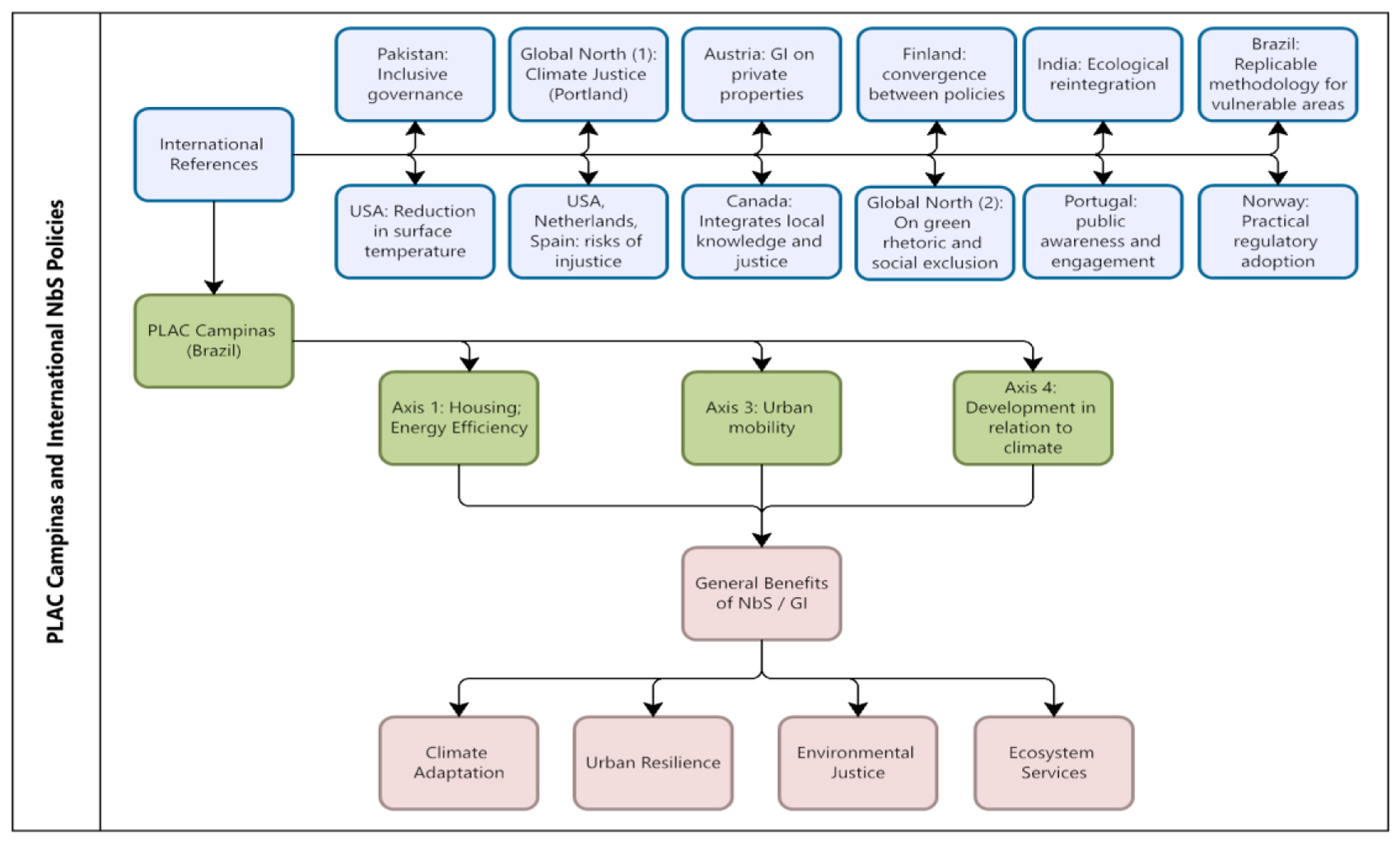
The analysis of the incorporation of GI into CA measures, in dialogue with international policy frameworks and empirical studies from the Global North and the Global South, reveals modest advances and persistent challenges in aligning urban planning practices with the demands of the climate emergency. Although GI is widely recognised for its multifunctional benefits, particularly in mitigating urban heat islands, managing surface water, and enhancing biodiversity, its implementation remains constrained by technical, institutional, and legal barriers. These barriers include the absence of binding regulatory frameworks, insufficient cross-sectoral coordination, limited integration in private and residential areas, and the underrepresentation of vulnerable groups in decision-making processes.
The international cases analysed show that the effectiveness of GI as a public policy for adaptation depends not only on technical innovation, but also on political will, participatory planning, and multiscalar governance structures. Successful experiences, such as those of Portland and Chennai, indicate that when embedded in broader equity-oriented agendas and supported by inclusive governance models, GI can contribute significantly to building more resilient and just urban environments. Conversely, risks such as green gentrification and the reproduction of spatial inequalities persist when GI interventions are not accompanied by robust social safeguards and justice-centred planning mechanisms.
In this direction, recent literature suggests that such safeguards depend on at least three complementary fronts: the explicit recognition of historically marginalised groups and the structural inequalities that shape their vulnerability; intersectoral articulation between climate, health, and urban planning; and participatory mechanisms capable of incorporating experiential knowledge, avoiding unintended consequences, and reducing risks of displacement and exclusion. Thus, more than simply expanding green areas, Green Infrastructure-based adaptation policies must ensure that their benefits are not selectively captured by already privileged groups.
This concern brings back, in explicit terms, the question of for whom the green city is being produced. By contrast, more positive cases such as Portland [19] suggest that articulation between planning, public health, and community-led coalitions, combined with the recognition of socio-structurally vulnerable groups, may reduce risks of injustice, although the available evidence does not allow a conclusive claim that green gentrification has been fully overcome. In addition, recent studies suggest that advancing from general principles to implementation also requires clearer technical and operational references, such as criteria related to vegetation density, proximity to water bodies, park size, siting, and context-sensitive design processes.
Finally, it should be acknowledged that this study is based on a narrative review and documentary analysis, which allow the identification of patterns, tensions, and enabling conditions, but do not directly measure cost-effectiveness, long-term performance, or safety across different contexts. These aspects remain dependent on context-specific empirical assessments and constitute an important agenda for future research.
There is therefore an urgent need to move beyond rhetorical commitments to NbS and advance towards the institutionalisation of GI within national and local regulatory systems. This includes the development of clear normative instruments, measurable indicators, and stable financing mechanisms, as well as fostering the co-production of knowledge and practices that recognise local, traditional, and Indigenous contributions.
For policymakers, this implies embedding GI and NbS into binding urban planning instruments, defining measurable performance indicators, securing resources for maintenance and monitoring, and linking CA to mobility, housing, health, and risk reduction agendas. For implementation actors, including utilities, urban developers, and technical sectors, wider uptake also depends on clearer guidance for siting, scale, design, and feasibility assessment, as well as on improved monitoring, evaluation, and decision-support tools. Future research may advance precisely by comparatively assessing the cost-effectiveness, maintenance demands, safety implications, and long-term performance of these solutions across different urban contexts.
In this context, the conclusions of this study align closely with the ambitions of the 2030 Agenda, particularly SDG 11 (Sustainable Cities and Communities) and SDG 13 (Climate Action), by offering evidence-based recommendations to strengthen cities’ adaptive capacity through GI. In this direction, LCAP instruments can act as strategic tools to promote climate justice by guiding the territorially informed implementation of adaptation measures, with explicit priorities for the most vulnerable groups and areas.
Moreover, these conclusions relate directly to the call for bold political commitments and tangible local action aligned with global adaptation and climate justice goals, especially in the Global South. By promoting integrated, inclusive, and just approaches to urban CA, GI can serve not only as a technical solution, but also as a transformative pathway for public policies towards more sustainable urban futures.
- ,
Inteligência artificial e mudanças climáticas (in Portuguese, Artificial Intelligence and Climate Change) ,Revista USP , (141), 29-4020242024https://jornal.usp.br/wp-content/uploads/2024/05/2-Paulo-Artaxo.pdf - , , Climate Change 2022: Impacts, Adaptation and Vulnerability. Contribution of Working Group II to the Sixth Assessment Report of the Intergovernmental Panel on Climate Change, 2022
- , Global Surface Air Temperature Anomalies for January
- , ONU confirma 2024 como o ano mais quente já registrado, com cerca de 1,55 °C acima dos níveis pré-industriais (in Portuguese, United Nations Confirms 2024 as the Hottest Year on Record, Approximately 1.55 °C above Preindustrial Levels)
- Mudança do clima no Brasil: síntese atualizada e perspectivas para decisões estratégicas, 2024(in Portuguese, Climate Change in Brazil: Updated Synthesis and Perspectives for Strategic Decisions)
- ,
Impactos sociais dos eventos climáticos extremos (in Portuguese, Social Impacts of Extreme Climate Events) ,Ciência e Cultura , Vol. 76 (3), :1-82024, https://doi.org/10.5935/2317-6660.20240068, - ,
Response of Ecosystem Water Use Efficiency to Extreme Drought and Wet Events in the Loess Plateau, China ,Forest Ecology and Management , Vol. 585 , 2025, https://doi.org/10.1016/j.foreco.2025.122528 - ,
Micro Stressors and Experiences: Effects of Extreme Climate Events on Smallholder Food Security in Semi-arid Ghana ,Food and Humanity , Vol. 4 , 2025, https://doi.org/10.1016/j.foohum.2025.100560 - ,
Assessing the Impact of Climate Extreme Events and Conflicts on Internal Displacement in Burkina Faso ,International Journal of Disaster Risk Reduction , Vol. 123 , 2025, https://doi.org/10.1016/j.ijdrr.2025.105470 - ,
Climate and Security Risks and Their Implications for Sustainable Livelihoods: The Case of Maguindanao in Conflictridden Philippine Bangsamoro ,World Development Perspectives , Vol. 36 , 2024, https://doi.org/10.1016/j.wdp.2024.100642 - ,
Sociodemographic and Geographic Inequalities in Exposure to Projected Hot and Extreme Summer Days in England: A Nationwide Socio-spatial Analysis ,Environment International , Vol. 197 , 2025, https://doi.org/10.1016/j.envint.2025.109351 - , A emergência climática: governança multinível e multiatores no contexto brasileiro (in Portuguese, The Climate Emergency: Multilevel and Multi-actor Governance in the Brazilian Context), 2023
- , Climate Change 2023: Synthesis Report. Contribution of Working Groups I, II and III to the Sixth Assessment Report of the Intergovernmental Panel on Climate Change, IPCC, Geneva, Switzerland, 2023
- ,
The Impact of Extreme Temperatures on Emergency Department Visits: A Systematic Review of Heatwaves, Cold Waves, and Daily Temperature Variations ,Science of The Total Environment , Vol. 970 , 2025, https://doi.org/10.1016/j.scitotenv.2025.178869 - ,
The Challenge of Unprecedented Floods and Droughts in Risk Management ,Nature , Vol. 608 , :80-862022, https://doi.org/10.1038/s41586-022-04917-5 - ,
Integrating Green Infrastructure, Ecosystem Services and Nature-based Solutions for Urban Sustainability: A Comprehensive Literature Review ,Sustainable Cities and Society , Vol. 98 , 2023, https://doi.org/10.1016/j.scs.2023.104843 - ,
Local Responses to Climate Change: Navigating Mainstreaming and Transformative Adaptatio ,Cities , Vol. 157 , 2025, https://doi.org/10.1016/j.cities.2024.105606 - ,
The Multifunctionality Concept in Urban Green Infrastructure Planning: A Systematic Literature Review ,Urban Forestry & Urban Greening , Vol. 85 , 2023, https://doi.org/10.1016/j.ufug.2023.127975 - ,
Just Urban Greening for Climate Adaptation & Health Equity Planning: Lessons Learned from 5Cities , Vol. 158 , 2025, https://doi.org/10.1016/j.cities.2024.105677, Cities in the Global North - ,
Assessing the Cooling Potential of Green and Blue Infrastructure from Twelve US Cities with Contrasting Climate Conditions ,Urban Forestry & Urban Greening , Vol. 104 , 2025, https://doi.org/10.1016/j.ufug.2024.128660 - ,
Epistemic Justice in Flood-adaptive Green Infrastructure Planning: The Recognition of Local Experiential Knowledge in Thorncliffe Park, Toronto ,Landscape and Urban Planning , Vol. 238 , 2023, https://doi.org/10.1016/j.landurbplan.2023.104834 - ,
How to Disseminate the Research Results on Climate Change Impacts in Cities to Guide Adaptation Public Policies? Application to the Paris Region (France) ,Climate Services , Vol. 38 , 2025, https://doi.org/10.1016/j.cliser.2025.100545 - ,
Planning the ‘Unknown’: Perception of Urban Green Infrastructure Concept in Romania ,Urban Forestry & Urban Greening , Vol. 51 , 2020, https://doi.org/10.1016/j.ufug.2020.126649 - ,
The Role of Sustainable Energy and Climate Action Plans: Synergies with Regional Sustainable Development Strategies for a Local 2030 Agenda ,Environmental Development , Vol. 47 , 2023, https://doi.org/10.1016/j.envdev.2023.100894 - ,
Tracking Global Climate Change Adaptation among Governments ,Nature Climate Change , Vol. 9 (6), :440-4492019, https://doi.org/10.1038/s41558-019-0490-0 - , How Civil and Structural Engineers Can Help to Deliver the UN's New Urban Agenda, Proceedings of the Institution of Civil Engineers - Civil Engineering, 2020
- , Climate Change Adaptation: The Missing Component in the Local Climate Change Action Plans of Turkish Metropolitan Municipalities, Urban Climate, 2025
- ,
Extreme Weather Disasters Challenges for Sustainable Development: Innovating a Science and Policy Framework for Disaster-resilient and Sustainable Quezon City, Philippines ,Progress in Disaster Science , Vol. 5 , 2020, https://doi.org/10.1016/j.pdisas.2020.100066 - ,
Urban Climate Adaptation and Mitigation Action Plans: A Critical Review ,Renewable and Sustainable Energy Reviews , Vol. 189 , 2024, https://doi.org/10.1016/j.rser.2023.113886 - , , Climate Change 2014: Impacts, Adaptation, and Vulnerability. Working Group II Contribution to the Fifth Assessment Report of the Intergovernmental Panel on Climate Change, 2014
- , Guiding Principles for City Climate Action Planning, 2015
- , ICLEI’s Climate Neutrality Framework: Accelerating Integrated Climate Action for Sustainable Urban Development, 2020
- ,
A Methodological Framework to Assess the Urban Content in Climate Change Policies (in Italian: Valutare il contenuto urbano nelle politiche di adattamento al cambiamento climatico: una proposta metodologica) ,Valori e Valutazioni , Vol. 27 (29), :123-1322021, https://doi.org/10.48264/VVSIEV-20212909 - ,
Equity in Urban Climate Change Adaptation Planning: A Review of Research ,Urban Planning , Vol. 6 (4), :287-2972021, https://doi.org/10.17645/up.v6i4.4399 - ,
Integration of Mitigation and Adaptation in Urban Climate Change Action Plans in Europe: A Systematic Assessment ,Renewable and Sustainable Energy Reviews , Vol. 121 , 2020, https://doi.org/10.1016/j.rser.2019.109623 - ,
From Greening the Climate-adaptive City to Green Climate Gentrification? Civic Perceptions of Short-lived Benefits and Exclusionary Protection in Boston, Philadelphia, Amsterdam and Barcelona ,Urban Climate , Vol. 48 , 2023, https://doi.org/10.1016/j.uclim.2022.101295 - ,
Assessing the Impacts of Climate Change in Cities and Their Adaptive Capacity: Towards Transformative Approaches to Climate Change Adaptation and Poverty Reduction in Urban Areas in a Set of Developing Countries ,Science of The Total Environment , Vol. 692 , :1175-11902019, https://doi.org/10.1016/j.scitotenv.2019.07.227 - ,
Green Infrastructure as Key Tool for Climate Adaptation Planning and Policies to Mitigate Climate Change: Evidence from a Pakistani City ,Urban Climate , Vol. 56 , 2024, https://doi.org/10.1016/j.uclim.2024.102074 - ,
Collaborative Governance for Climate Change Adaptation: Mapping Citizen-municipality Interactions ,Environmental Policy and Governance , Vol. 28 (2), :82-972018, https://doi.org/10.1002/eet.1795 - , Climate Emergency Declarations in 2,366 Jurisdictions and Local Governments Cover 1
- , C40 & 100 Cidades Resilientes anunciam parceria para avançar em conjunto nos esforços de resiliência e mudança climática nas cidades membros (in Portuguese C40 and 100 Resilient Cities Announce Partnership to Jointly Advance Resilience and Climate Change Efforts in Member Cities)
- ,
Revisão sistemática: uma revisão narrativa (in Portuguese, Systematic Review: A Narrative Review) ,Revista do Colégio Brasileiro de Cirurgiões , Vol. 34 (6), :428-4312007, https://doi.org/10.1590/S0100-69912007000600012 - Meio Ambiente e Sustentabilidade (SECLIMAS), Plano Local de Ação Climática de Campinas/SP (in Portuguese, Campinas/SP Local Climate Action Plan) , 2024
- ,
From Strategy to Implementation: Mainstreaming Urban Green Infrastructure in Austria’s Spatial Planning Instruments for Climate Change Adaptation ,Urban Forestry & Urban Greening , Vol. 94 , 2024, https://doi.org/10.1016/j.ufug.2024.128232 - ,
Greening the Compact City: Unarticulated Tensions and Incremental Advances in Municipal Climate Action Plans ,Cities , Vol. 152 , 2024, https://doi.org/10.1016/j.cities.2024.105251 - ,
Integrating Blue-green Infrastructure in Urban Planning for Climate Adaptation: Lessons from Chennai and Kochi, India ,Land Use Policy , Vol. 124 , 2023, https://doi.org/10.1016/j.landusepol.2022.106455 - ,
Urban Green Boosterism and City Affordability: For Whom Is the ‘Branded’ Green City? ,Urban Studies , Vol. 58 (1), :90-1122021, https://doi.org/10.1177/0042098019885330 - ,
Perceptions and Preferences of Urban Residents for Green Infrastructure to Help Cities Adapt to Climate Change Threats ,Cities , Vol. 141 , 2023, https://doi.org/10.1016/j.cities.2023.104478 - ,
The Institutionalization of Nature- Based Solutions—A Discourse Analysis of Emergent Literature ,Resources , Vol. 9 (1), 2020, https://doi.org/10.3390/resources9010006 - ,
Green Infrastructure as a Solution to Mitigate the Effects of Climate Change in a Coastal Area of Social Vulnerability in Fortaleza (Brazil) ,Environmental Advances , Vol. 13 , 2023, https://doi.org/10.1016/j.envadv.2023.100398 - Índice de Vulnerabilidade às Mudanças Climáticas e Plano de Adaptação: Fortaleza, Ceará – Caderno de Anexos (in Portuguese, Climate Change Vulnerability Index and Adaptation Plan: Fortaleza, Ceará – Annex Booklet), Report , 2020 (accessed )
- , Guia Metodológico para Implantação de Infraestrutura Verde (in Portuguese, Methodological Guide for Implementing Green Infrastructure), 2020
- ,
Nature-based Solutions for Climate Change Adaptation in Urban Areas: A Norwegian Planning Perspective ,Land Use Policy , Vol. 157 , 2025, https://doi.org/10.1016/j.landusepol.2025.107678 - , Plano de Mobilidade Urbana de Campinas (in Portuguese, Campinas Urban Mobility Plan), 2019
- , Região Metropolitana de Campinas (RMC) - Plano de Desenvolvimento Urbano Integrado da Região Metropolitana de Campinas (PDUI-RMC) (in Portuguese, Campinas Metropolitan Region - Integrated Urban Development Plan for the Campinas Metropolitan Region)
- , Panorama - São Paulo (in Portuguese, Overview - São Paulo)
- , (in Portuguese Brazilian Institute of Geography and Statistics (IBGE)), Panorama - Campinas (in Portuguese, Overview - Campinas)
- , Brazilian Institute of Geography and Statistics, IBGE), IBGE Cidades, São Paulo, Campinas, Pesquisa, Produto Interno Bruto dos Municípios, PIB a preços correntes (in Portuguese, IBGE Cities, São Paulo, Campinas, Survey, Municipal Gross Domestic Product, Gross Domestic Product at Current Prices)
- , Meio Ambiente e Sustentabilidade (SECLIMAS), Campinas: Clima, Meio Ambiente e Sustentabilidade - Plano Local de Ação Climática (in Portuguese, Campinas: Climate, Environment and Sustainability - Local Climate Action Plan), 2024
- , Meio Ambiente e Sustentabilidade - Parques Lineares (in Portuguese, Campinas: Climate, Environment and Sustainability - Linear Parks), 2024
- ,
Greening Urban Mobility: Assessing Environmental and Functional Characteristics of Bicycle Infrastructure in the Post-pandemic Era ,Habitat International , Vol. 153 , 2024, https://doi.org/10.1016/j.habitatint.2024.103200 - ,
Encouraging Cycling through the Improvement of Streetscape Perception: A Bottom-up Investigation into the Relationship between Street Greening and Bicycling Volume ,Applied Geography , Vol. 171 , 2024, https://doi.org/10.1016/j.apgeog.2024.103388 - ,
How to Create a Sustainable Growth in Bicycle Traffic? The Case of Paris ,Journal of Cycling and Micromobility Research , Vol. 5 , 2025, https://doi.org/10.1016/j.jcmr.2025.100081