


Land transport plays a fundamental role in the European Union (EU) economy, not only due to the automotive industry, which produces over 18 million vehicles annually, but also because it supports nearly every other sector through the movement of people and goods [1]. However, this sector also generates a disproportionately high environmental impact. According to the European Commission (EC), transport, especially road transport, is the leading cause of air pollution in Europe, and one of the few emission sectors that has not experienced a significant decline in pollutant output [2]. This is largely due to the difficulties in scaling up low-emission technologies [3].
Indeed, in contrast to other sectors, such as industry and energy production, greenhouse gas emissions from the EU’s transport sector have continued to rise over the past three decades. Between 1990 and 2023, for example, total transport emissions in the EU-27 increased by 33.5% [4]. One of the main drivers of this increase is the continuous growth in transport demand [5]. Over recent decades, both passenger and freight transport volumes have grown significantly. CO2 emissions for passenger cars rose by 5.8% between 2000 and 2023, largely due to an increase of 16.6% in total passenger-kilometres travelled [4]. In this context, urban and peri-urban mobility play a critical role, as densely populated areas are particularly vulnerable to the accumulation of air pollutants, with significant public-health impact [6]. This upward trend highlights the importance of the EU’s ‘Fit for 55’ package, which sets stricter transport emission targets to help achieve a 55% reduction in overall greenhouse gases by 2030 [7].
In response to escalating urban traffic congestion and air pollution, micromobility solutions – such as light electric vehicles (LEVs) with a maximum speed of 45 km/h and a weight below 350 kg – have emerged as a transformative paradigm, providing cost- and energy-efficient alternatives to private motorized transport for short-distance trips [8]. The widespread diffusion of LEVs is consistent with the strategic vision of sustainable urban development, contributing to enhanced multimodality of the system. These vehicles provide a seamless connection to public transport, effectively reducing the barriers of the first and last mile [9].
Beyond passenger mobility, micromobility has also gained traction in urban logistics. The accelerated expansion of e-commerce, particularly after the COVID-19 pandemic, has boosted demand for efficient, low-emission delivery modes [10]. Cargo e-bikes, in particular, are well suited to last-mile distribution, ensuring zero-emission operations even in constrained environments such as historic city centres. Leading logistics operators including and public institutions have already deployed cargo bikes at scale within their fleets [11]. Evidence from the Horizon 2020 CityChangerCargoBike project underlines the magnitude of this transition, with European sales reaching 28,500 cargo bikes in 2019 and 43,600 in 2020 [12]. When effectively integrated into intermodal transport frameworks and complemented by collective transport for longer-distance mobility, micromobility emerges as one of the most promising approaches for mitigating the adverse externalities of transport on urban air quality [13]. It can lower concentrations of traffic-related pollutants, though users may still face increased exposure to fine particulates (PM25) and other emissions [14].
Recognizing this potential, the EC mandates that all cities within the Trans-European Transport Network (TEN-T) adopted sustainable urban mobility plans (SUMPs). These plans must include measures to support micromobility, ranging from safe cycling infrastructure and designated parking to regulatory frameworks for managing shared mobility services [15]. Such interventions are essential in dense urban environments, where congestion, air pollution, and limited public space demand structural changes in mobility behaviour [16].
In parallel, EU funding instruments are supporting innovation in this field. The LIFE Programme [17], launched in 1992, has progressively expanded its role in fostering sustainable urban mobility by financing projects aimed at reducing greenhouse gas emissions, improving air quality, and promoting modal shifts. Among them, the LIFE2M – Long LIFE to Micromobility project [18] targets both technological and environmental challenges by developing and demonstrating retrofit solutions based on hybrid supercapacitor (HSC) energy storage, with the objective of enabling ultra-fast charging, improved thermal behaviour, reduced maintenance, and a lower reliance on conventional lithium-ion batteries (LIBs) [19]. While recent reviews offer thorough coverage of supercapacitor fundamentals, material innovations, performance trade-offs [20], and broader analyses of battery-supercapacitor hybridization strategies [21] and micromobility charging infrastructure concepts [22], this study's original contribution lies in its application and pilot-oriented perspective, which connects these technical advances to real deployment constraints.
From this standpoint, LIFE2M is not limited to a technology substitution at component level. Rather, it proposes a system-level pathway to reduce the environmental footprint of micromobility by extending the service life, lowering material throughput, and mitigating the demand for raw materials and end-of-life battery recycling. Complementing these advancements, solar photovoltaic (PV) fast-charging stations will be deployed, equipped with supercapacitor storage and advanced power electronics for optimal charge-discharge management.
Anchored in European policy objectives, the analysis presented in this study explores how these innovations can jointly contribute to decarbonizing urban mobility, extending vehicle lifespans, reducing dependence on critical raw materials, and enabling the transition towards more resilient and sustainable transport systems.
The LIFE2M project promotes sustainable urban mobility by enhancing the technological, environmental, and socio-economic performance of LEVs. The initiative combines awareness campaigns with scalable business models designed to foster behavioural change and lower operational costs, making micromobility more accessible and competitive. Coordinated by the University of Florence, LIFE2M relies on a multidisciplinary public-private partnership involving academic institutions, local authorities, manufacturers, and service providers. A key focus is minimizing the environmental footprint of micromobility by limiting resource and energy consumption, extending the service life of vehicles, promoting revamping and reuse, and reducing dependence on battery recycling through the adoption of sustainable materials and innovative technologies. The central research objective is the development and validation of a next-generation energy storage system for microvehicles, designed to deliver:
Ultra-fast charging: significantly shorter charging times, improving fleet management and minimizing downtime.
Extended operational life: longer service cycles enabled by advanced technologies, resulting in lower replacement and maintenance costs.
Environmental sustainability: reduced carbon footprint through prolonged vehicle lifetime and optimized resource efficiency.
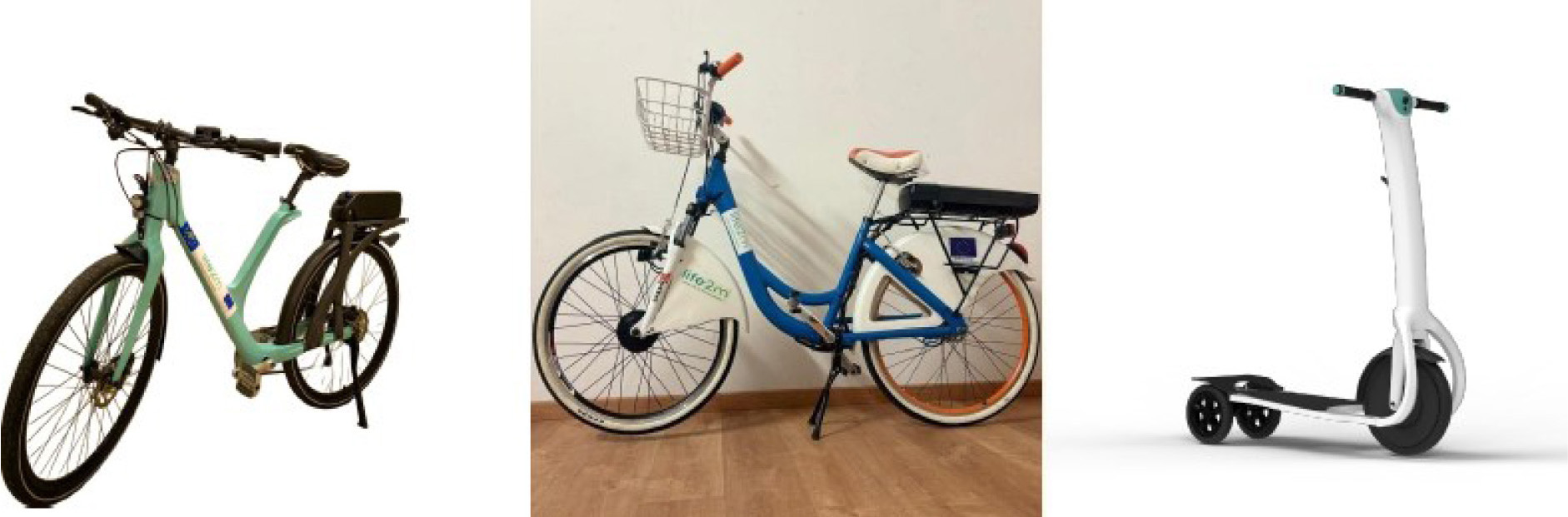
A pilot deployment will take place in three Italian cities, Palermo, L’Aquila and Florence and in Brussels, Belgium. It will integrate 15 converted bikes from mechanical to assisted, 33 new e-bikes, retrofit of the batteries of 40 e-scooters, 24 new e-scooters whose model is based on the Leonardo project (hybrid between e-scooter and monowheel) [23], 1 cargo bike. In addition, 9 solar charging stations will be installed to demonstrate the scalability and real-world impact of the proposed solutions. Three examples are highlighted in Figure 1.
Microvehicles implemented for the LIFE2M project: prototypes of e-bikes (left), retrofitted muscular bikes (centre) and Leonardo e-scooters (right), which integrate HSC-based accumulators
During the first part of the project, e-scooter deployment was planned across the three Italian pilot cities of L’Aquila, Palermo, and Florence. However, during implementation phase, the Italian regulatory framework changed through Decree No. 210 of 27 June 2025 [24], which introduced stricter requirements in terms of technical standards, registration, and accountability. Under the updated provisions, each vehicle must display an official identification plate in the form of a non-removable retroreflective sticker bearing a unique alphanumeric code generated by the Ministry and incorporating security features aimed at preventing tampering and counterfeiting. The issuance of this mark is linked to mandatory third-party liability insurance introduced by Law No. 177/2024 [25].
These new requirements materially affected the feasibility of the Italian pilots. In particular, mandatory individual insurance constrained vehicle rotation and fleet management, increased administrative overhead, and reduced usability in a shared-service setting, while the compulsory helmet requirement introduced additional operational friction. In order to preserve the continuity of the experimental campaign, 30 newly procured e-scooters – based on the Leonardo project model and equipped with HSC-based accumulators – were consequently relocated to Brussels, where the regulatory environment was comparatively less stringent. This relocation highlights two distinct national approaches to micromobility governance:
In Belgium, the minimum rider age is 16 (with exceptions in some residential areas); e-scooters are allowed on cycle paths and roads without bike lanes, but sidewalks are prohibited. The speed limit is set to 25 km/h, and helmet use and insurance are recommended rather than mandatory. No registration or license plate is required, and kerbs parking is generally tolerated provided pedestrian circulation is not obstructed [26].
Italy places stronger emphasis on traceability and accountability. It allows use from age 14, mandates helmet use (including for shared e-scooters), requires an identification plate and third-party liability insurance, and sets detailed technical equipment requirements such as dual independent braking, lighting, an acoustic warning device, and turn indicators. Circulation is restricted to urban roads with speed limits at or below 50 km/h, while cycle lanes, pedestrian areas, and non-urban roads remain excluded [24], [25].
Although the net impact of these divergent regulatory regimes on demand is context-dependent, a brief user-acceptance projection is informative. In the short term, a lower-friction setting is expected to favor shared ridership and reduce compliance-related barriers, which is consistent with the scale of LEVs usage observed in Brussels [27]. In Italy, where official national statistics report non-negligible casualty figures involving e-scooters [28], stricter requirements may dampen some forms of shared uptake; at the same time, stronger safety and accountability provisions can increase perceived legitimacy and reassurance for more risk-averse users, potentially supporting acceptance and private adoption over the medium term.
Overall, this episode underscores that micromobility pilots are not only technology-driven, but also highly sensitive to rapidly evolving compliance requirements. To strengthen resilience against sudden regulatory shifts and prevent legislative changes from translating into operational disruptions, future projects should integrate a structured regulatory risk assessment from the outset and adopt a compliance-by-design approach, supported by an implementation strategy that preserves operational flexibility and enables timely adaptation to new requirements.
Within the framework of the LIFE2M project, the transition from conventional LIBs to innovative HSCs addresses persistent limitations in current micromobility technologies. Although LIBs are widely used in electric microvehicles, they present critical drawbacks, including limited cycle life (<1000) [29], long charging times (~1 ‒ 3 hours) [30], high maintenance requirements [31], and safety concerns related to thermal runaway and flammability [32]. Their production and disposal also raise environmental issues due to the extraction and use of critical raw materials such as cobalt, lithium, and nickel [33].
To address these challenges, LIFE2M introduces next-generation HSCs, which combine ultra-fast charging (under 20 minutes, i.e., 3C) [34], enhanced thermal stability (‒20 °C to 45 °C) [35], and extended operational lifetime (up to 20 times) [36]. Advances in materials science support their longer lifespan, thereby reducing maintenance and replacement costs, limiting electronic waste, and improving economic feasibility for urban transit applications [37]. High power density is especially advantageous for applications requiring instantaneous energy delivery. HSCs outperform LIBs in this respect (24 kW/kg vs. 10 kW/kg) [34], [38], making them ideal for regenerative braking in electric vehicles and peak load support in grid applications [39]. Performance is further enhanced by reduced internal resistance and optimized electrode geometries, which increase short-term responsiveness well beyond that of LIBs [40]. Whereas lithium-ion cells progressively lose capacity after relatively few cycles, HSCs can maintain stable performance for tens of thousands [41]. Integrated thermal management systems provide additional protection against overheating, thereby reducing risks commonly associated with conventional storage technologies [42]. Finally, the adoption of composite materials and hybrid electrodes enables a balanced trade-off between energy and power density, while simultaneously reducing energy losses [43].
Despite these advantages, it is acknowledged that HSCs generally offer lower gravimetric energy density than the highest-energy LIBs, therefore, for equal pack mass, LIBs can deliver longer single-charge range. However, for urban micromobility, the relevant metric is often operational availability rather than maximum uninterrupted range. Accordingly, even if charging events may be more frequent with HSCs, the substantially shorter top-up times can reduce perceived inconvenience and mitigate range concerns in the LIFE2M urban LEVs context. Table 1 summarises the main LIB and HSC characteristics for mobility and high-power cycling applications, as derived from the targeted literature selection.
Comparative overview of energy storage systems partially based on data from [44], [45]
Parameter |
LIBs |
HSCs |
|---|---|---|
Specific Energy [Wh/kg] |
100÷320 |
120÷240 |
Specific Power [kW/kg] |
0.3÷9.6 |
0.3÷24 |
Int. Resistance [mΩ] |
>15 |
<15 |
Cycle life |
<1000 |
>500,000 |
In the project, two types of HSCs will be employed: the 8900F (2.5-4.2 V; 2.5 Ah) and the 5300F (2.5-4.2 V; 4.2 Ah) modules. The choice of configuration depends on the type of light electric vehicle and the operational requirements in terms of nominal voltage, energy capacity, and charging speed.
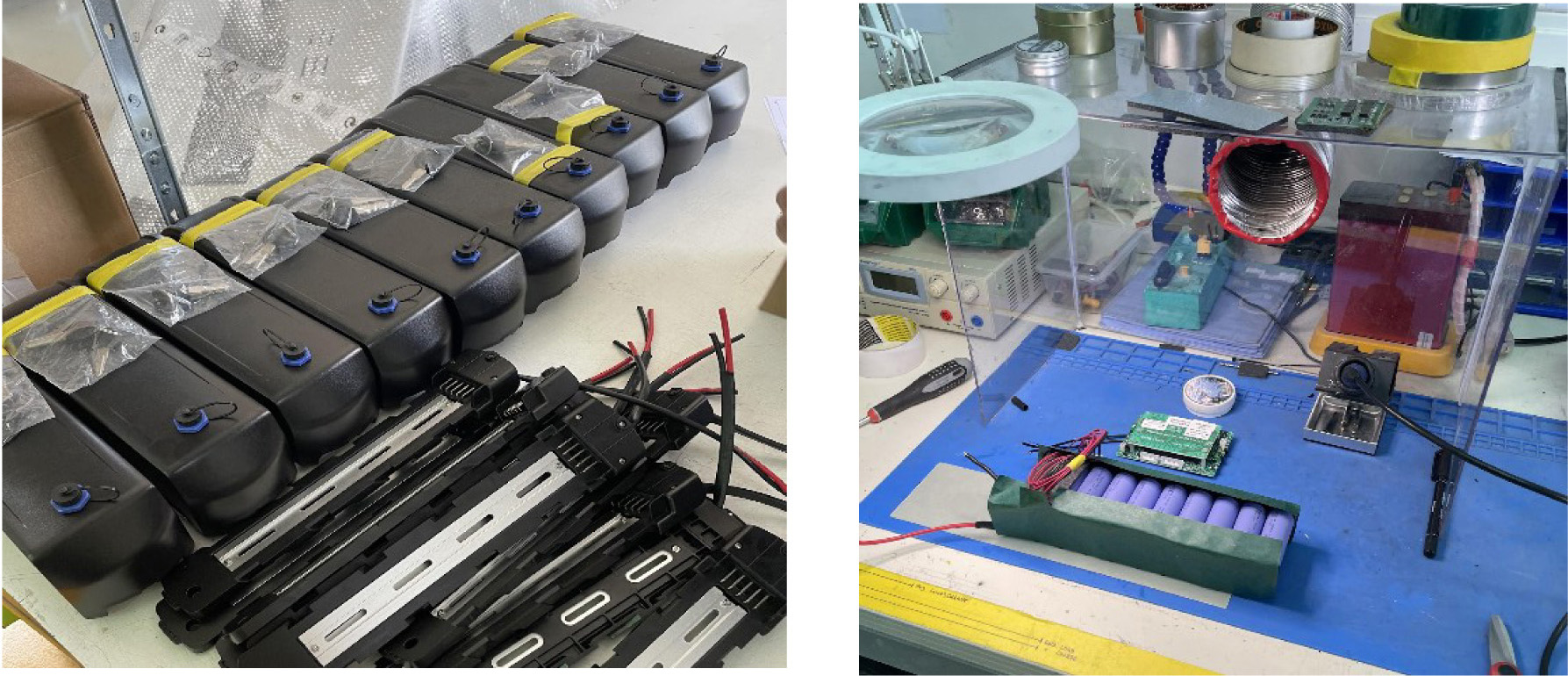
For the retrofit of e-scooters, the 8900F HSCs will be employed in two alternative configurations: one consisting of thirteen cells connected in series with two strings in parallel, which results in a nominal voltage of approximately 48 V (average 3.7 V; 18.5 - 31 Wh), and another based on thirteen cells in series with three parallel strings, reaching a nominal voltage of 50.4 V (average 3.7 V; 27.7 – 46.5 Wh), and offering enhanced energy capacity and current delivery. In the case of e-bikes, the architecture will rely on ten cells in series and two in parallel, corresponding to a nominal voltage of 36 V. Within this framework, both the 8900 F and the 5300 F modules will be implemented: the former to enable fast-charging applications, and the latter to provide super-fast-charging capability. Cargo bikes, characterized by substantially higher energy and power demands, will instead adopt a configuration of ten cells in series and four in parallel, maintaining the same nominal voltage of 36 V (average 3.6 V; 36 – 60.5 Wh) but significantly increasing the storage capacity and current-handling capability. Figure 2 shows the HSCs received at the project partner’s facility, which is responsible for testing them and integrating them into the vehicles.
HSCs pack in the LIFE2M project
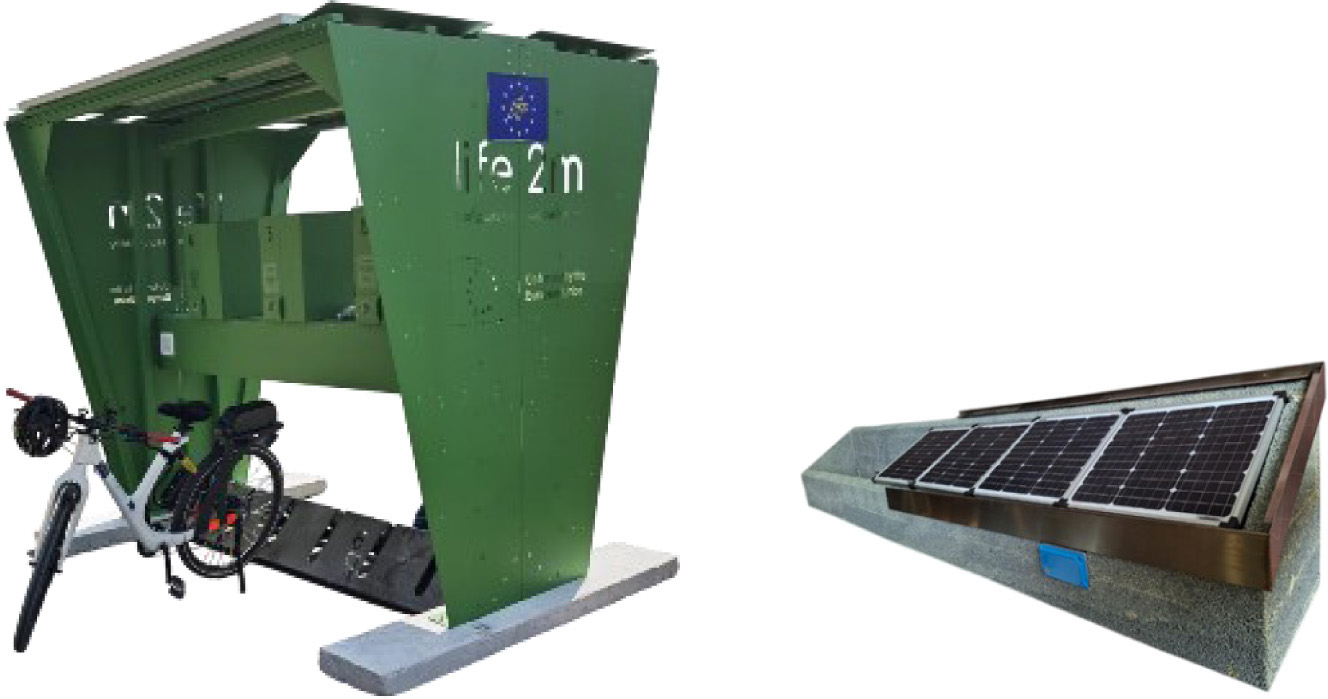
The charging stations represent a key complement to the deployment of LEVs within the project. Designed entirely according to circular economic principles, each of the nine planned stations is conceived for easy disassembly, reuse, or recycling. Figure 3 provides a representation of the station, highlighting the PV system integrated into the roof.
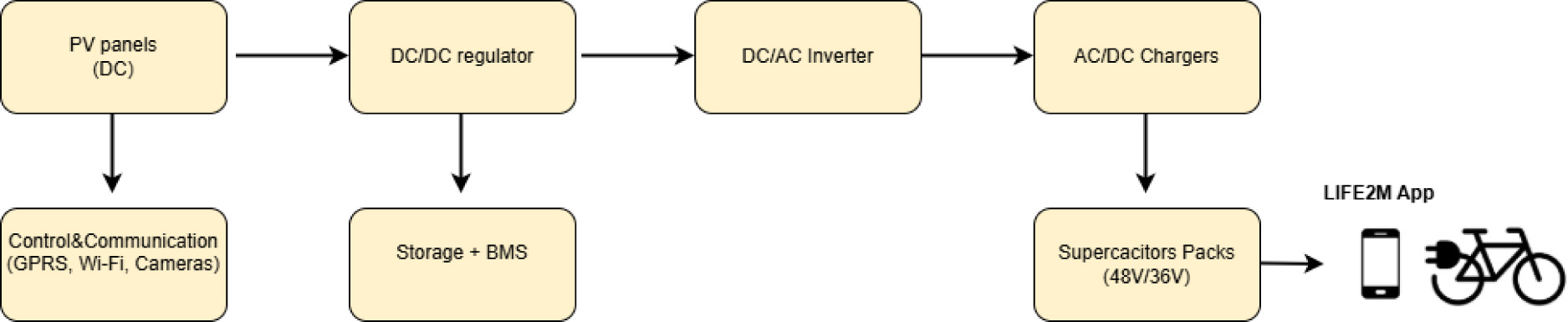
Each station is primarily powered by a 500 Wp PV array integrated into the structure and modularly expandable up to 1.5 kWp. Energy is stored in a hybrid bank of supercapacitors with a capacity of 2.5 - 5 kWh at 48 V, sized to capture a full day of sunlight and guarantee multiple recharges, thereby ensuring both reliability and availability. The stored energy is distributed through DC/DC converters for low-voltage loads – such as backup batteries, communication systems, and control electronics – and through an inverter delivering a continuous 1200 W of AC power for the chargers. Importantly, the station can host up to six charging stalls, while charging power is dynamically allocated across connected vehicles within the station’s continuous power envelope, hence, the number of physical stalls does not imply simultaneous full rate charging on all outlets. Maximum power point tracking optimizes solar generation, while advanced charge–discharge regulation extends the lifespan of the storage system and ensures the safe, efficient delivery of the high currents needed for ultra-fast charging.
This configuration is intended to enable installations in parks, pedestrian zones, and newly developed urban areas with minimal infrastructure requirements. Nevertheless, PV-only operation remains inherently site- and season-dependent. During winter months in low-irradiance locations, PV-only energy availability may be insufficient, after conversion and charging losses, to consistently sustain the station’s nominal daily throughput, which is equal to six full recharges of an e-scooter pack per day. In such conditions, reliability can be preserved through limited grid-assisted replenishment as a fallback, while the station is already designed to accommodate PV expansion up to 1.5 kWp, thereby reducing grid reliance.
Intelligence is embedded in the stations through an integrated on-board unit equipped with sensors and communication modules. This system continuously monitors and transmits data on energy flows, charging sessions, system performance, and environmental conditions such as temperature and solar irradiance. The parameters that are prioritised in the integrated on-board unit on the charging station are related to the energy recharged to the batteries. The primary objective of the station is to optimise the recharging speed in accordance with the requirements of the battery being recharged, thereby ensuring the highest possible efficiency in the recharging process. The resulting datasets considering these parameters feed into the central project platform, enabling both operational optimization and impact assessment.
Charging station design highlighting the photovoltaic panels integrated on the roof (left); kerb version of the charging station for ultra-fast charge (right)
Beyond energy management, the station is also conceived as a connected platform. A central mini-PC coordinates the operation of the subsystems, while Wi-Fi and General Packet Radio Service (GPRS) connectivity extends communication to smartphones and cloud platforms, supporting remote monitoring and data management.
In this way, the station not only provides clean energy for micromobility but also demonstrates how digital control and renewable integration can converge to create resilient, smart, and user-oriented urban infrastructure. A scheme of the charging infrastructure is represented in Figure 4.
Block Diagram of the LIFE2M Solar Charging Station
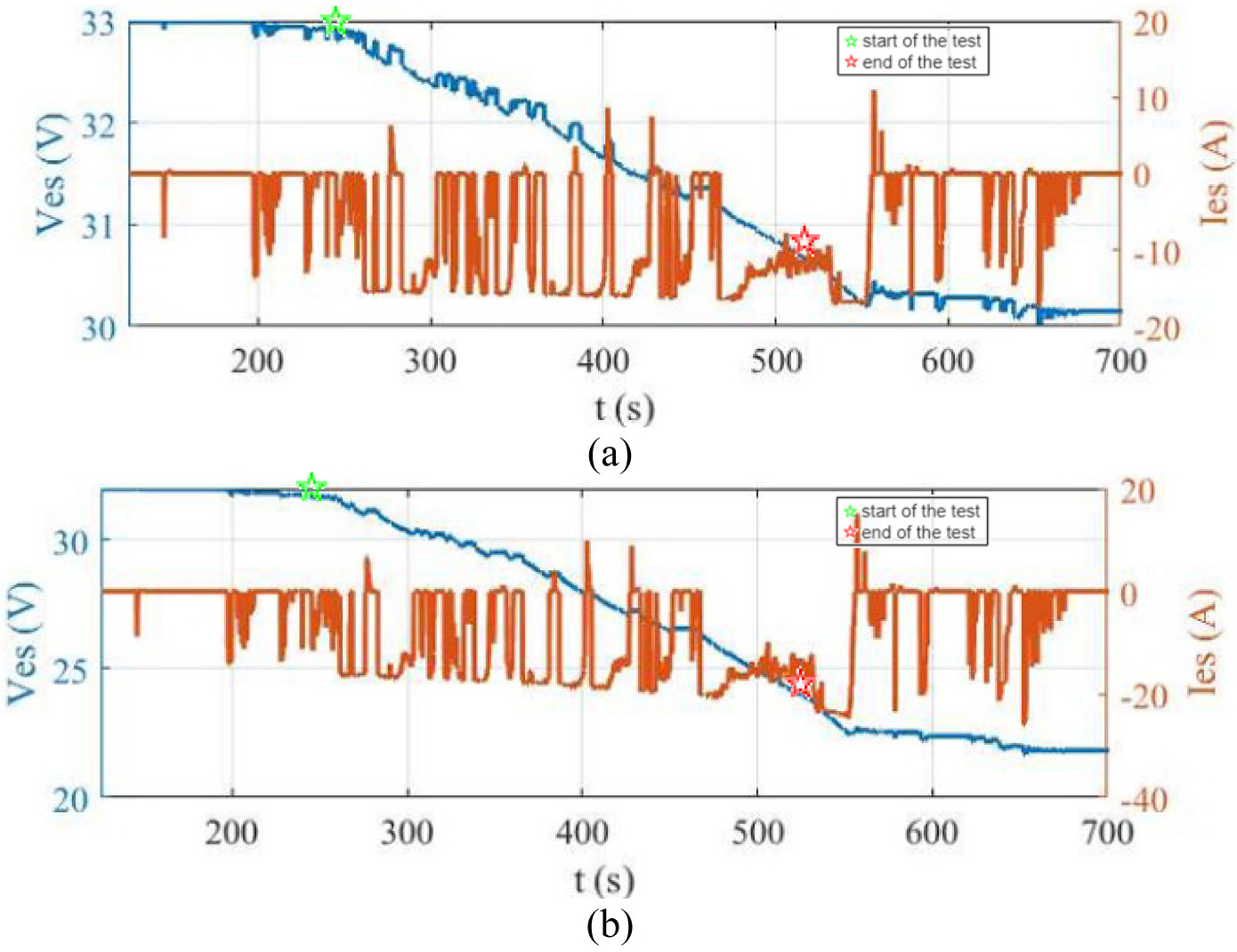
Preliminary tests conducted on HSCs have highlighted significant advantages compared to conventional LIBs, particularly in applications where rapid charging and high cycle life are critical. Simulation-based analyses demonstrate that HSCs can effectively sustain intense and short charging cycles, making them a promising alternative for micromobility systems that require frequent fast-charging opportunities [44].Figure 5 illustrates the operating range of the two technologies. The battery pack (Figure 5a) reaches a peak current of 20.4 A over a 27.9 – 36.9 V voltage window, yielding an instantaneous power range of approximately 0.57 – 0.75 kW. For the HSC pack (Figure 5), the peak current is 30 A, within 25.9 – 42.0 V, corresponding to roughly 0.78 – 1.26 kW. Overall, the HSC supports about a peak current and peak power that are approximately 47% and 67% higher than the LIB, at the cost of a broader voltage difference.
In addition, experimental studies confirm their strong resistance to degradation under a variety of operating conditions, including temperature variations and different states of charge [46]. Recent accelerated ageing campaigns have further shown that, although fast-charging strategies can reduce cycle life to a few hundred cycles, the degradation dynamics of HSCs are predictable and can be effectively monitored through electrochemical impedance spectroscopy (EIS), enabling accurate health prognostics and remaining useful life estimation [47].
Comparison between the voltages and currents at the beginning and end of testing for (a) LIBs and (b) supercapacitors taken from [44]
This diagnostic capability has a direct economic implication in high-cycling micromobility services, where total cost of ownership is strongly influenced by replacement planning, service continuity, and downtime. By reducing uncertainty on end-of-life timing and enabling condition-based interventions, EIS-driven prognostics mitigate unplanned failures and allow the asset to be exploited closer to its actual end-of-life rather than being replaced conservatively [45]. In this context, although HSCs entail higher upfront costs when expressed on an energy basis, the improvement can translate into more favourable life-cycle economics than LIB systems operated under comparable high-power, fast-charge duty cycles [48].
Beyond electrochemical durability, mechanical robustness is crucial in real-world micromobility contexts, where packs are exposed to road vibration due to limited damping.
To assess this aspect, specific vibration tests have been carried out on HSCs, exposing the cells to variable-frequency mechanical stresses derived from real driving profiles (e.g., cobblestones, speed bumps, and uneven urban pavements) over 0–140 s, with measured accelerations spanning approximately –30 g to +30 g. The tests distinguished between low-frequency vibrations, typical of urban commuting, and high-frequency stresses, associated with dynamic driving conditions. Results revealed that at high discharge frequencies, HSCs undergo significantly less structural and electrical damage than LIBs, while at lower frequencies the impact of mechanical stress is more pronounced, with measurable variations in impedance response [49]. Assuming that the natural frequency of the frame is sufficiently elevated to preclude resonance, a strategy for mitigating the impact of low-frequency mechanical vibrations is involving the addition of pads or damping structures composed of rubber or elastomeric materials. These structures are positioned in contact with the accumulator housing, acting as a low-pass filter. This comprehensive testing framework provides a thorough evaluation of HSCs performance, confirming its reliability and sustainability as an alternative to LIBs in micromobility.
Despite the technological benefits of LIFE2M, several non-technical constraints may limit scalability. Regulatory volatility, as illustrated by the Italian, case reduces operational flexibility, particularly for shared and experimental fleets. More broadly, fragmented national and municipal rules hinder replication by forcing context-specific technical and organizational adaptations.
From a safety standpoint, HSC-based storage provides improved thermal stability and a lower thermal-runaway risk than conventional LIBs. However, risk perception linked to vehicle stability and crash exposure remains relevant in mixed-traffic urban environments [50]. In addition, ultra-fast charging must comply with stringent electrical safety standards, which can increase protection-system complexity, certification effort, and time-to-deployment [22].
Finally, while charging infrastructure for micromobility can generally be deployed with limited civil works, performance constraints persist due to meteorological variability. PV-powered stations are inherently site- and season-dependent, and prolonged low-irradiance conditions may reduce charging availability and require extensive grid-assisted operation. For wide diffusion, deployment strategies should also account for permitting timelines, competition for public space, and integration with existing streetscape assets.
The LIFE2M project demonstrates that HSCs can provide a viable and sustainable alternative to conventional LIBs in the field of micromobility. Experimental and simulation results indicate rapid charging capability, substantially longer cycle life, and higher tolerance to mechanical stress attributes that directly reduce downtime and replacement-driven costs for both shared fleets and privately owned LEVs.
By integrating HSC-based retrofits with PV-powered charging stations, LIFE2M outlines a system-level pathway toward renewable and circular micromobility services. While the technical design supports scalable deployment, the pilots also confirm that implementation is highly sensitive to governance conditions. The Italian-Belgian comparison shows how regulatory settings can directly affect fleet operability and user uptake and therefore must be considered a primary variable in replication strategies.
Three key points emerge. First, HSC-based storage is most advantageous where service availability and fast turnaround are more important than maximum single-charge range. Second, distributed PV charging can reduce operational emissions, but its output is intrinsically site- and season-dependent and may require grid-assisted operation to ensure reliability under low-irradiance conditions. Third, predictable and coherent regulatory pathways are essential to preserve fleet flexibility and enable cross-city replication.
Future work should focus on long-term field validation of HSC ageing under real chargedischarge patterns and environmental conditions; systematic assessment of charging-station throughput and reliability across seasons and locations; and user-behaviour and safety-perception analyses to quantify how compliance requirements affect adoption, especially in shared services, thereby further aligning technological development with evolving policy and social frameworks.
This study was conducted within the LIFE2M project co-financed by the European Union under the Programme for the Environment and Climate Action, topic LIFE-2021-SAP-ENV-ENVIRONMENT, No. 101074307.
- ,
European Vehicle Market Statistics 2023/24 Pocketbook ,International Council on Clean Transportation (ICCT), Berlin , 2024 - ,
, EEA , 2022https://www.eea.europa.eu/en/analysis/publications/air-quality-in-europe-2022/sources-and-emissions-of-air-pollutants-in-europe, European Environment Agency, Sources and emissions of air pollutants in Europe - ,
, EEA , 2024https://www.eea.europa.eu/en/analysis/publications/sustainability-of-europes-mobility-systems, European Environment Agency, Sustainability of Europe’s mobility systems - ,
Annual European Union greenhouse gas inventory 1990-2023 and inventory document 2025 ,EEA , 2025https://www.eea.europa.eu/en/analysis/publications/annual-european-union-greenhouse-ga s-inventory-2025, European Environment Agency - ,
Quantification of Savings for the European Transport Sector through Energy Efficient Urban Planning ,J. Sustain. Dev. Energy Water Environ. Syst. , Vol. 10 (4), 2022, https://doi.org/10.13044/j.sdewes.d10.0426 - ,
Global burden and strength of evidence for 88 risk factors in 204 countries and 811 subnational locations, 1990–2021: a systematic analysis for the Global Burden of Disease Study 2021 ,The Lancet , Vol. 403 (10440), :2162-22032024, https://doi.org/10.1016/S0140-6736(24)00933-4 - ,
Cost-effective reduction of fossil energy use in the European transport sector: An assessment of the Fit for 55 Package ,Energy Policy , Vol. 168 , 2022, https://doi.org/10.1016/j.enpol.2022.113085 - ,
Life Cycle Assessment of Shared Dockless Stand-up E-scooters in Sweden ,J. Sustain. Dev. Energy Water Environ. Syst. , Vol. 12 (2), 2024, https://doi.org/10.13044/j.sdewes.d12.0508 - ,
The Impact of Micromobility on the Environment ,J. Traffic Transp. Manag. , Vol. 4 (1), :21-272023, https://doi.org/10.5383/JTTM.04.01.005 - ,
Last mile distribution using cargo bikes: a simulation study in Padova ,European Transport - Trasporti Europei, No. 90 , 2023, https://doi.org/10.48295/et.2023.90.3 - ,
Results and learnings from Europe’s largest cargo bike testing program for companies and public institutions ,Transportation Research Procedia , Vol. 79 , :146-1532024, https://doi.org/10.1016/j.trpro.2024.03.021 - ,
, 2020https://www.cargobike._jetzt/europaeische-marktumfrage-2020/#:~:text=Industry°%o20surve y0%o20expects0%o20over0%o2050,cydelogistics.eu∕market%2Dsize, CityChangerCargoBike – Horizon2020, First European Cargo Bike Industry Survey - ,
Estimating the Emissions Reduction Due to the Use of Cargo Bikes: Case Studies for the Selected European Cities ,Energies (Basel). , Vol. 15 (14), 2022, https://doi.org/10.3390/en15145264 - ,
Micro-mobility users’ exposure to PM2.5 pollution: A scoping review ,Journal of Cycling and Micromobility Research , Vol. 4 , 2025, https://doi.org/10.1016/j.jcmr.2025.100072 - ,
Sustainable urban mobility plans (SUMPs): An overview ,Intelligent Urban Mobility , 1-162025, https://doi.org/10.1016/B978-0-443-34160-1.00011-0 - ,
On the Future of Passenger Mobility and its Greenhouse Gas Emissions in Cities: Scenarios for Different Types of Policies ,J. Sustain. Dev. Energy Water Environ. Syst. , Vol. 10 (4), 2022, https://doi.org/10.13044/j.sdewes.d10.0424 - ,
The LIFE Programme - Over 20 Years Improving Sustainability in the Built Environment in the EU ,Procedia Environ. Sci. , Vol. 38 , :913-9182017, https://doi.org/10.1016/j.proenv.2017.03.179 - ,
, 2022https://www.life2m.eu/, LIFE Programme, LIFE2M - LONG LIFE TO MICROMOBILITY - ,
Lithium-ion capacitor safety testing for commercial application ,Batteries , Vol. 5 (4), 2019, https://doi.org/10.3390/batteries5040074 - ,
Supercapacitors: Overcoming current limitations and charting the course for next-generation energy storage ,Journal of Industrial and Engineering Chemistry , Vol. 141 , :46-662025, https://doi.org/10.1016/j.jiec.2024.07.014 - ,
Control Strategies for Battery/Supercapacitor Hybrid Energy Storage Systems ,IEEE Energy 2030 Conference , 1-62008, https://doi.org/10.1109/energy.2008.4781031 - ,
A comprehensive review of charging infrastructure for Electric Micromobility Vehicles: Technologies and challenges ,Energy Reports , Vol. 12 , :545-5672024, https://doi.org/10.1016/j.egyr.2024.06.026 - ,
, 2021https://leonardopro_ject.eu/, Horizon 2020 Research and Innovation Programme, Leonardo Project - ,
, Ministry of Infrastructure and Transport , 2025, Head of Department Decree No. 210 of 27/06/2025 (in Italian, Decreto Capo Dipartimento n. 210 del 27/06/2025) - , , 2024
- ,
, Belgium (Federal Government) , 2022, Law of 15 May 2022 amending the Royal Decree of 1 December 1975 establishing the general regulations on road traffic policing and the use of public roads, regarding the regulation of personal mobility devices (in French, Loi du 15 mai 2022 modifiant l’arrȇté royal du 1er décembre 1975 portant règlement général sur la police de la circulation routière et de l’usage de la voie publique, en ce qui concerne la réglementation des engins de déplacement) - ,
, https://urban-mobility-observatory.transport.ec.europa.eu/news-events/news/new-way-go-r eport-reveals-shared-mobility-boom-belgium-2025-03-05 en?utm source=chatgpt.com, EU Urban Mobility Observatory, New Way To Go report reveals shared mobility boom in Belgium - ,
, https://www.istat.it/wp-content/uploads/2025/07/REPORT INCIDENTISTRADALI 2024.pdf? utm source=chatgpt.com, ISTAT, Traffic accidents. - ,
, 2019, https://doi.org/10.2873/685441, Cornelius. Moll, Anna. Grimm, Konstantin. Krauβ, and Antoine. Durand, Follow-up feasibility study on sustainable batteries under FWC ENER/C3/2015-619-Lot 1. Task 1 report: Feasibility of scope extension to electric scooter, bicycles, mopeds and motorcycles, Publications Office of the European Union - ,
Optimization of charging process for electric micromobility devices with real-time operation ,Results in Engineering , Vol. 28 , 2025, https://doi.org/10.1016/j.rineng.2025.107826 - ,
Design for Reliability and Total Cost of Ownership: the case of electric micromobility ,Procedia CIRP , Vol. 119 , :302-3082023, https://doi.org/10.1016/j.procir.2023.02.137 - ,
Lithium-ion battery fast charging: A review ,eTransportation , Vol. 1 , 2019, https://doi.org/10.1016/j.etran.2019.100011 - ,
Sustainability of the use of critical raw materials in electric vehicle batteries: A transdisciplinary review ,Environmental Challenges , Vol. 16 , 2024, https://doi.org/10.1016/j.envc.2024.100966 - ,
Super capacitors for energy storage: Progress, applications and challenges ,Journal of Energy Storage , Vol. 49 , 2022, https://doi.org/10.1016/j.est.2022.104194 - ,
Holistic 1d electro-thermal model coupled to 3d thermal model for hybrid passive cooling system analysis in electric vehicles ,Energies (Basel). , Vol. 14 (18), 2021, https://doi.org/10.3390/en14185924 - ,
Life Cycle Assessment and Life Cycle Costing of Supercapacitors: A Comprehensive Review and Assessment of Environmental and Economic Impacts ,ChemSusChem , Vol. 18 (21), 2025, https://doi.org/10.1002/cssc.202500583 - ,
Review of battery-supercapacitor hybrid energy storage systems for electric vehicles ,Results in Engineering , Vol. 24 , 2024, https://doi.org/10.1016/j.rineng.2024.103598 - ,
Inverted Design for High-Performance Supercapacitor Via Co(OH)2-Derived Highly Oriented MOF Electrodes ,Adv. Energy Mater. , Vol. 8 (7), :17022942018, https://doi.org/10.1002/aenm.201702294 - ,
A Comprehensive Review on Supercapacitor Applications and Developments ,Energies , Vol. 15 , 2022, https://doi.org/10.3390/en15030674 - ,
Empowering the Future: Cutting-Edge Developments in Supercapacitor Technology for Enhanced Energy Storage ,Batteries , Vol. 11 (6), 2025, https://doi.org/10.3390/batteries11060232 - ,
A Comprehensive Review on Lithium-Ion Battery Lifetime Prediction and Aging Mechanism Analysis ,Batteries , Vol. 11 , 2025, https://doi.org/10.3390/batteries11040127 - ,
Thermal Management of Batteries Using a Hybrid Supercapacitor Architecture ,IEEE, No. Design, Automation & Test in Europe Conference & Exhibition (DATE) , 1-62014 - ,
Carbon fiber composite electrodes derived from metal organic polyhedra-18 and matrimid for hybrid supercapacitors ,Energy Advances , Vol. 3 (4), :883-8932024, https://doi.org/10.1039/d3ya00537b - ,
Simulation-based assessment of Supercapacitors as Enabling Technology for Fast Charging in Micromobility ,in MELECON 2022 - IEEE Mediterranean Electrotechnical Conference, Proceedings , 890-8952022, https://doi.org/10.1109/melecon53508.2022.9842956 - ,
Economic Comparison Between a Battery and Supercapacitor for Hourly Dispatching Wave Energy Converter Power: Preprint ,Golden, CO , 2021https://www .nrel.gov/docs/fy21osti/77398.pdf - ,
Experimental Characterization of Hybrid Supercapacitor Under Different Operating Conditions Using EIS Measurements ,IEEE Trans. Instrum. Meas. , Vol. 73 , :20242023, https://doi.org/10.1109/tim.2023.3329094 - ,
Study of Accelerated Aging Effects on Hybrid Supercapacitors Under Different Fast-Charging Strategies ,IEEE Trans. Instrum. Meas. , Vol. 74 , :40117152025, https://doi.org/10.1109/TIM.2025.3577838 - ,
Life Cycle Assessment and Life Cycle Costing of Supercapacitors: A Comprehensive Review and Assessment of Environmental and Economic Impacts ,ChemSusChem , Vol. 18 (21), 2025, https://doi.org/10.1002/cssc.202500583 - ,
Performance of hybrid supercapacitors in the presence of mechanical vibrations for applications of micro-mobility ,IOP Conf. Ser. Mater. Sci. Eng. , Vol. 1275 (1), :0120132023, https://doi.org/10.1088/1757-899x/1275/1/012013 - ,
Perceptions of safety and security among e-bike and e-scooter users in Iberian capital cities: Implications for urban mobility planning ,Transp. Res. Part F Traffic Psychol. Behav. , Vol. 114 , :977-10052025, https://doi.org/10.1016/j.trf.2025.07.009