



Solid biomass is widely regarded as Serbia’s most immediately deployable domestic renewable energy carrier for heat, as it is storable, dispatchable, and compatible with household, district, and industrial heat applications. National climate-energy planning documents explicitly recognise renewable heat, including biomass-based pathways, as a relevant component of the decarbonisation portfolio for the period to 2030 and beyond [1].
However, the environmental performance of biomass heat is not determined by feedstock identity alone [2]. For solid biofuels, upstream diesel use in non-road machinery, logistics intensity (distance, load factor, and routing), moisture management, and electricity demand in processing can dominate life-cycle burdens and shift impacts from the combustion point to upstream supply-chain stages [3]. Consequently, supply-chain design parameters often govern midpoint results more strongly than the fuel’s nominal “renewable” character [4].
Policy expectations for the sustainability and greenhouse-gas performance of biomass fuels have tightened in recent years. The amended Renewable Energy Directive strengthens sustainability and greenhouse-gas saving requirements, including provisions relevant to forest biomass governance and risk-based approaches to compliance. Although Serbia is not an EU Member State, methodological alignment with this framework is increasingly relevant for comparability, reporting credibility, and cross-border decision contexts [5].
Recent peer-reviewed LCA research increasingly shows that the environmental performance of solid biofuels for heat is shaped primarily by how the supply chain is configured: notably, preprocessing intensity, logistics design, and energy inputs, rather than by feedstock identity alone. Sgarbossa et al. [6] compared different wood-pellet supply chains and showed that upstream processing choices and supply-chain organisation can substantially affect climate-change results. Martín-Gamboa et al. [7] reviewed methodological choices in biomass pellet life cycle assessment and demonstrated that system boundary definition, energy inputs, and modelling assumptions strongly influence reported results. These findings support the use of operation-resolved models when comparing alternative biomass pathways. The district-heating literature likewise demonstrates strong dependence on system configuration and boundary choices, suggesting that screening LCAs should explicitly link fuel pathways to the heat-service context [8]. Topić Božič et al. [9] evaluated firewood and wood pellets as primary wood-based heating systems and showed that upstream supply chain and fuel-preparation choices affect environmental performance. Polgár [10] assessed wood utilisation from a sustainability and carbon-footprint perspective and highlighted the importance of transparent regional assumptions for wood-based energy pathways.
These studies reinforce the need to explicitly parameterise logistics and processing energy. For densified fuels in particular, recent life-cycle assessment studies emphasise the importance of preprocessing energy demand. Koido et al. [11] quantified the influence of plant scale and sawdust drying configuration on life-cycle carbon dioxide emissions and the techno-economic performance of wood-pellet production and combined heat and power pathways. Saosee et al. [12] showed that electricity and process energy requirements in wood-pellet production can materially affect environmental performance, particularly when upstream energy supply is carbon- and emission-intensive. Sadaghiani et al. [13] demonstrated, for a remote-community bioenergy case, that pellet-based bioenergy performance depends strongly on supply-chain configuration, conversion pathway, and local energy-system context. These findings support the explicit treatment of densification electricity and upstream electricity supply in the present screening comparison. EU renewable energy governance and sustainability requirements for bioenergy [14] are set out in the revised Renewable Energy Directive [15] and associated implementation guidance [16], [17].
In Serbia, two practically relevant supply-chain archetypes motivate a transparent comparison of screening methods. The first archetype is forest-based wood chips, characterised by multiple diesel-dominated non-road operations and potentially long-distance trucking. The second archetype is densified agricultural biomass, where electricity-driven processing steps can be decisive, particularly under electricity systems with significant fossil generation. Serbian peer-reviewed studies have reported inventories and results for both beech wood chips and Miscanthus-based solid fuels under local operating conditions, providing an empirical basis for operation-resolved parameterisation in the present screening framework [3], [4].
Cherubini et al. [2] demonstrated that carbon dioxide emissions from biomass combustion have time-dependent climate effects because atmospheric decay and carbon-cycle interactions influence their contribution to global warming. The additional bioenergy carbon-accounting literature cited in this study [18] further shows that rotation periods, land-management counterfactuals, and the timing of biogenic carbon can alter the interpretation of greenhouse-gas indicators. Therefore, screening studies that exclude cultivation, forest rotation, land occupation, and land-use change must explicitly document these exclusions and define the limits of comparability.
For densified agricultural biomass in particular, the electricity mix is a key determinant of acidification- and particulate-related midpoint categories, because upstream power generation can dominate emissions of sulphur dioxide, nitrogen oxides, and particulate precursors. In the Serbian context, where power generation remains dominated by coal and hydropower, consistent modelling of grid electricity is essential for reproducibility and robust interpretation of differences between diesel-driven and electricity-driven supply-chain operations [2]. In Serbia, policy implementation pathways and compliance expectations are regularly assessed at the regional level [17], [19], while national decarbonisation planning frames the medium-term role of solid biomass in heat-sector transition [20]; in parallel, recent electricity-sector trend evidence highlights why electricity-intensive preprocessing steps (e.g., densification) can materially affect non-climate indicators under current supply conditions [2].
Operational parameterisation of the mass-based functional unit follows the foreground-data resolution adopted in the Serbian case inventories; the energy-service conversion to useful heat is implemented using the explicit lower-heating-value and end-use-efficiency pathway described in the manuscript. Accordingly, the screening levers (transport, fleet, productivity, and electricity supply) are defined explicitly in this manuscript to support scenario-based interpretation and regional transferability.
The innovation is an operation-resolved life-cycle assessment screening framework tailored to Serbian fleets and logistics. The present work advances the Serbian evidence base beyond stand-alone pathway assessments by formulating a transferable screening model with explicit decision-relevance and operationally resolved transparency. The contribution is fourfold.
First, the study provides a harmonised, process-explicit supply-chain decomposition for two distinct Serbian archetypes, beech wood chips and Miscanthus briquettes, using a consistent set of unit operations and a consistent interpretation logic. This approach facilitates a like-for-like comparison of where impacts are generated along the chain (non-road operations, trucking, electricity-driven densification), rather than comparing only aggregated totals.
Second, the primary functional unit is deliberately defined as one tonne (1 t) of delivered product to match the resolution of available Serbian foreground data (productivity and fuel use per tonne), thereby enabling transparent unit-process inventory compilation and hotspot attribution. This choice is not presented as the decision endpoint, but as a screening basis that preserves traceability of operational parameters and enables robust parameter variation.
Third, to ensure decision relevance for heat decarbonisation, the manuscript defines a transparent conversion pathway to express results per unit of useful heat delivered by combining the as-delivered lower heating value (including moisture effects) with representative end-use efficiencies. This structure directly addresses the practical need to compare fuels and supply chains on an energy-service basis, while preserving the underlying operational inventory intact for scenario screening.
Fourth, the study explicitly targets screening levers that are controllable in Serbian practice and that frequently dominate results: transport distance and truck standard, machinery productivity and fuel consumption (modernisation), and electricity supply for densification. By coupling midpoint results with a lever-oriented interpretation, the work supports prioritisation of supply-chain improvements. It provides a template for extending the model to other Serbian regions and feedstocks under consistent assumptions.
Against this background, the manuscript quantifies midpoint impacts for climate change, ozone depletion, terrestrial acidification, freshwater eutrophication, photochemical ozone formation, and particulate matter formation; identifies dominant operations and upstream drivers by category; and positions the resulting model structure for regional screening extensions aligned with evolving sustainability expectations.
This section defines the methodological framework, system boundary, inventory modelling choices, and impact assessment settings adopted for a screening-level comparison of two Serbian biomass supply chains.
This section defines the methodological framework and modelling choices used to construct a screening-level life-cycle assessment model case for two Serbian biomass supply chains. The design is oriented toward (i) transparent operation-resolved inventory compilation, (ii) identification of dominant unit operations and upstream drivers by impact category, and (iii) parameterisation for scenario screening in other regions and for other feedstocks. The modelling choices follow the general structure and reporting principles of the relevant international standards for life cycle assessment [21], [22].
The goal of this study is to quantify and compare the environmental impacts of two biomass supply chains under Serbian operational conditions and to identify the dominant unit operations and upstream processes driving each reported impact category. The intended application is screening-level decision support for heat decarbonisation across three end-use segments: household heating, district heating, and industrial heat. The study is formulated as a model case that can be parameterised for other Serbian regions and additional feedstocks, with sensitivity levers explicitly defined a priori.
To align the modelling approach with the decision context and data availability, the analysis is organised into two screening tiers. Tier 1 expresses the result per unit of delivered product mass to preserve traceability of operation-level data. Tier 2 provides a transparent conversion pathway to express results per unit of useful heat delivered, enabling cross-fuel comparisons for heating applications.
The primary functional unit (functional unit based on delivered mass) is defined as 1 tonne of processed biomass delivered to the market or end user (as delivered), i.e., beech wood chips or Miscanthus briquettes. This functional unit is selected because the foreground operational inventory (productivity and fuel use) is available at the process level per tonne of product, enabling consistent and transparent compilation of unit-process inventory and hotspot attribution.
As heating options are ultimately compared on an energy-service basis, a secondary functional unit (functional unit based on delivered useful heat) is defined as 1 GJ of useful heat delivered at the point of use. Results are converted from the mass-based functional unit to the useful-heat functional unit by using the as-delivered lower heating value and a representative end-use efficiency, according to eq. (1):
where Ik,mass is the impact result in category k per tonne delivered product, Ik,heat is the impact result per unit of useful heat delivered,
The system boundary is defined as cradle-to-market/end-user for delivered solid biofuels, including operational activities from feedstock acquisition and processing to delivery of the processed product. For supply chain A (beech wood chips), the included processes are: felling and stump processing (chainsaw), extraction to the roadside (skidder), chipping (tractor-driven chipper), and long-distance transport of chips to market/end user (medium truck). Supply chain B (Miscanthus briquettes) includes processes: harvesting, baling and loading, short-distance tractor-and-trailer transport from the field to the briquetting site, electricity-driven briquetting, and long-distance transport of briquettes to the market/end user (truck).
As a screening cut-off, the manufacture of machinery and capital equipment, the construction of the briquetting facility, and infrastructure are excluded. The focus is on operational impacts driven by fuel and electricity use, which are expected to dominate the screening results and constitute the most actionable levers for improvement. The exclusion of Miscanthus cultivation and establishment, land occupation, land-use change, and forest rotation/carbon stock changes is explicitly acknowledged as a limitation that may affect the comparability of climate-change interpretation. The consequences of these exclusions are addressed in the interpretation and limitations discussion, and are recommended for inclusion as sensitivity extensions in higher-tier follow-up work.
The woodchip supply chain represents the "tree-length beech" system, which is commonly practised in Serbia’s high natural forests. The system boundaries consider four operations: 1) felling and processing, 2) extraction, 3) chipping of logs, and 4) transportation over long distances to the plant (see Figure 1).
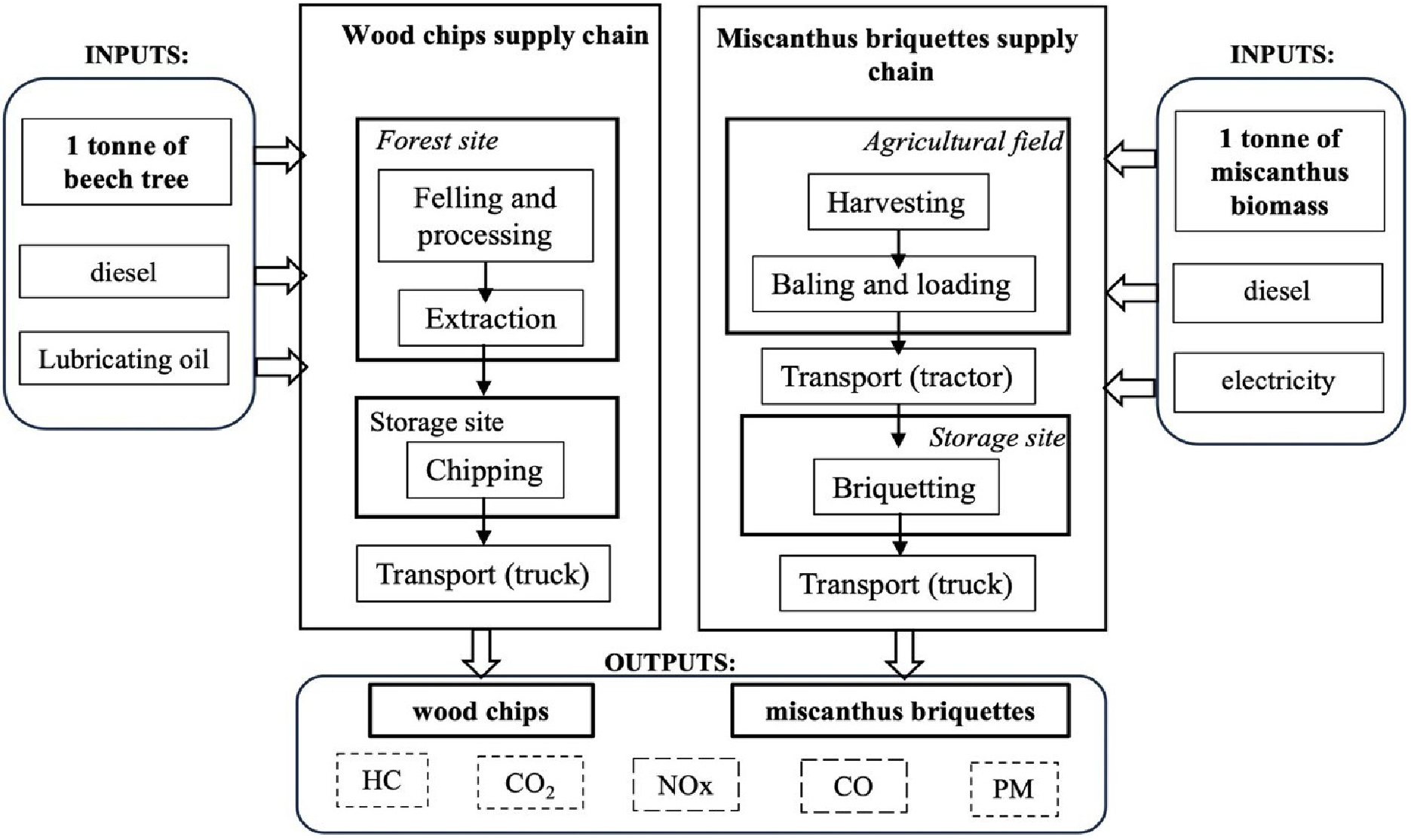
The supply chain for Miscanthus briquettes includes several of the following operations:
1) mowing or harvesting, 2) baling and loading, 3) transportation by tractor, 4) briquetting, and 5) transportation to market by truck (Figure 1). Quantitative parameters for each unit operation (time per tonne, fuel/electricity inputs, and transport distances) are reported in Table 1.
| BEECH WOOD CHIPS | ||||
|---|---|---|---|---|
| Operation | Machinery | Productivity [h/t] | Fuel consumption [L/t] | Pollutant emissions [g/t] |
| Felling and processing | Chainsaw |
0.63 | gasoline: 0.62, lubricating oil: 0.02 kg | HC: 574 |
| Extraction | Skidder |
0.21 | diesel: 5.88 | HC: 1093 |
| Chipping | Mobile chipper: Heizohack HM 5e400 & tractor IMT 577 (52 kW) | 0.83 | diesel: 4.85 | HC: 195 |
| MISCANTHUS BRIQUETTES | ||||
|---|---|---|---|---|
| Operation | Machinery | Productivity [h/t] | Fuel consumption [L/t] | Pollutant emissions [g/t] |
| Harvesting | New Holland H8080, 168 kW, 750 HD |
0.04 | diesel: 1.4 | HC: 4 |
| Baling and loading | Tractor + press |
0.22 | diesel: 0.7 | HC: 4 |
| Transport tractor | Tractor (60 kW) + 2 trailers Zmaj-470/489 | 0.25 | diesel: 1.9 | HC: 8 |
| Briquetting | BIOMASSER® 2Duo-Set: Shredder RK7 (7.5 kW) −2x |
3.36 | electricity | Emissions from electricity |
Transport by Agri-footprint process:
“Transport, truck >20 t, EURO2, 100%LF, default/GLO Mass” (productivity: 0.08 h/t, fuel consumption diesel: 1.6 L/t)
Foreground inventory data represent Serbian operational practice and are compiled per functional unit (1 t delivered product) at the unit-process level (process time, fuel/electricity inputs, and transport services). The representativeness of agricultural machinery practices and fleet structure aligns with national statistical evidence, while forestry machinery choices reflect the documented state of mechanisation and needs in Serbian forestry [23], [24]. Extraction is modelled as skidder-based hauling to the roadside using a cycle-structure representation consistent with regional skidding literature [25]. Supporting machinery/operation sources are used to parameterise comminution and handling steps where required, e.g., chipper performance proxies and equipment specifications [26]−[31].
Background processes for diesel supply, electricity supply, and road transport services are taken from established life cycle inventory databases (ecoinvent v3.10.1 and Agri-footprint) and modelled in SimaPro (PRé Sustainability), with the ecoinvent methodological basis documented in the database reference publication [32]−[35]. Table 1 reports the resulting operation-resolved inventory per functional unit, enabling transparent hotspot attribution in Results.
Direct emissions from non-road machinery are treated consistently with the screening objective and the available foreground resolution. Where exhaust emissions are represented, the approach follows standard LCA practice by combining fuel/energy inputs with background datasets and maintaining transparency regarding modelling assumptions and data limitations. Direct emissions from non-road machinery were represented using engine-class-specific emission factors suitable for older fleets, consistent with the observed age structure of Serbian forestry and agricultural machinery. Emission factors were applied to derive operation-level emissions (e.g., carbon monoxide, hydrocarbons, nitrogen oxides, particulate matter, and greenhouse gases) for each machine class and operating time; the resulting operation-resolved inventory is reported in Table 1.
Transport services are modelled in tonne-kilometres using a medium truck payload class of approximately 20 tonnes. The base case assumes 100 km of long-distance truck transport for both delivered products. For Miscanthus, 10 km of short-distance tractor transport from the field to the briquetting site is also included. Transport distance, truck emission standard class, and load factor are treated as primary screening parameters due to strong site- and market-dependence.
For comparability, fleet assumptions are treated explicitly as a screening lever; the base case reflects locally typical fleet segmentation, and robustness is assessed through harmonised Euro-class scenarios (Euro II–Euro VI).
Life cycle impact assessment was performed using ReCiPe 2016 Midpoint H (hierarchist perspective), as implemented in the selected life cycle assessment software. Six midpoint categories are reported: climate change, ozone depletion, terrestrial acidification, freshwater eutrophication, photochemical ozone formation, and particulate matter formation. Category indicators and units are reported consistently with the method implementation and are presented in Table 2 for the mass-based functional unit.
| Impact category and its unit | Beech wood chips (1 t delivered) | Miscanthus briquettes (1 t delivered) | Relative difference, |
|---|---|---|---|
| Climate change CO2eq [kg]a | 35 | 33.5 | +4.4% |
| CO2 eq [kg/GJ useful heat], η = 0.88 | 3.43 | 2.75 | +22.0 |
| Ozone depletion CFC-11 eq [kg] | 51 | 23.6 | +73.5% |
| Terrestrial acidification SO2 eq [g] | 201 | 392 | −64.4% |
| Freshwater eutrophication P eq [mg] | 75 | 62 | +19.0% |
| Photochemical oxidant formation NMVOC eq [g] | 462 | 257 | +57.0% |
| Particulate matter formation PM10 eq [g] | 77 | 145 | −61.3% |
a Units differ among impact categories to improve readability, relative differences were calculated using eq. (2); positive values indicate higher impacts for beech wood chips, whereas negative values indicate higher impacts for Miscanthus briquettes
Interpretation follows a screening-oriented structure comprising: (i) total results per tonne of delivered product and their conversion pathway to useful heat; (ii) contribution analysis to identify dominant unit operations and upstream drivers by category; and (iii) predefined sensitivity levers reflecting controllable parameters and major sources of variability. Relative differences between supply chains are quantified using the symmetric per cent difference, eq. (2):
where a and b are the category results for the two supply chains, and the sign indicates direction.
Sensitivity levers are defined a priori for scenario screening: (i) transport distance (e.g., 25–200 km), (ii) truck emission standard class (e.g., Euro II to Euro VI), (iii) machinery productivity and fuel consumption reflecting fleet modernisation, (iv) electricity mix used for briquetting (current versus decarbonised), and (v) as-delivered moisture content and end-use efficiency for conversion to useful heat. These levers directly support the stated purpose of regional screening and prioritisation of supply-chain improvements.
The study is designed for screening-level comparison and hotspot identification under Serbian operating conditions. Results are intended for early-stage supply chain design and prioritisation of improvement measures, rather than for product declarations or comparative marketing claims. Several processes are excluded by screening cut-off (capital goods, infrastructure, and land-related impacts), and background datasets and proxies represent some upstream data; therefore, conclusions are conditional on the defined boundary and scenario parameters. Higher-tier follow-up work is recommended to incorporate cultivation and establishment for Miscanthus, forest rotation and carbon stock dynamics for woody biomass, and land occupation and land-use change, as needed.
This section reports and interprets midpoint results, starting with the data in Table 1, for the two biomass supply chains within the defined screening boundary and cut-off rules.
Results are presented primarily per tonne of delivered product to preserve operation-resolved transparency and to enable attribution of impacts to individual unit operations using the inventory in Table 1. The interpretation focuses on (i) category-specific trade-offs, (ii) hotspot mechanisms by operation, and (iii) decision-relevant sensitivity levers (transport distance and fleet characteristics, machinery productivity, and electricity supply for densification). Two supply chains are assessed: (i) beech wood chips from a tree-length system in Serbian high natural forests and (ii) Miscanthus briquettes produced via harvesting, handling, electricity-driven briquetting, and transport to market/end user. The detailed unit-process structure, system boundaries, and operation-resolved inventory used to compile Table 1 are reported in the Materials and Methods section (see Figure 1 and Table 1).
Operation-level foreground parameters (process time, fuel use, and productivity) were compiled from the cited Serbian case inventories and supporting machinery/operation sources. Forestry machinery representativeness and operation parameterisation are supported by the literature [24], [25], [27]. Miscanthus harvesting parameterisation is supported by [29], [30]. Briquetting (densification) equipment specifications and nominal performance parameters were taken from the manufacturer’s documentation [31].
The comparative results are summarised in Table 2 and illustrated in Figure 2, Figure 3, and Figure 4. Relative differences between supply chains are quantified using the symmetric per cent difference defined in eq. (2), where the sign indicates direction. Unless stated otherwise, the present section refers to results per tonne of delivered product; the pathway to express results per unit of useful heat delivered is addressed explicitly in a dedicated subsection.
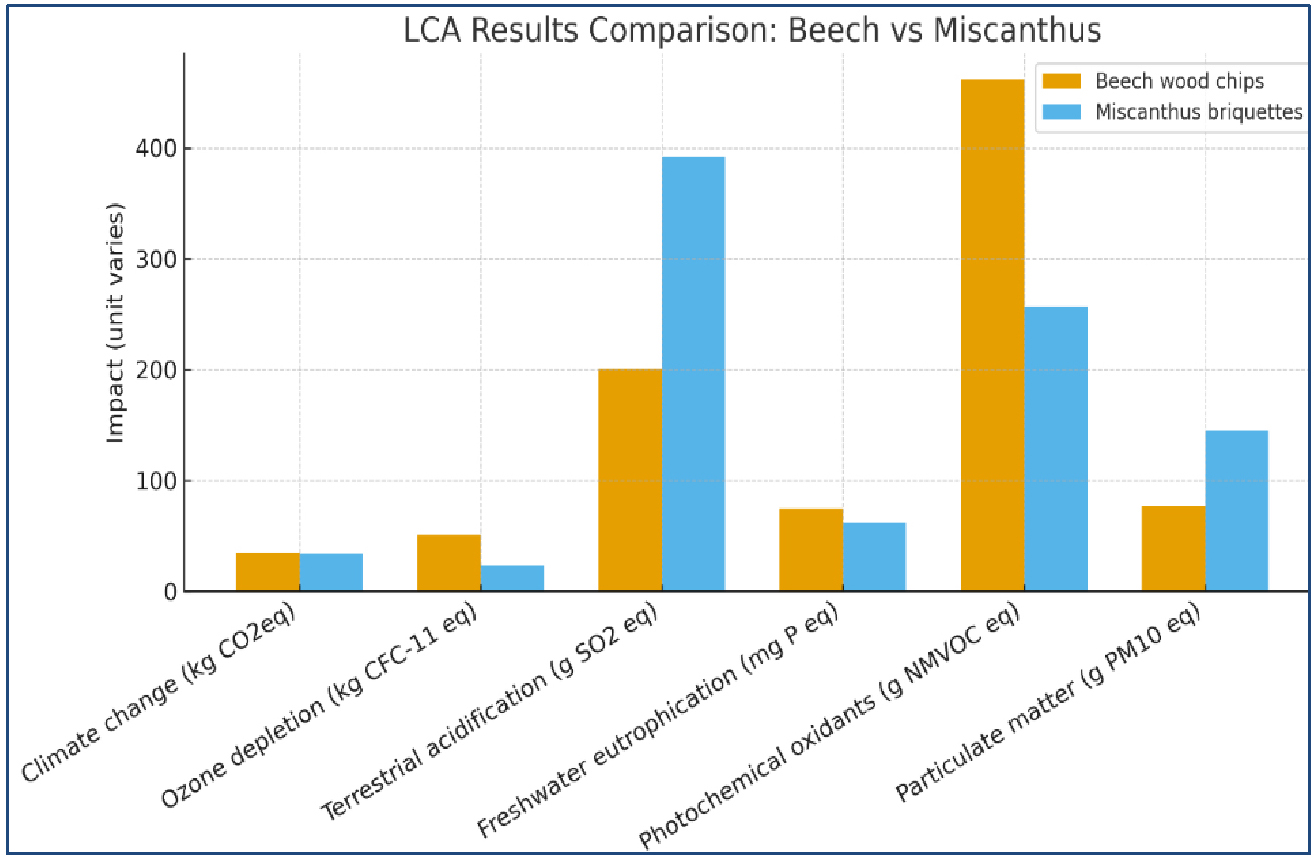
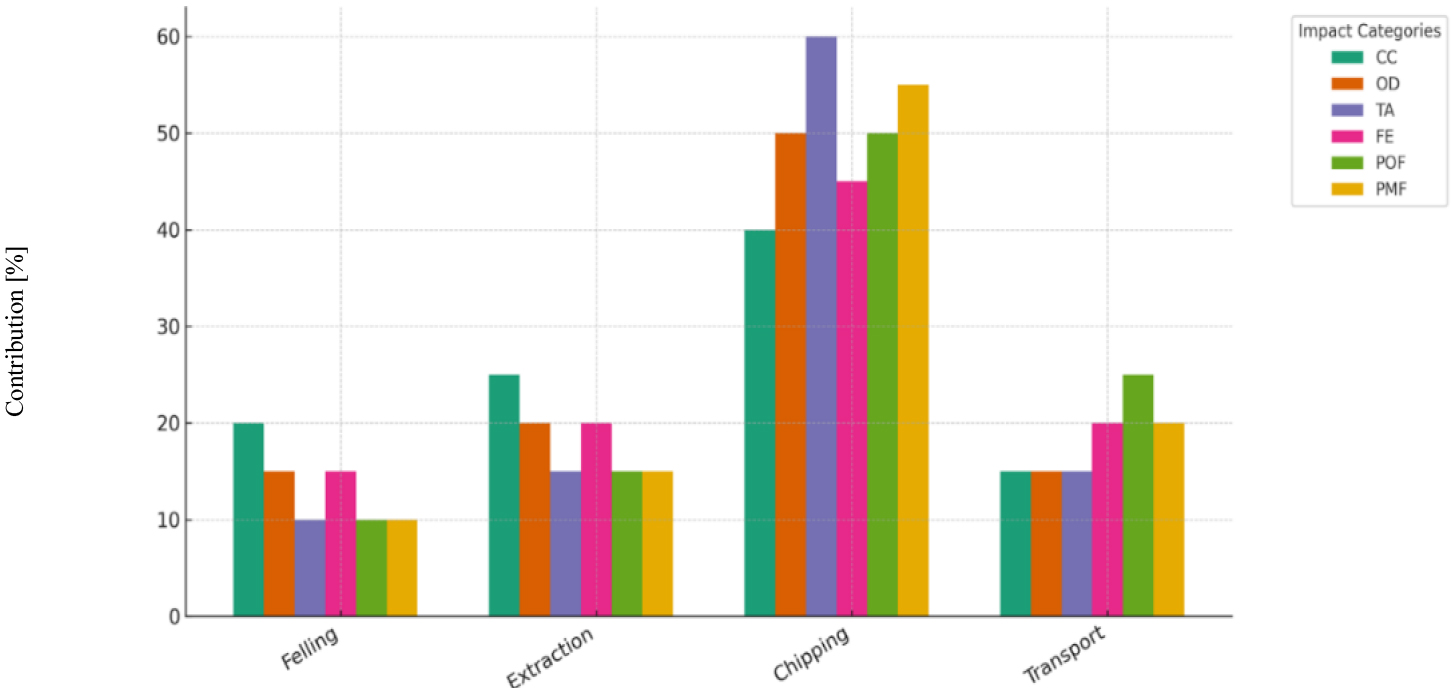
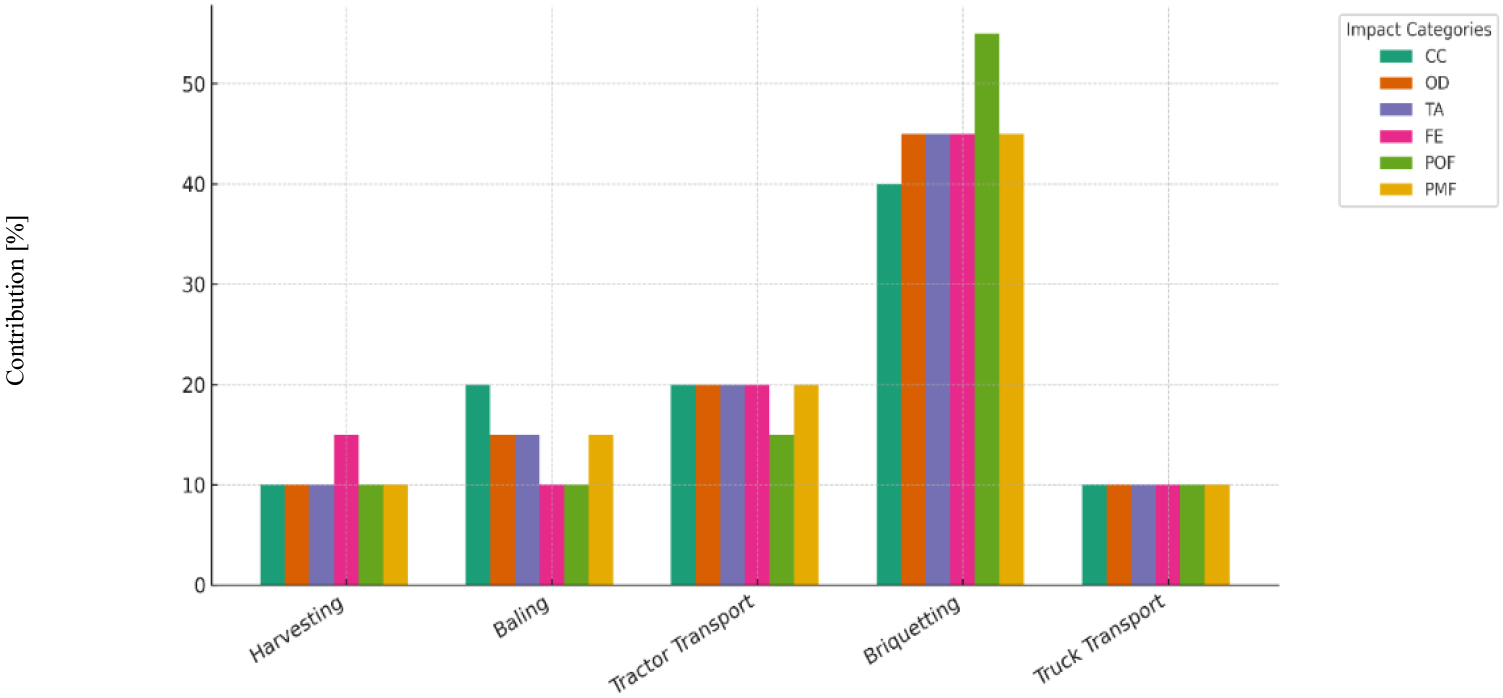
Table 2 indicates category-specific trade-offs within the defined screening boundary. Beech wood chips are higher in climate change, ozone depletion, freshwater eutrophication, and photochemical ozone formation, while Miscanthus briquettes are higher in terrestrial acidification and particulate matter formation. These patterns reflect differences in diesel-intensive unit operations (beech chain) versus electricity demand for densification and additional handling/short-haul logistics (Miscanthus chain).
An energy-service representation is obtained by converting Tier 1 results per tonne of delivered product to impacts per 1 GJ of useful heat using eq. (1) and the conversion parameters in Table 3. For climate change, the Tier 2 values are reported directly in the extended Table 2 for η = 0.88 together with the corresponding useful heat delivered per tonne.
| Parameter | Beech wood chips (energy wood) | Giant Miscanthus briquettes | Base-case value | Screening range | Notes/basis |
|---|---|---|---|---|---|
| Moisture content at delivery, MC wet basis [%] | 31.72 (debarked mean) | 10.4 | Beech: 31.72; Miscan-thus: 10.4 | Beech: 25.96–37.48 (±SD) variant 42.90 | Beech MC from moisture analysis (debarked mean ± SD); Miscanthus MC from proximate analysis |
| Ash content, wet basis [%] | 0.66 (debarked) | 3.8 | as stated | Beech: 0.66–0.91 Miscanthus: 3–5 (screening) | Fuel-quality descriptor (not used in Tier-2 conversion directly) |
| Gross calorific value, HHV [MJ/kg] | 19.446 (debarked) | 17.020 | as stated | Beech: 19.446–19.593 Miscanthus: 16.5–18.0 (screening) | Beech HHV from calorimetry table; Miscanthus HHV from ultimate/calorimetry table |
| Hydrogen mass fraction on dry basis, Hd [–] | 0.060 (assumed) | 0.059 (measured) | Beech: 0.060; Miscan-thus: 0.059 | Beech: 0.055–0.065 Miscanthus: 0.055–0.063 | HHV→LHV; Miscanthus value from ultimate analysis |
| Lower heating value at delivery, LHVdela [MJ/kg] | 11.60 (debarked, derived) | 13.83 (derived) | Beech: 11.60; Miscan-thus: 13.83 | Beech: 10.42–12.79 (±SD) high-MC ≈ 9.30 Miscanthus: 13.0–14.5 (MC sensitivity) | Derived using standard HHV→LHV and moisture correction (latent heat 2.442 MJ/kg water) |
| End-use efficiency, η [-] household boiler | – | – | 0.80 | 0.75–0.85 | Screening assumption b |
| End-use efficiency, η [-] household boiler | – | – | 0.88 | 0.85–0.92 | Screening assumptionb |
| End-use efficiency, η (assumption) – industrial heat | – | – | 0.90 | 0.85–0.93 | Screening assumptionb |
| Electricity demand for briquetting [kWh/t] | – | 108.5 | 108.5 | 76–109 | Derived from installed power 32.3 kW and 3.36 h/t; sensitivity via load factor 0.7–1.0 |
| Long-distance trucking, distance [km] | 100 | 100 | 100 | 25–200 | Primary screening lever |
| Short-distance tractor, haul distance [km] | – | 10 | 10 | 5–30 | Field-to-briquetting transport; screening lever |
| Truck emission standard (base case) | Euro IV | Euro II | as stated | Euro II–Euro VI | Keep the base-case difference |
a derived from measured gross calorific value (HHV) and moisture content using a standard HHV-to-LHV conversion; for Miscanthus, the Tier-2 conversion uses proximate/ultimate and calorimetric inputs as reported in the source datasets compiled for this study, briquetting-related parameterisation supported by [23], the hydrogen mass fraction taken from ultimate analysis; for beech, a screening hydrogen fraction typical for woody biomass was assumed
b to be refined for site- and technology-specific applications
Table 2 shows a pronounced difference in the ozone depletion indicator between the two supply chains (51 kg CFC-11 eq for beech wood chips versus 23.6 kg CFC-11 eq for Miscanthus briquettes per tonne delivered product). In the midpoint assessment, ozone depletion results are frequently driven by a limited set of upstream background processes and specific halogenated elementary flows; therefore, this category is particularly sensitive to database choices, dataset parametrisation, and versioning. Accordingly, the ozone depletion gap is interpreted here as a screening-level signal rather than as a stand-alone basis for strong comparative conclusions.
Because the ozone depletion indicator is strongly influenced by a limited number of upstream background flows and database-specific halogenated emissions, the result is interpreted conservatively. In this study, ozone depletion is therefore used as a screening-level indicator of background-process sensitivity rather than as a primary basis for comparative ranking. The main conclusions are consequently based on more robust and mechanistically transparent categories, particularly climate change, terrestrial acidification, photochemical ozone formation, and particulate matter formation, where the dominant drivers can be directly linked to diesel-intensive operations, logistics, and electricity-driven densification.
In the climate change category, the supply chains exhibit comparable burdens when expressed per tonne of delivered product: 35.0 kg CO2 equivalent for beech wood chips and 33.5 kg CO2 equivalent for Miscanthus briquettes, corresponding to a symmetric difference of +4.4 % in Table 2. This near-parity at the mass-based functional unit reflects broadly similar magnitudes of operational energy use per delivered tonne within the defined screening boundary.
When expressed on an energy-service basis, the comparison becomes more decision-relevant. Using the as-delivered lower heating values derived from the reported fuel characterisation and applying representative end-use efficiencies, the climate change impacts per unit of useful heat delivered are lower for Miscanthus briquettes in the base case. This shift is explained by the higher delivered energy per tonne of Miscanthus briquettes under the reported moisture content and calorimetric properties, whereas the delivered energy per tonne for beech wood chips is strongly constrained by moisture content. Consequently, moisture management for wood chips and end-use efficiency assumptions are decisive parameters for interpreting climate-change results in a heating context, and Tier 2 reporting should be considered alongside Tier 1 results in screening applications.
In terrestrial acidification and particulate matter formation, Miscanthus briquettes show higher results than beech wood chips (Table 2), with symmetric differences of −64.4% and −61.3%, respectively. This outcome is mechanistically consistent with the process structure and the Tier 2 parameter set (Table 3). Unlike the beech wood chip chain, the Miscanthus chain includes an electricity-driven densification step, and the electricity demand for briquetting is substantial on a per-tonne basis (108.5 kWh/t, derived from installed power and operating time; screening range 76–109 kWh/t). Under an electricity supply mix with significant fossil-based generation, this upstream electricity demand becomes a dominant driver of sulphur dioxide- and particulate-related burdens, thereby increasing acidification- and particulate-matter indicators relative to a diesel-dominated chain where electricity use is limited.
The linkage to Table 3 is also important for interpreting these categories on an energy-service basis. Regarding miscanthus briquettes, their as-delivered lower heating value (LHVdel ≈ 13.83 MJ/kg) is higher than that of beech wood chips under the measured moisture content for debarked beech (LHVdel ≈ 11.60 MJ/kg), which improves Miscanthus performance when results are expressed per unit of useful heat. Nevertheless, the electricity-intensive briquetting step can remain decisive for acidification and particulate matter formation even after conversion to useful heat, particularly under coal-influenced electricity mixes. Therefore, the most direct improvement levers for Miscanthus briquettes in these categories are (i) reducing electricity consumption per tonne through densification efficiency measures, and (ii) sourcing lower-impact electricity, both of which are explicitly represented as screening levers in Table 3.
The operation-level hotspot pattern follows directly from the process inventories in Table 1 and the Tier 2 parameters in Table 3. For the beech wood chip chain, chipping emerges as the dominant operational driver across several categories because it combines (i) comparatively high process time per delivered tonne (0.83 h/t) with (ii) substantial diesel consumption (4.85 L/t) and (iii) the associated non-road emission profile reported for this operation. In addition, chipping is performed with an older tractor–chipper configuration, which amplifies specific fuel use and tailpipe emissions per tonne under Serbian fleet conditions. The combination of high specific diesel input and low throughput explains why chipping disproportionately contributes to air-quality-related categories (e.g., photochemical ozone formation and particulate matter formation) and also materially affects climate change through diesel supply and combustion burdens.
For the Miscanthus briquette chain, briquetting is a key hotspot because it introduces a high electricity demand per tonne in addition to diesel-based agricultural and short-haul logistics operations. Table 1 reports an operating time of 3.36 h/t for briquetting, with an installed electrical power of 32.3 kW, corresponding to a nominal electricity demand of 108.5 kWh/t; Table 3 therefore defines a screening range of 76–109 kWh/t to reflect plausible load factors. Under an electricity supply mix with substantial fossil-based generation, this electricity input becomes the primary upstream driver of terrestrial acidification and particulate matter formation, consistent with the higher values for Miscanthus in these categories in Table 2. As already stated in the preceding section, Miscanthus exhibits a higher delivered energy content per tonne than beech wood chips under the measured moisture content for debarked beech; nevertheless, the electricity intensity of briquetting can remain category-dominant for acidification- and particulate-related indicators unless electricity is decarbonised and desulphurised or process electricity demand is reduced.
In summary, the reported midpoint trade-offs are consistent with a diesel-dominated operational chain for beech chips and an electricity-influenced densification step for Miscanthus briquettes under the defined screening boundary; the following section positions these mechanisms against published LCA evidence.
This section interprets the Serbian screening results in relation to published life-cycle assessment evidence, evaluates the robustness of the main hotspot mechanisms, and identifies the practical implications and scope of applicability of the proposed model case. The discussion is organised around contextual benchmarking, sensitivity of the screening comparison, and operational improvement levers relevant for regional biomass supply-chain planning.
The purpose of benchmarking in this section is not to establish a definitive numerical ranking of studies, but to provide a contextual range check for the magnitude of reported impacts and for the dominant mechanisms identified in the Serbian model case. Published life-cycle assessments of solid biomass supply chains often differ in functional unit choice, system boundary definition, treatment of biogenic carbon and land-related processes, assumptions about the electricity mix, and impact assessment methods. Therefore, numerical comparisons are interpreted with caution and used only where functional units and boundaries are sufficiently aligned.
For wood chips, the international literature consistently identifies comminution (chipping) and transport as dominant contributors to operational burdens, with strong sensitivity to machinery productivity and logistics distance. This qualitative mechanism aligns with the current Serbian beech wood chip chain, in which chipping and long-distance trucking dominate multiple midpoint categories within the screening boundary.
For Miscanthus-based solid fuels, published studies emphasise the importance of processing electricity for densification and, when included, cultivation-stage inputs and field emissions. The present Serbian model case excludes cultivation and establishment by design; consequently, benchmarking for Miscanthus is limited to the operational portion of the chain and should not be interpreted as a full comparison of the agricultural life cycle. Within this operational scope, the present finding that briquetting electricity demand drives acidification- and particulate-related categories under coal-influenced electricity supply is consistent with the broader literature.
Table 4 summarises selected benchmark studies and highlights boundary and functional-unit differences that condition interpretability. Where studies report results per unit of delivered energy service, those values are used for contextual comparison; where studies report mass-based indicators or adopt materially different boundaries, the comparison is limited to qualitative alignment of hotspots and order-of-magnitude consistency.
| Study | Pathway | Primary functional unit | Key boundary differences vs. this study | Climate-change indicator | How to interpret relative to this study |
|---|---|---|---|---|---|
| This study | Beech wood chips | 1 t delivered product | Screening boundary; no forest rotation/carbon stock; no land use | 35.0 kg CO2 eq/t | Tier 1 operational burdens; Tier 2 known via Table 3 assumptions |
| This study | Miscanthus briquettes | 1 t delivered product | Screening boundary; cultivation/establishment excluded; no land use | 33.5 kg CO2 eq/t | Operational burdens only; the electricity mix strongly affects non-climate categories |
| Perić et al. (Serbia) [[4]] | Miscanthus heating chain | Unit of heat (energy service) | Includes cultivation and heat production stages | Value reported per MJ heat | Not directly comparable numerically; useful to highlight the effect of including cultivation |
| Rincione et al. (Italy) [[36]] | Wood chips from residual biomass | Mass-based | Feedstock type/residual assumptions; boundary details differ | Value reported per mass | Use for order-of-magnitude comparison under residual-biomass assumptions |
| Scrucca et al. (Italy) [[37]] | Wood chips from residual biomass | Mass-based | Regional context and boundary assumptions differ | Value reported per mass | Use qualitatively to support the relevance of logistics and processing assumptions |
| Balcıoğlu et al. (various) [[38]] | Forest residues for district heating | Energy-service basis or scenario-specific | District-heating context; residue assumptions; logistics options | Value reported (study-specific) | Use qualitatively to justify distance/logistics as a dominant lever |
The benchmarking evidence in Table 4 is intended as a contextual range check rather than a definitive numerical ranking across studies. Published life cycle assessments of solid biomass supply chains frequently differ in functional unit choice, system boundary definition, inclusion of land-related processes and cultivation/rotation dynamics, electricity mix assumptions, and impact assessment methods. For this reason, the most defensible conclusions from benchmarking are mechanistic.
For wood chip supply chains, the literature consistently identifies comminution (chipping) and transport as dominant contributors, with strong sensitivity to machinery productivity and logistics distance. This mechanism aligns with the current Serbian beech wood chip chain, in which chipping and long-distance trucking dominate several midpoint categories within the defined screening boundary. Accordingly, the beech-chain improvement priorities inferred here, higher chipper productivity, reduced specific diesel use, and logistics optimisation, are consistent with the operational levers highlighted in comparable studies.
For Miscanthus-based solid fuels, published studies emphasise the influence of electricity used for processing and densification and, where included, cultivation-stage inputs and field emissions. Because cultivation and establishment are excluded from the present screening boundary, benchmarking for Miscanthus is interpreted only for the operational portion of the chain. Within this scope, the finding that briquetting electricity demand drives acidification- and particulate-related categories under coal-influenced electricity supply is consistent with the broader literature. It reinforces the view that electricity sourcing and the efficiency of densification are decisive levers. Numerical alignment with studies that include cultivation is not attempted here; instead, those studies are used to highlight the likely direction and magnitude of additional burdens that would be introduced in a higher-tier agricultural life cycle assessment.
Overall, Table 4 supports the interpretation that the Serbian model case behaves consistently with international evidence in terms of dominant mechanisms and sensitivity drivers, while also highlighting Serbia-specific conditions, particularly the age structure of non-road machinery and the current electricity mix, that can shift the relative importance of diesel-driven versus electricity-driven operations across midpoint categories.
The comparative outcomes are primarily controlled by a limited set of screening parameters that vary across Serbian practice and market configurations. First, logistics intensity (transport distance and payload utilisation) scales the transport contribution approximately with tonne-kilometres, and its influence is stronger for wood chips, as moisture content reduces delivered energy per tonne. Second, fleet characteristics (truck emission standards and the representativeness of non-road machinery) affect air-quality-related categories via nitrogen oxides and particulate emissions; therefore, Euro-class assumptions should be treated explicitly as a robustness lever rather than an implicit modelling choice. Third, Miscanthus briquettes exhibit an electricity-driven hotspot during densification, so both electricity intensity (kWh per tonne) and the electricity supply profile are decisive for terrestrial acidification and particulate matter formation. Finally, the Tier-2 conversion to useful heat is most sensitive to moisture content (wood chips) and the assumed end-use efficiency; these parameters should therefore be reported transparently and interpreted as scenario inputs within the screening scope rather than as fixed properties.
Within the defined screening boundary, the results translate into distinct operational levers. For beech wood chips, the dominant reduction potential lies in increasing chipping productivity, reducing specific diesel consumption in non-road operations, and optimising long-distance trucking by reducing average distances and improving load factors. For Miscanthus briquettes, the most effective improvements target the electricity-driven densification step by lowering electricity consumption per tonne and reducing electricity impact intensity through lower-impact supply options; these measures directly address the drivers of acidification- and particulate-related trade-offs.
The model case is transferable because it preserves a fixed unit-process structure while allowing parameterisation of the dominant levers (distance, fleet, productivity, electricity intensity/supply, and moisture/efficiency for Tier-2 conversion). This feature enables regional screening extensions without rebuilding the inventory. However, conclusions remain conditional on the screening cut-off: cultivation and establishment of Miscanthus, land occupation and land-use change indicators, and forest rotation/carbon stock dynamics are excluded by design. Accordingly, the present results should be interpreted as operational supply-chain burdens and hotspot signals. At the same time, higher-tier extensions are recommended when land-related indicators or the timing of biogenic carbon are decision-critical.
This study developed a screening-level life cycle assessment model case for two biomass supply chains relevant for heat applications in Serbia: beech wood chips produced through a diesel-dominated forest operations and logistics chain, and Miscanthus briquettes produced through a chain that includes electricity-driven densification. Midpoint results per tonne of delivered product show comparable climate change burdens (35.0 kg CO2 eq/t for beech wood chips and 33.5 kg CO2 eq/t for Miscanthus briquettes) but reveal pronounced trade-offs in non-climate categories within the defined operational boundary. Beech wood chips are higher in ozone depletion and photochemical ozone formation, whereas Miscanthus briquettes are higher in terrestrial acidification and particulate matter formation under the current electricity supply assumptions.
To ensure decision relevance for heating, results were additionally expressed on an energy-service basis, using a transparent Tier 2 conversion to useful heat delivered. Fuel characterisation data were used to derive as-delivered lower heating values for both products, and end-use efficiency was treated as an explicit screening assumption across representative application segments. When expressed per unit of useful heat delivered, the climate change comparison becomes more differentiated due to differences in delivered energy per tonne, particularly the strong influence of moisture content for wood chips. This confirms that moisture management and end-use efficiency are decisive parameters for interpreting biofuel performance in heating contexts and should be explicitly reported in regional screening applications.
Hotspot interpretation identifies distinct, actionable levers for improvement aligned with the dominant mechanisms of each pathway. For beech wood chips, chipping and long-distance transport are the primary operational drivers; therefore, increasing chipper productivity, reducing specific diesel consumption, and optimising logistics distance and payload utilisation are expected to yield the most direct reductions across multiple impact categories. For Miscanthus briquettes, electricity demand for briquetting is the decisive hotspot for acidification- and particulate-related categories; therefore, reducing electricity consumption per tonne through densification efficiency measures and sourcing lower-impact electricity are the most effective levers within the screening boundary. Transport fleet assumptions were treated as a robustness concern and were therefore defined as sensitivity levers, consistent with the screening objective.
The model case is designed to be transferable to regional screening by keeping the unit-process structure fixed and varying a limited set of parameters (transport distances, fleet characteristics, machinery productivity, electricity intensity and supply, moisture content, and end-use efficiency). This structure supports rapid extension to other Serbian regions and feedstocks while preserving process-level transparency for hotspot attribution.
Several processes that can materially influence bioenergy interpretation are excluded by design, including Miscanthus cultivation and establishment, forest rotation and carbon stock dynamics, and indicators of land occupation and land-use change. Consequently, conclusions should be interpreted as operational supply-chain burdens and screening-level signals. Higher-tier extensions are recommended when the decision context requires full agricultural coverage, land-related indicators, or explicit timing of treatment for the biogenic carbon and forest carbon dynamics.
Overall, the presented LCA can serve as a model case for evaluating additional Serbian and regional biomass pathways and for supporting evidence-based prioritisation of supply-chain improvements and investments.
This research was supported by the Science Fund of the Republic of Serbia, Grant No. 2929, Sustainable deployment of biomass catalytic gasification technology to increase the utilisation of renewable energy in the Serbian industry − STABILISE.
- Integrated National Energy and Climate Plan of the Republic of Serbia for the Period up to 2030 with a Vision to 2050 , 2024 (accessed )
- ,
CO2 emissions from biomass combustion for bioenergy: atmospheric decay and contribution to global warming: GLOBAL WARMING POTENTIAL OF CO2 FROM BIOENERGY ,GCB Bioenergy , Vol. 3 (5), :413-4262011, https://doi.org/10.1111/j.1757-1707.2011.01102.x - ,
Life cycle assessment of wood chips supply chain in Serbia ,Renewable Energy , Vol. 155 , :1302-13112020, https://doi.org/10.1016/j.renene.2020.04.026 - ,
Life Cycle Impact Assessment of Miscanthus Crop for Sustainable Household Heating in Serbia ,Forests , Vol. 9 (10), :6542018, https://doi.org/10.3390/f9100654 - , , Directive (EU) 2023/2413 of 18 October 2023 amending Directive (EU) 2018/2001, Regulation (EU) 2018/1999 and Directive 98/70/EC as regards the promotion of energy from renewable sources, and repealing Council Directive (EU) 2015/652, 2023
- ,
Comparative Life Cycle Assessment of Bioenergy Production from Different Wood Pellet Supply Chains ,Forests , Vol. 11 (11), 2020, https://doi.org/10.3390/f11111127 - ,
Life cycle assessment of biomass pellets: A review of methodological choices and results ,Renewable and Sustainable Energy Reviews , Vol. 133 , , https://doi.org/10.1016/j.rser.2020.110278 - ,
Life Cycle Assessment of District Heating Systems in Europe: Case Study and Recommendations ,Sustainability , Vol. 13 (20), 2021, https://doi.org/10.3390/su132011256 - ,
Life Cycle Assessment of Using Firewood and Wood Pellets in Slovenia as Two Primary Wood-Based Heating Systems and Their Environmental Impact ,Sustainability , Vol. 16 (4), 2024, https://doi.org/10.3390/su16041687 - ,
Carbon footprint and sustainability assessment of wood utilisation in Hungary ,Environ Dev Sustain , Vol. 26 (9), :24495-245192023, https://doi.org/10.1007/s10668-023-03571-9 - ,
Life Cycle CO2 Emissions and Techno-Economic Analysis of Wood Pellet Production and CHP with Different Plant Scales and Sawdust Drying Processes ,Sustainability , Vol. 17 (1), 2024, https://doi.org/10.3390/su17010140 - ,
Life Cycle Assessment of Wood Pellet Production in Thailand ,Sustainability , Vol. 12 (17), 2020, https://doi.org/10.3390/su12176996 - ,
Life Cycle Assessment of Bioenergy Production Using Wood Pellets: A Case Study of Remote Communities in Canada ,Energies , Vol. 16 (15), 2023, https://doi.org/10.3390/en16155697 - ,
Effect of combustion technology and biogenic CO2 impact factor on global warming potential of wood-to-heat chains ,Applied Energy , Vol. 235 , :1381-13882019, https://doi.org/10.1016/j.apenergy.2018.11.060 - Approaches to Sustainability Compliance and Verification for Forest Biomass IEA Bioenergy, 2023 (accessed )
- Renewable Energy Directive: targets and rules , 2023 (accessed )
- Global Electricity Review 2025: Global Electricity Source Trends , 2025 (accessed )
- Recommendations on the Draft Integrated National Energy and Climate Plan of the Republic of Serbia Covering the Period 2025-2030 , 2023 (accessed )
- Annual Implementation Report 2024 , 2024 (accessed )
- Low Carbon Development Strategy of the Republic of Serbia for the Period 2023-2030 with Projections until 2050 , 2023 (accessed )
- , Environmental Management—Life Cycle Assessment—Principles and Framework, ISO 14040:2006, 2006
- , Environmental Management—Life Cycle Assessment—Requirements and Guidelines, ISO 14044:2006+Amd 2:2020, 2020
- Press Release: 2023 Census of Agriculture—First results , 2024 (accessed )
- Wood Biomass Product Catalogue , 2016 (accessed )
- ,
Mehanizacija za iskorišćavanje šuma Srbije: stanje i potrebe (Mechanization in the utilization of Serbian forests: current state and requirements) ,Traktori i pogonske mašine , Vol. 10 (5), :23-302005 - ,
Problem privlačenja drva u nizinskim šumama Hrvatske (in Croatian, Problem of skidding timber in Croatian lowland forests) ,Šumarski list , Vol. 3 (4), :151-1561996 - Chipper Review: Internal Project Information Note 06/05 , 2005The Research Agency of the Forestry Commission. https://cdn.forestresearch.gov.uk/2022/02/fr_bec_chipper_review_ipin_0605_2005.pdf (accessed )
- , STIHL MS 650, MS 660: Owners/Instruction Manual, 2024
- ,
Cutting energy characteristics of Miscanthus x giganteus stems with varying oblique angle and cutting speed ,Biosystems Engineering , Vol. 112 (1), :42-482012, https://doi.org/10.1016/j.biosystemseng.2012.02.003 - , Energy requirements and productivity of machinery used to harvest herbaceous energy crops, M.S. thesis, 2012
- ,
Impact of miscanthus yield on harvesting cost and fuel consumption ,Biomass and Bioenergy , Vol. 81 , :162-1662015, https://doi.org/10.1016/j.biombioe.2015.06.024 - , ecoinvent Database v3.10.1: Change Report, 2024
- , ecoinvent Database (v3.10.1) Documentation and Knowledge Base, 2024
- , SimaPro (LCA software)—Documentation/Manual, 2024
- ,
The ecoinvent database version 3 (part I): overview and methodology ,Int J Life Cycle Assess , Vol. 21 (9), :1218-12302016, https://doi.org/10.1007/s11367-016-1087-8 - ,
Life Cycle Assessment of Wood Chips from Residual Biomass: A Case Study ,IJSDP , Vol. 18 (7), :2253-22582023, https://doi.org/10.18280/ijsdp.180730 - ,
Woodchips from Forest Residues as a Sustainable and Circular Biofuel for Electricity Production: Evidence from an Environmental Life Cycle Assessment ,Energies , Vol. 17 (1), 2023, https://doi.org/10.3390/en17010105 - ,
Energy from forest residues in Turkey: An environmental and economic life cycle assessment of different technologies ,Science of The Total Environment , Vol. 874 , 2023, https://doi.org/10.1016/j.scitotenv.2023.162316