



Micro, small, and medium enterprises (MSMEs) play a pivotal role in employment generation, income creation, and regional economic development, particularly in developing economies, where they constitute a strategic component of national economic structures [1]. Sound managerial and accounting practices have been identified as essential to the sustainability of small-business operations [2], while urbanization has been shown to interact closely with MSME growth in forming urban economic development [3]. The sector's contribution to regional economic development has likewise been well established [4]. Although the electricity consumption of an individual enterprise is typically modest, the aggregate demand across the sector becomes substantial at the regional and national scale. Energy efficiency is therefore a critical concern for small enterprises, particularly those that rely on continuously operating electrical equipment.
Energy management in this context has been examined from several perspectives. The adoption of renewable and alternative energy sources has been reported to enhance the sustainability of manufacturing MSMEs [5]. At the national level, methodological frameworks for characterizing energy consumption in small and medium-sized enterprises (SMEs) suggest that systematic energy assessment is a prerequisite for effective efficiency interventions [6]. Meaningful improvement opportunities have also been demonstrated when monitoring, awareness, and operational best practices are applied systematically within SMEs [7]. Nevertheless, many small enterprises continue to face practical barriers, including limited technical capacity, restricted access to monitoring technology, and the absence of simple decision-support tools capable of translating energy data into actionable operational recommendations.
Among the most energy-intensive facilities used by food-processing enterprises are cold storage systems, which must sustain low temperatures continuously to preserve product quality. In small-scale food businesses, these systems are commonly operated with simple on–off control, limited instrumentation, and manual decision-making. Consequently, operators frequently lack reliable information regarding room temperature stability, evaporator behaviour, door-opening disturbances, and actual electrical power consumption. Refrigeration has been identified as a major electricity-consuming process within food cold supply chains [8], and the environmental implications of cold chain development further underscore the importance of improving refrigeration efficiency [9]. Field-based energy performance analyses have additionally shown that cold storage performance is strongly influenced by operating conditions and refrigeration equipment behaviour [10].
Prior research has approached energy efficiency, digital monitoring, and decision support from multiple perspectives. Financial constraints limited internal capacity, and insufficient technical information have been identified as persistent barriers to energy efficiency adoption in SMEs [6]. Multicriteria approaches, including the analytic hierarchy process, have been applied to support sustainable decision-making in small and medium-sized manufacturing enterprises, illustrating the potential of structured evaluation methods [11]. Advanced decision-support platforms have likewise been developed to improve energy efficiency in SMEs, demonstrating the relevance of digital tools for operational energy management [12]. Within cold-chain applications, real-time temperature and humidity measurements have been shown to support supply-chain energy improvement for perishable products [13]. Monitoring as a standalone function, however, does not automatically yield actionable operational recommendations; a decision-support layer is required to translate sensor data into interpretable performance indicators for operators.
Despite the growing adoption of sensor-based monitoring and digital energy-management systems, several limitations persist in the application of smart cold storage for small food-processing enterprises [14]. First, most studies focus on monitoring or control performance, with comparatively few translating long-term operational data into daily decision indicators accessible to non-specialist operators. Second, temperature stability, electrical energy consumption, and door-opening disturbances are typically evaluated in isolation, despite their strong interactions in real cold storage operation [15]. Third, although multicriteria decision-making methods are widely employed for technology selection and strategic energy decision-making [16], [17], including in SME applications [11], their use as a daily operational evaluation framework for small-scale cold storage remains limited. Existing cold storage studies have predominantly addressed cold-chain energy flow assessment [18], [8], field energy performance evaluation [10], advanced control strategies [19], and simulation-based energy optimization, while door-opening activity has been demonstrated to influence temperature fluctuation and energy consumption in refrigerated systems [20]. Collectively, these limitations highlight the need for a practical framework that integrates thermal data, electrical power measurement, and operational disturbance indicators within a unified decision-support system.
The novelty of this study lies in the integration of long-term cold storage monitoring, direct electrical power measurement, door-status-based operational disturbance identification, and multicriteria operational evaluation within a single practical framework tailored to food-processing MSMEs. In contrast to prior work focused on cold-chain energy assessment [8], [18], field energy performance [10], advanced control strategies [19], simulation-based optimization, or real-time monitoring alone [21], this study evaluates cold storage operation jointly through room temperature, evaporator temperature, setpoint, door status, and measured electrical power data. The proposed framework transforms operational data into daily performance scores that capture energy performance, temperature stability, and door-opening disturbance. A temperature differential scenario is retained as a supplementary analysis to illustrate the trade-off between temperature stability and energy consumption, while the primary evaluation is grounded in long-term operational data.
Accordingly, this study aims to develop and evaluate a smart cold storage monitoring and multicriteria operational assessment system for food-processing MSMEs. The working hypothesis is that the integration of temperature monitoring, electrical power measurement, door-status information, and multicriteria evaluation yields a more practical assessment of cold storage performance than temperature or energy monitoring alone. The investigation was conducted using a 15 m3 cold storage unit with a dominant operating setpoint of −20 °C. Room and evaporator temperatures were measured using negative temperature coefficient (NTC) thermistor sensors, while electrical parameters were acquired with a Schneider PM6200H power meter. The collected data were used to characterize long-term thermal and electrical behaviour, estimate electricity cost from measured energy consumption, identify door-opening disturbances, and compute daily multicriteria performance scores. The results demonstrate that the proposed system can distinguish optimal from suboptimal operating conditions and provide interpretable information for improving cold storage energy management in small food-processing enterprises.
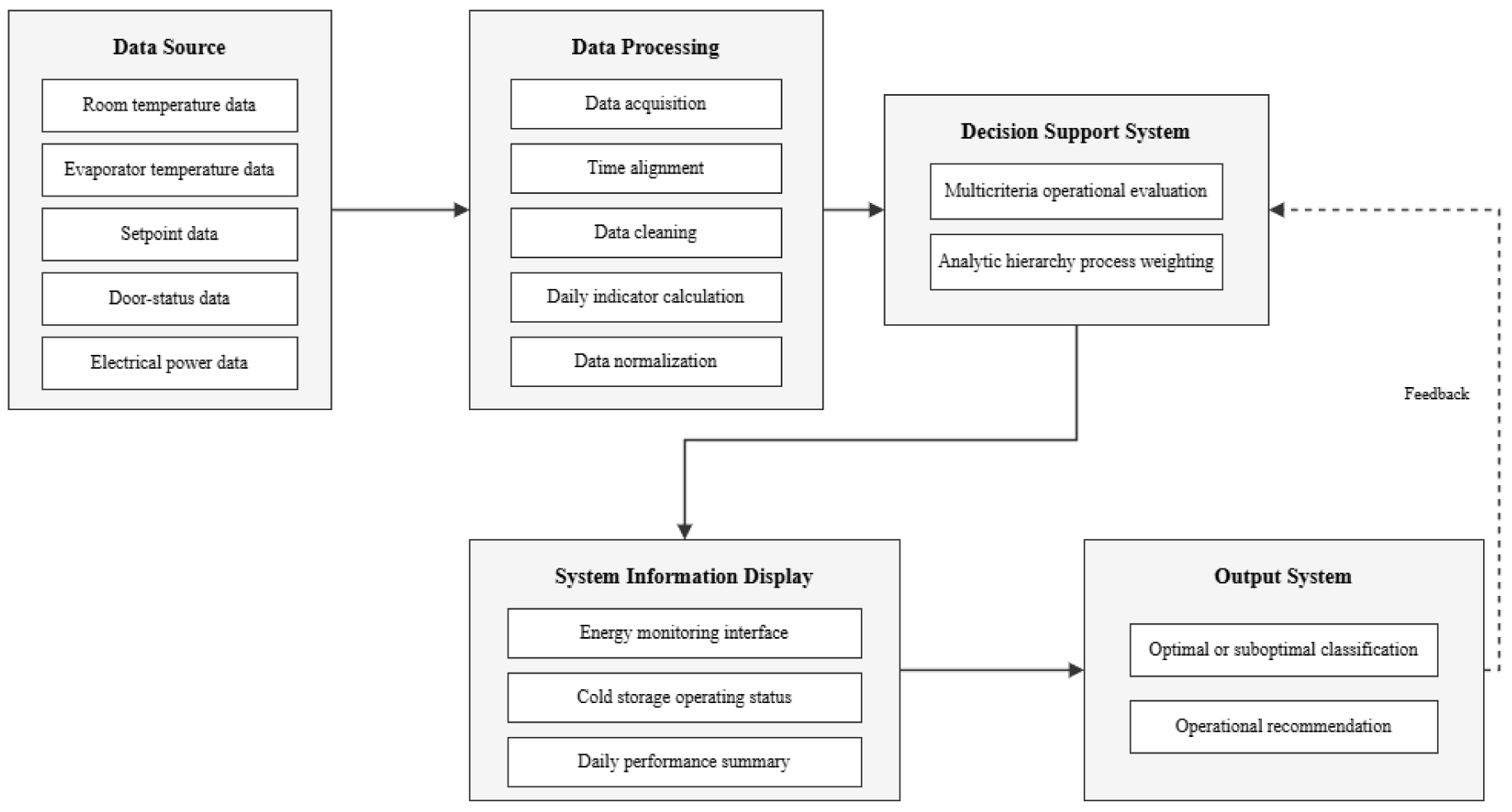
A quantitative field-monitoring approach was adopted to develop and evaluate a smart cold storage monitoring and multicriteria operational assessment system for food-processing micro, small, and medium enterprises (MSMEs). The methodological design was structured to transform empirically measured operational data into interpretable daily performance indicators suitable for use by non-specialist operators. The proposed framework comprises six sequential stages: (i) cold storage system identification, (ii) sensor and power meter installation, (iii) long-term data acquisition, (iv) data preprocessing, (v) operational indicator computation, and (vi) multicriteria evaluation. The primary analysis was based on long-term operational monitoring under steady-state setpoint conditions, whereas the temperature differential setting scenario was retained as a supplementary analysis to illustrate the inherent trade-off between temperature stability and energy consumption. The overall research workflow is presented in Figure 1. The proposed system integrates five operational variables: room temperature, evaporator temperature, temperature setpoint, door status, and electrical power. These variables were selected to jointly capture the thermal, electrical, and disturbance-related dimensions of cold storage operation, which have been shown to interact in real-world conditions but are seldom evaluated within a unified framework. The acquired data were processed through a sequential pipeline consisting of data acquisition, cleaning, temporal alignment, normalization, and daily indicator computation, after which the resulting indicators were synthesized through a multicriteria decision-support procedure to yield daily performance scores.
The cold storage unit examined in this study was installed in Malang, East Java Province, Indonesia. The chamber had internal dimensions of 2.0 m × 2.5 m × 3.0 m, corresponding to a nominal storage volume of approximately 15 m3. The refrigeration system comprised a 2 hp Tecumseh compressor, an XMK forced-air evaporator, and R404A refrigerant. The installation was further equipped with a thermostatic expansion valve, solenoid valve, filter drier, accumulator, oil separator, pressure protection devices, an electronic thermostat, an electrical control panel, and the associated refrigerant piping and wiring. The unit served as an operational cold storage facility for food-processing applications throughout the monitoring period. The unit served as an operational cold storage facility for food-processing applications throughout the monitoring period.
Two loading conditions were considered in the interpretation of the operational data. The first, an unloaded (empty-chamber) condition, was used to characterize the maximum cooling capability of the system in the absence of a significant thermal load. The second, a loaded condition, involved the storage of milk products, with a maximum recorded inventory of 3,600 cups of 120 mL each (≈432 L). Rather than treating product loading and unloading times as a primary experimental variable, operational disturbances were inferred from the door-status signal acquired continuously by the monitoring system.
Room and evaporator temperatures were measured using negative temperature coefficient (NTC) thermistor sensors, which offer adequate sensitivity and stability for cold storage applications [22], [23]. The room temperature sensor was mounted on the sidewall adjacent to the entrance door to capture the thermal response of the storage space during both steady-state operation and door-opening events. The evaporator temperature sensor was installed behind the evaporator unit to monitor cooling-side thermal behaviour. Both sensors were calibrated against an ELITECH RC-4 reference temperature controller prior to data collection. Four temperature variables were logged: processed room temperature, processed evaporator temperature, and their corresponding raw sensor readings.
The door status was logged as a binary variable, with values of 0 and 1 denoting closed and open conditions, respectively [24], [25]. This convention reflects the dominance of the closed-door state in normal cold storage operation. Electrical parameters—including current, voltage, and active power—were acquired using a Schneider PM6200H three-phase power meter. The recorded electrical data supported the calculation of daily energy consumption and the evaluation of electrical performance under realistic operating conditions [15], [26].
Timestamped measurements of room temperature, evaporator temperature, door status, setpoint, current, voltage, and active power were continuously recorded by the monitoring system. The temperature dataset spans 21 January 2026 to 6 May 2026, while the setpoint and electrical-power datasets cover a longer interval from 23 December 2025 to 6 May 2026. The dominant sampling interval was approximately 3 s, and the prevailing operating setpoint over the long-term monitoring period was − 20 °C. Accordingly, −20 °C was adopted as the reference setpoint for all subsequent long-term operational analyses.
Prior to indicator computation, the raw datasets were subjected to a five-step preprocessing procedure. First, all timestamp fields were converted to a uniform datetime format. Second, numerical variables stored as character strings were cast to numeric type. Third, temperature, setpoint, electrical-power, and door-status streams were temporally aligned on a common time index. Fourth, duplicate and incomplete records were removed. Fifth, the cleaned dataset was aggregated into daily observation windows for the computation of thermal, electrical, and operational indicators. Days with insufficient temporal coverage were excluded from the daily performance scoring to prevent biased interpretation.
Daily energy consumption was derived from the measured active power data. Since active power was recorded as a time-series variable, the corresponding energy consumption was determined by integrating the power profile over the observation period. Accordingly, the daily energy consumption was calculated using eq. (1):
where Ed denotes daily energy consumption [kWh/day], Pi is the active power measured at the i-th sampling point [W], and Δti is the time interval between two consecutive records [s]. The denominator 3,600,000 is used to convert watt-seconds to kilowatt-hours 22.
Temperature stability was assessed using two indicators: the daily room-temperature range and the mean absolute error between the measured room temperature and the corresponding setpoint. The daily room-temperature range was calculated using eq. (2):
where Rd denotes the daily room-temperature range [°C], while Tmax,d and Tmin,d represent the maximum and minimum measured room temperatures on day d, respectively 28. The mean absolute error was calculated using eq. (3):
where MAEd is the daily mean absolute error [°C], Troom,i is the measured room temperature at record [°C], Tsetpoint,i is the corresponding recorded setpoint [°C], and n is the number of valid daily records. Lower values of both the daily temperature range and MAEd indicate improved temperature stability [27].
Door-opening disturbance was quantified using the binary door-status signal. The cumulative daily door-open duration was determined using eq. (4):
where Dopen,d is the cumulative door-open duration on day d [s], Oi is the door-status value at record i , and Δti is the time interval between consecutive records [s]. The variable Oi was assigned a value of 1 when the door was open and 0 when the door was closed. The daily door-open ratio was then obtained by normalizing the cumulative door-open duration by the total valid observation duration for the same day. A higher door-open ratio indicates greater operational disturbance and a higher potential thermal load entering the cold storage chamber [28].
The daily electricity cost was estimated from the measured daily energy consumption and the applicable electricity tariff. In this study, the tariff was set at IDR 1,444.70/kWh, corresponding to the Indonesian business electricity tariff for small and medium business customers in the B-1 and B-2 categories. The daily electricity cost was calculated using eq. (5):
where Cd is the estimated daily electricity cost [IDR/day], Ed is the daily energy consumption [kWh/day], and Te is the electricity tariff [IDR/kWh]. The monthly electricity cost was estimated by multiplying the daily cost by 30 days. This calculation was used solely to provide an indicative electricity-cost estimate and was not intended as a comprehensive economic optimization model. The B-1 and B-2 business tariff of 1,444.70 IDR/kWh follows PLN tariff information [29].
The daily operational condition of the cold storage was evaluated through a multicriteria scoring scheme weighted using the analytic hierarchy process (AHP). Three criteria were defined for the main evaluation, namely energy performance, representing the electrical burden imposed by system operation; temperature range stability, capturing the system’s capability to maintain steady thermal conditions; and door-opening disturbance, reflecting operational interference associated with product handling and door activity.
The hierarchical structure of the evaluation framework is illustrated in Figure 2. The objective of the multicriteria assessment is to classify each day of operation as either optimal or suboptimal, thereby providing operators of food-processing MSMEs with an interpretable, evidence-based indicator for routine performance monitoring.
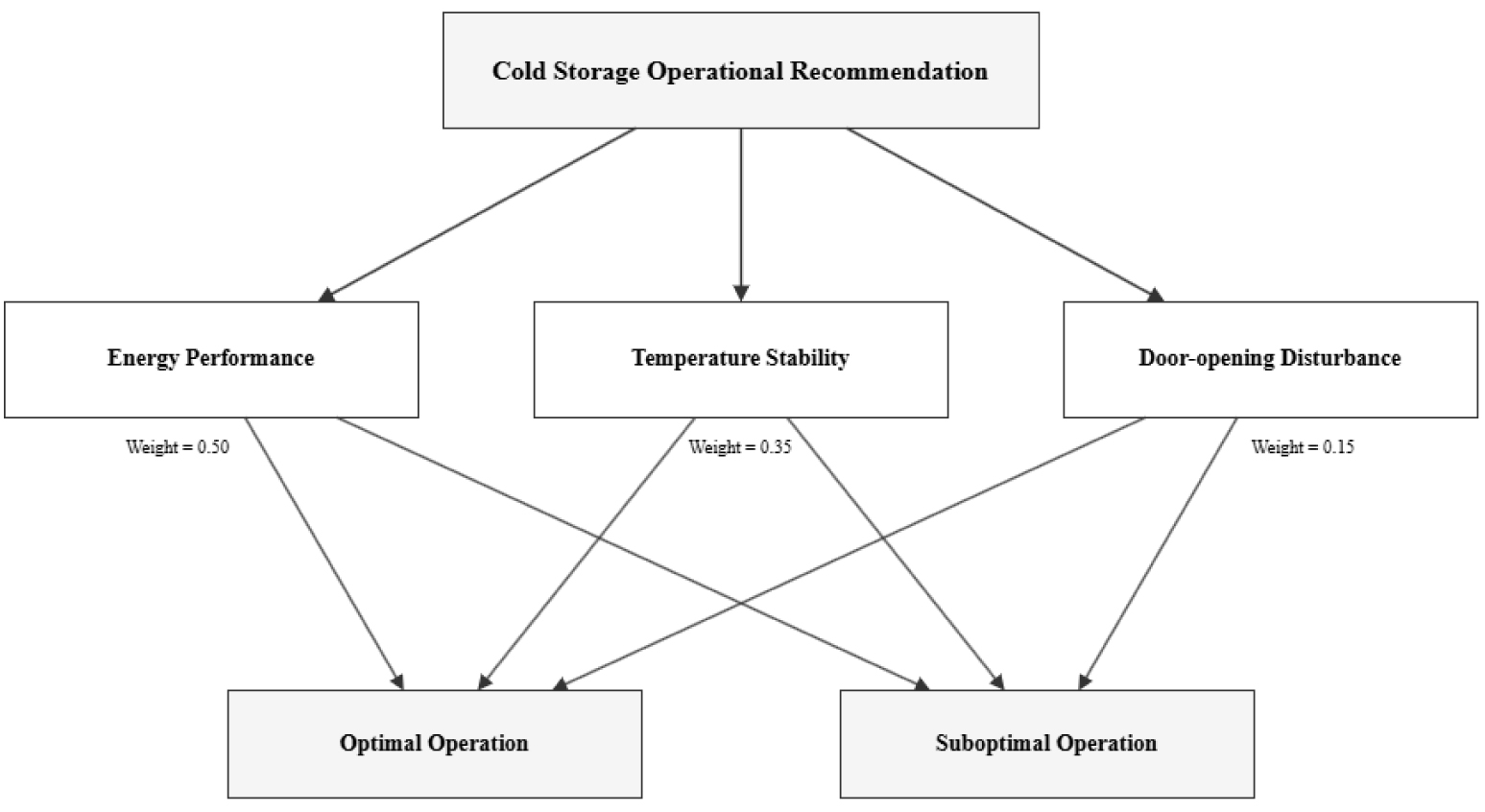
Each criterion was converted into a normalized score on a five-level scale ranging from 0.20 to 1.00, in which higher values denote superior operational performance. As all three criteria were of the cost type, lower observed values corresponded to preferable outcomes. A rolling baseline derived from prior valid daily records served as the reference benchmark for scoring. Daily values were assigned a score of 1.00 when substantially better than the baseline, 0.80 when comparable to the baseline, 0.50 when moderately worse, and 0.20 when substantially worse. Days lacking sufficient baseline information were labelled as no decision. This adaptive scoring strategy enables the framework to assess daily operation relative to recent system behaviour rather than against a fixed threshold, thereby accommodating seasonal and operational variability characteristic of small-scale food-processing facilities.
Criterion weights were derived from pairwise comparison within the analytic hierarchy process framework [30]. Energy performance was assigned the highest priority, reflecting electricity consumption as the dominant recurring operating expenditure for small enterprises. Temperature stability was ranked second, owing to its direct linkage with product storage quality. Door-opening disturbance was ranked third, as it constitutes an operational factor that influences thermal load but is partially captured by the temperature and energy criteria. The pairwise comparison matrix adopted in this study is presented in Table 1.
Criterion |
Energy Performance [-] |
Temperature Stability [-] |
Door Disturbance [-] |
|---|---|---|---|
Energy Performance |
1.000 |
1.429 |
3.333 |
Temperature Stability |
0.700 |
1.000 |
2.333 |
Door Disturbance |
0.300 |
0.429 |
1.000 |
The resulting weights were 0.50 for energy performance, 0.35 for temperature stability, and 0.15 for door-opening disturbance. The consistency ratio of the matrix was 0.000, well below the conventionally accepted threshold of 0.10 [31], confirming the internal consistency of the pairwise judgments. The global daily operational score was subsequently computed as using Eq. (6):
where Sd is the global operational score on day d, and Pd,
A supplementary temperature-differential scenario was also evaluated to illustrate the trade-off between temperature stability and energy consumption. Three differential settings, 1 °C, 3 °C, and 5 °C around the −20 °C setpoint, were considered. This analysis was not used as the primary basis for long-term operational recommendations; rather, it was included to demonstrate how tighter temperature control increases compressor cycling, whereas wider differential settings reduce switching frequency. The evaluated criteria were temperature mean absolute error, energy consumption, and differential width.
In this supplementary scenario, temperature mean absolute error and energy consumption were assigned primary importance because they represent storage quality and electrical load, respectively. Differential width was treated as a secondary control-setting criterion because it indirectly affects temperature fluctuation and compressor operation. Accordingly, the weights were set at 0.40 for temperature mean absolute error, 0.40 for energy consumption, and 0.20 for differential width. The corresponding pairwise comparison matrix is presented in Table 2.
Criterion |
Temperature Error [-] |
Energy Consumption [-] |
Differential Width [-] |
|---|---|---|---|
Temperature Error |
1.000 |
1.000 |
2.000 |
Energy Consumption |
1.000 |
1.000 |
2.000 |
Differential Width |
0.500 |
0.500 |
1.000 |
The consistency ratio of the supplementary pairwise matrix was 0.000, confirming the internal consistency of the weighting structure. The supplementary scenario was therefore reported separately from the long-term operational evaluation to avoid overextending conclusions derived from short-term differential observations.
The proposed system was implemented on a small-scale cold storage unit used in food-processing operations. The monitoring interface integrated room temperature, evaporator temperature, setpoint, door status, voltage, current, and active power. These variables supported both real-time monitoring and daily operational evaluation. The system was designed to assist micro, small, and medium enterprise operators by translating technical measurements into interpretable performance information.
The long-term analysis was conducted at the dominant operating setpoint of −20 °C. Measured electrical power was used to determine actual energy consumption, while temperature stability and door-status data served as supporting criteria in the multicriteria evaluation. This approach enabled performance assessment based on sustained operational data rather than short-term observation. Figure 3 shows the developed monitoring interface, which presents cold storage status, room and evaporator temperatures, compressor and defrost status, and electrical power parameters in a unified display. The interface was designed to support real-time assessment of the system’s thermal and electrical operating conditions.
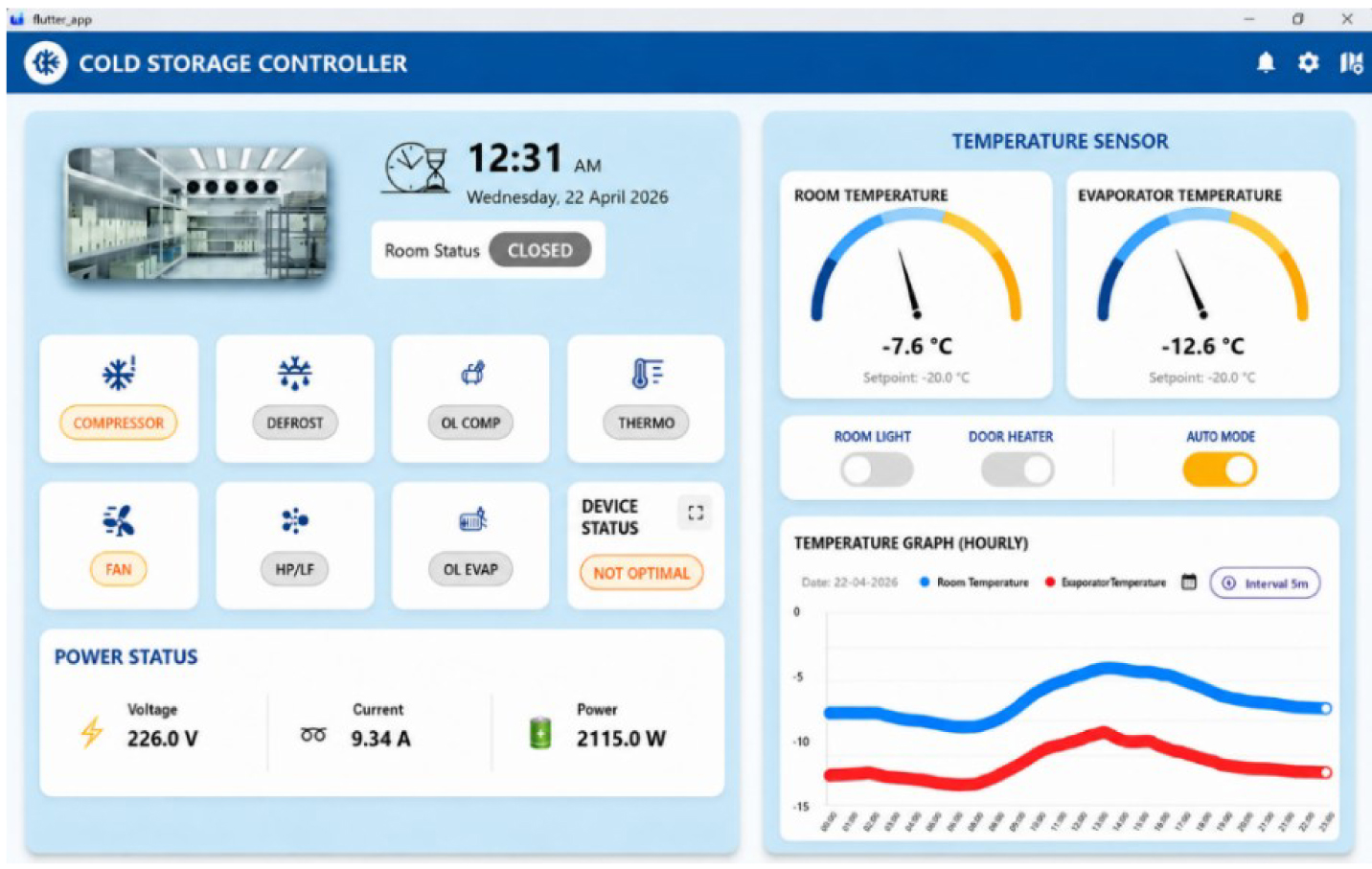
The dashboard (see Figure 3) presents the operational status of the cold storage system, including room condition, compressor operation, defrost status, oil compressor status, thermostat status, fan status, high- and low-pressure indicators, oil separator status, and emergency status. The power section displays voltage, current, and active power, whereas the temperature section shows the room and evaporator temperatures. By integrating these parameters into a single interface, the system enables operators to monitor cold storage operation in real time without manual measurement.
The measured electrical data indicate that the cold storage unit operated under a relatively high continuous load. During active operating days, the average active power was approximately 2.14 kW, with a maximum recorded value of approximately 3.02 kW. These values are consistent with the use of a 2 hp compressor and associated refrigeration components, including the evaporator fan, control panel, and auxiliary electrical devices. The detailed electrical performance parameters and estimated electricity costs are presented in Table 3.
Parameter |
Value |
|---|---|
Average active power [kW] |
2.14 |
Maximum active power [kW] |
3.02 |
Minimum daily energy consumption [kWh/day] |
40.49 |
Maximum daily energy consumption [kWh/day] |
53.48 |
Average daily energy consumption [kWh/day] |
50.92 |
Electricity tariff used [IDR/kWh] |
1,444.70 |
Estimated average daily electricity cost [IDR/day] |
73,568 |
Estimated average monthly electricity cost [IDR/month] |
2,210,000 |
Daily energy consumption was determined by integrating active power over time. For complete active operating days between February and May 2026, energy consumption ranged from 40.49 to 53.48 kWh/day, with an average of 50.92 kWh/day. This level of consumption indicates that cold storage operation represents a substantial recurring electricity burden for small food-processing enterprises.
Using the business electricity tariff of 1,444.70 IDR/kWh, the average daily operating cost was estimated at IDR 73,568, corresponding to approximately IDR 2.21 million for 30 days of operation. These values indicate that electricity consumption constitutes a major operational cost for MSMEs using cold storage. Accordingly, energy monitoring is essential not only for technical supervision but also for improving operational cost awareness.
This cost estimate was derived from long-term measured power data rather than short-duration extrapolation. Such an approach provides a more representative basis for evaluating energy consumption because it captures actual operating patterns over time. The measured average daily energy use further indicates that electricity-cost assessment based on a limited two-hour observation period may not adequately represent real cold storage operation.
To assess daily operational performance, a multicriteria evaluation framework was applied using weights derived from the analytic hierarchy process. The evaluation incorporated three criteria: energy performance, temperature stability, and door-opening disturbance. Energy performance was given the greatest weight because electricity consumption has a direct effect on operating cost. Temperature stability was assigned the second-highest priority because it is closely associated with product storage quality. Door-opening disturbance was included as a supporting operational criterion because door activity contributes to thermal load and increases refrigeration workload. The criteria and corresponding weights obtained from the analytic hierarchy process are presented in Table 4.
Criterion |
Weight |
Operational meaning |
|---|---|---|
Energy performance |
0.50 |
Electrical consumption and operating cost |
Temperature stability |
0.35 |
Ability to maintain storage condition near setpoint |
Door-opening disturbance |
0.15 |
Operational disturbance from door activity |
The final weighting structure assigned values of 0.50, 0.35, and 0.15 to energy performance, temperature stability, and door-opening disturbance, respectively. The global operational score was then calculated as the weighted sum of the normalized scores for these criteria. A daily operation was classified as optimal when the global score was equal to or greater than 0.75, whereas days with scores below this threshold were classified as suboptimal.
The evaluation produced global scores ranging from 0.290 to 0.720, with a mean value of 0.616. No valid daily record exceeded the optimal threshold of 0.75. Although several days achieved relatively high scores for energy performance and door-operation disturbance, the overall performance remained constrained by consistently low temperature-stability scores. This result indicates that the principal operational limitation was not electricity consumption alone, but the inability to maintain stable thermal conditions near the −20 °C setpoint. A summary of the operational evaluation results is presented in Table 5.
Parameter |
Value |
|---|---|
Minimum global score [-] |
0.290 |
Maximum global score [-] |
0.720 |
Average global score [-] |
0.616 |
Optimal threshold [-] |
0.750 |
Main limiting criterion [-] |
Temperature stability |
Overall classification tendency [-] |
Suboptimal |
These findings highlight the value of the proposed decision-support system. Power-based monitoring alone may suggest acceptable operation on several days; however, incorporating temperature stability reveals that the system had not achieved optimal performance. Thus, the multicriteria evaluation provides a more comprehensive and balanced assessment than single-parameter monitoring.
A supplementary temperature-differential scenario was included to illustrate the trade-off between temperature stability and energy consumption. Three differential settings, 1 °C, 3 °C, and 5 °C, were evaluated. Although this analysis was not used as the primary basis for the long-term operational conclusion, it supports the interpretation that tighter temperature control improves stability at the expense of higher energy use. The comparative results of the supplementary differential scenarios are presented in Table 6.
Alternative |
Temperature error [°C] |
Energy consumption [kWh/h] |
Differential [°C] |
Global score [-] |
|---|---|---|---|---|
1 °C differential |
0.504 |
1.5168 |
1 |
0.507 |
3 °C differential |
1.389 |
1.4300 |
3 |
0.268 |
5 °C differential |
2.196 |
1.3560 |
5 |
0.224 |
The 1 °C differential achieved the highest global score since it produced the lowest temperature error. Although the 5 °C differential resulted in the lowest energy consumption, its larger temperature deviation reduced the overall score. This finding indicates that energy reduction should not be pursued independently of temperature stability. In food-processing cold storage, the lowest-energy configuration may be unsuitable if it compromises stable storage conditions. The sensitivity analysis results for the supplementary differential scenarios are presented in Table 7.
Weight scenario |
Temperature error [-] |
Energy consumption [-] |
Differential width [-] |
Best-ranked alternative |
|---|---|---|---|---|
Balanced |
0.40 |
0.40 |
0.20 |
1 °C differential |
Energy-oriented |
0.30 |
0.50 |
0.20 |
1 °C / 3 °C differential |
Stability-oriented |
0.50 |
0.30 |
0.20 |
1 °C differential |
Differential-tolerant |
0.35 |
0.45 |
0.20 |
1 °C / 3 °C differential |
Sensitivity analysis showed that the 1 °C differential remained the preferred alternative under balanced and stability-oriented weighting scenarios. However, under energy-oriented and differential-tolerant scenarios, the performance gap between the 1 °C and 3 °C alternatives narrowed. This confirms that the supplementary differential recommendation is sensitive to weighting assumptions and should not be used as the sole basis for long-term operational decisions.
Overall, the proposed system supports cold storage energy management by integrating actual power measurement, electricity-cost estimation, and multicriteria performance evaluation. The measured average energy consumption of 50.92 kWh/day corresponds to an estimated monthly electricity cost of approximately IDR 2.21 million, representing a substantial recurring expense for MSMEs.
The analytic hierarchy process evaluation further demonstrates that cold storage performance cannot be assessed from energy consumption alone. Although energy reduction remains important, temperature stability must be maintained to protect stored products. The proposed decision-support system therefore provides practical value by helping operators determine whether energy use is balanced with storage performance.
This study developed a smart cold storage monitoring and multicriteria operational assessment system for food-processing micro, small, and medium enterprises (MSMEs). The system integrates room temperature, evaporator temperature, setpoint, door status, and electrical power measurements to support data-driven operational assessment. The analysis was based on long-term operational data collected at a dominant setpoint of −20 °C.
The measured electrical performance showed an average active power of approximately 2.14 kW and an average daily energy consumption of 50.92 kWh/day. Based on a business electricity tariff of 1,444.70 IDR/kWh, the corresponding operating cost was estimated at 73,568 IDR/day, or approximately 2.21 million IDR/month. These findings confirm that electricity consumption represents a substantial recurring operational cost for small-scale cold storage users.
The analytic hierarchy process-based evaluation produced global operational scores ranging from 0.290 to 0.720, with an average score of 0.616. None of the evaluated daily operations reached the optimal threshold of 0.75. Temperature stability was identified as the primary limiting criterion, indicating that cold storage performance cannot be evaluated adequately using energy consumption alone.
The supplementary temperature-differential scenario further showed that narrower differentials improved temperature stability, whereas wider differentials reduced energy consumption but increased temperature deviation. Operational recommendations should therefore balance electricity cost reduction with the need to maintain stable storage temperatures.
The proposed method is most applicable to small-scale cold storage systems equipped with continuous temperature measurement, electrical power monitoring, setpoint logging, and door-status recording. For systems with different storage volumes, refrigerants, control strategies, product loads, or ambient conditions, recalibration of scoring thresholds and criterion weights is required. Future studies should conduct repeated controlled experiments under varying product loads, ambient conditions, and differential settings to strengthen the generalizability of the proposed framework.
This research was funded by the Directorate of Downstreaming and Partnership, Directorate General of Research and Development, Ministry of Higher Education, Science, and Technology of the Republic of Indonesia, in 2025. The authors gratefully acknowledge this financial support, which enabled the completion of the study.
- ,
Micro, Small, and Medium-Sized Enterprises (MSMEs): The significant role and challenges in Indonesia’s economy ,International Journal For Multidisciplinary Research , Vol. 6 (3), :208242024, https://doi.org/10.36948/ijfmr.2024.v06i03.20824 - ,
The role of accounting in managing micro, small and medium enterprises (MSMEs): The case of Indonesia, Australasian Accounting ,Business and Finance Journal , Vol. 17 (2), :113-1212023, https://doi.org/10.14453/aabfj.v17i2.08 - ,
Effects of urbanization and the growth of micro, small, and medium enterprises (MSMEs) as supports for the economy of Indonesia in an urban context ,Journal of Social Political Sciences , Vol. 4 (2), :201-2142023, https://doi.org/10.52166/jsps.v4i2.189 - ,
The role of small and medium micro enterprises (msmes) in economic development in Bandar Lampung ,International Journal of Environmental, Sustainability, and Social Science , Vol. 3 (3), :571-5762022, https://doi.org/10.38142/ijesss.v3i3.247 - ,
Achieving Sustainability in Manufacturing Micro, Small and Medium Enterprises (MSMEs’) in Tanzania Through Adoption of Solar Energy: Solar energy adoption by manufacturing MSMEs in Tanzania ,Journal of Industrial Engineering and Halal Industries , Vol. 3 (2), :77-892022, https://doi.org/10.14421/jiehis.3853 - ,
A methodology to characterize energy consumption in small and medium-sized enterprises at national level in European countries ,Clean Technologies and Environmental Policy , Vol. 26 (1), :93-1082024, https://doi.org/10.1007/s10098-023-02606-z - ,
Energy efficiency management in small and medium-sized enterprises: current situation, case studies and best practices ,Sustainability , Vol. 15 (4), :37272023, https://doi.org/10.3390/su15043727 - ,
Assessment of energy efficiency measures in food cold supply chains: A dairy industry case study ,Energies , Vol. 15 (19), :69012022, https://doi.org/10.3390/en15196901 - ,
Overview of cold chain development in China and methods of studying its environmental impacts ,Environmental Research Communications , Vol. 2 (12), :1220022020, https://doi.org/10.1088/2515-7620/abd622 - ,
Field energy performance of cold storage in East China: A case study ,Applied Thermal Engineering , Vol. 236 , :1217782024, https://doi.org/10.1016/j.applthermaleng.2023.121778 - ,
An analytic hierarchy process for the sustainable development of small-and medium-sized enterprises in the manufacturing sector, South Korea ,Environment, Development and Sustainability , Vol. 27 (8), :20153-201802025, https://doi.org/10.1007/s10668-024-05860-3 - ,
An advanced decision support platform in energy management to increase energy efficiency for small and medium enterprises ,Applied Sciences , Vol. 10 (10), :35052020, https://doi.org/10.3390/app10103505 - ,
Real-time temperature and humidity measurements during the short-range distribution of perishable food products as a tool for supply-chain energy improvements ,Processes , Vol. 10 (11), :22862022, https://doi.org/10.3390/pr10112286 - ,
Emerging Energy-Efficient Technologies for Food Preservation, Safety Enhancement and Carbon Footprint Reduction, Preprints , 2026, https://doi.org/10.20944/preprints202602.1245.v1 - ,
An optimization strategy of cold storage temperature control based on energy consumption prediction ,Journal of Building Engineering , Vol. 111 , :1134712025, https://doi.org/10.1016/j.jobe.2025.113471 - ,
The selection of renewable energy technologies using a hybrid subjective and objective multiple criteria decision making method ,Expert systems with applications , Vol. 206 , :1178392022, https://doi.org/10.1016/j.eswa.2022.117839 - ,
A multiple criteria decision making method to weight the sustainability criteria of renewable energy technologies under uncertainty ,Renewable and Sustainable Energy Reviews , Vol. 127 , :1098912020, https://doi.org/10.1016/j.rser.2020.109891 - ,
Cold chain energy analysis for sustainable food and beverage supply ,Sustainability , Vol. 14 (18), :111372022, https://doi.org/10.3390/su141811137 - ,
50% reduction in energy consumption in an actual cold storage facility using a deep reinforcement learning-based control algorithm ,Applied Energy , Vol. 352 , :1219962023, https://doi.org/10.1016/j.apenergy.2023.121996 - ,
Effect of door opening frequency and duration of an enclosed refrigerated display case on product temperatures and energy consumption ,Food Control , Vol. 111 , :1070442020, https://doi.org/10.1016/j.foodcont.2019.107044 - ,
Real-time monitoring and energy consumption management strategy of cold chain logistics based on the internet of things ,Energy Informatics , Vol. 8 (1), :342025, https://doi.org/10.1186/s42162-025-00493-w - ,
Continuous Surface Temperature Monitoring of Refrigerated Fresh Produce Through Visible and Thermal Infrared Sensor Fusion ,Postharvest Biology and Technology , Vol. 222 , 2025, https://doi.org/10.1016/j.postharvbio.2024.113354 - ,
Remote Monitoring Device for Refrigeration Systems, Proceedings of 2025 International Russian Automation Conference (RusAutoCon), Sochi, Russia , 993-999, https://doi.org/10.1109/RusAutoCon65989.2025.11177331 - , Predicting Train Door Failures Using Machine Learning Techniques, Proceedings of World Congress of Railway Research & International Heavy Haul Association Conference
- , A Smart Doorkeeper Solution for Visitor Monitoring to Enhance Security in a Smart Home Environment, Proceedings of 2025 IEEE International Conference on Electronics, Computing and Communication Technologies (CONECCT)
- ,
Energy consumption prediction of cold storage based on LSTM with parameter optimization ,International Journal of Refrigeration , Vol. 175 , :12-242025, https://doi.org/10.1016/j.ijrefrig.2025.03.033 - ,
Reproducing Cold-Chain Conditions in Real Time Using a Controlled Peltier-Based Climate System ,Sensors , Vol. 25 (21), :66892025, https://doi.org/10.3390/s25216689 - ,
Experimental study and statistical analysis of system performance parameters of a household freezer ,International Journal of Thermofluids , Vol. 24 , :1008672024, https://doi.org/10.1016/j.ijft.2024.100867 - ,
PT Perusahaan Listrik Negara (Persero), Detail Tarif Listrik Berdasarkan Golongan Daya dan Jenisnya (in Indonesian, Details of Electricity Tariffs Based on Power Group and Type) , https://web.pln.co.id/cms/media/2025/12/tarif-listrik/ - , , Models, Methods, Concepts & Applications of the Analytic Hierarchy Process, 2012
- , On Solving Multi-Attribute Decision Making Problem Using AHP, Proceedings of International Conference on Environmental Development Using Computer Science (ICECS'24), E3S Web of Conferences
- ,
Multi-Criteria Decision Analysis Framework for Evaluating Tools Supporting Renewable Energy Communities ,Sustainability , Vol. 18 (1), :292025, https://doi.org/10.3390/su18010029